


Scholars tell Zaobao the aerospace-to-Xinjiang official’s fall signals anti-corruption campaign will run through year-end to clear the deck for 2026 Party Congress
By TRH World Desk
New Delhi, April 4, 2026 — China has confirmed the investigation of Ma Xingrui, a member of the Communist Party’s powerful Politburo and former Party Secretary of Xinjiang, ending five months of public speculation about his fate and marking the third Politburo-level official to fall in the current leadership cycle.
Xinhua reported on Friday, April 3, that Ma is under investigation by the Central Commission for Discipline Inspection and the National Supervisory Commission for suspected serious violations of Party discipline and state law. The announcement came on the eve of the Qingming holiday.
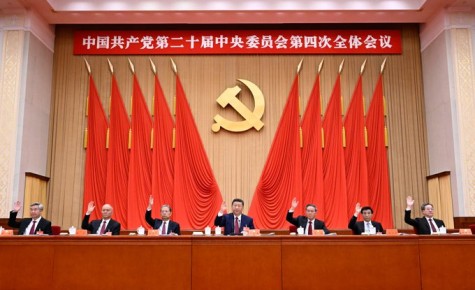
Ma had been conspicuously absent from public life since stepping down as Xinjiang Party Secretary in July last year. His last confirmed public appearance was at the Fourth Plenary Session of the 20th Central Committee in October 2024. He subsequently missed the Politburo’s collective study sessions, the Central Economic Work Conference, and the full session of the National People’s Congress in March 2025 — where his name did not even appear on the presidium list. Observers had long concluded his downfall was imminent.
Chinese authorities had never announced a new posting for Ma after he left Xinjiang. Only upon his official fall was it confirmed he had been serving as Deputy Head of the Central Rural Work Leading Group.
The Third Politburo Member to Fall
Ma’s investigation follows the earlier removals of two Central Military Commission Vice Chairmen — Zhang Youxia and He Weidong — making three Politburo members purged in the current term. The scale of the sweep, reaching simultaneously into civilian leadership and the military’s highest command, is without precedent in recent Party history.
From Aerospace Prodigy to Political Collapse
Ma Xingrui, 67, built one of the most impressive technocratic careers in contemporary China. Born in Yuncheng, Shandong, he rose through China’s space programme, serving as Deputy Commander of the Crewed Spaceflight Programme and playing a key role in the Shenzhou spacecraft development. He was widely known as the “young marshal of aerospace.”
Academically, Ma was exceptional — one of the first doctoral graduates produced under China’s post-reform national degree system, earning his PhD from Harbin Institute of Technology. He became HIT’s youngest doctoral supervisor at 34 and its vice president at 37, before moving into the China Academy of Space Technology and later the China Aerospace Science and Technology Corporation, where he eventually served as President.
In 2013 he transitioned into ministerial roles — briefly serving as Vice Minister of Industry and Information Technology, Director of the National Space Administration, and head of the National Atomic Energy Agency — before being parachuted into Guangdong province. There he served as Guangdong Party Secretary, Shenzhen Party Secretary, and Governor of Guangdong, acquiring a reputation as a rising political star.
In December 2021, one year before the 20th Party Congress, he replaced Chen Quanguo as Xinjiang Party Secretary, securing his Politburo seat at the 20th First Plenary Session in 2022.
Three Possible Corruption Trails
Scholars consulted by Zaobao identified three distinct lines of potential culpability — and suggested investigators will pursue all of them.
Chang Chih-chung, Professor at Kainan University in Taiwan, told Zaobao that Ma’s primary exposure stemmed from his deep ties to the aerospace system, which intersects directly with the current military and defence industry anti-corruption campaign. “This system involves enormous interests,” Chang said. “Once he is investigated, it won’t stop at aerospace — his tenures in Xinjiang and Guangdong will also become investigation focuses.”
Ting Shu-fan, Emeritus Professor at National Chengchi University’s Institute of East Asian Studies, noted that the investigation has already stretched eight months since Ma left Xinjiang — suggesting an unusually long retrospective scope. He pointed to Ma’s 2000 appointment as a part-time member of the General Equipment Department’s Science and Technology Committee, raising the question of whether he became entangled in procurement corruption within the military equipment system.
Ko Chien-wen, Distinguished Professor at Chengchi University’s Department of Political Science, offered the most detailed breakdown. In aerospace, the concern may involve falsification of equipment performance during the development process. In Guangdong, irregularities in the transfer of state assets to private enterprises. In Xinjiang, Ko noted rumours that Ma prioritised officials from outside the region over local cadres, generating resentment and internal reports against him. “That makes it easy to be reported on,” he said.
Clearing the Deck for the 21st Party Congress
All three scholars agreed on the broader strategic logic. The purge, Ko told Zaobao, is simultaneously an anti-corruption exercise and a personnel operation — running in parallel to prepare the leadership roster for the 21st Party Congress in the second half of 2026.
“This is a scraping-the-bone-to-cure-the-disease operation — all unwanted flesh must be cut away,” Ko said, adding: “Anti-corruption and personnel reshuffling are proceeding together. From the centre to the localities, every leadership team must be renewed. All those who need to be investigated must be cleared before the new personnel line-up is confirmed — no one with hidden problems should be promoted.”
Ko added that the recent wave of fallen scientists — including members of the Chinese Academy of Sciences and Chinese Academy of Engineering — alongside defence industry executives, points toward a potential cluster case in the aerospace sector that may have ensnared Ma.
The anti-corruption campaign, scholars assessed, is expected to continue at high intensity through the end of 2025, with sporadic cases likely to follow, as Xi Jinping consolidates control ahead of what will be one of the most consequential leadership transitions in the Party’s modern history.
Follow The Raisina Hills on WhatsApp, Instagram, YouTube, Facebook, and LinkedIn




