World Order Collapsing, Global South Will Decide Future: Stubb
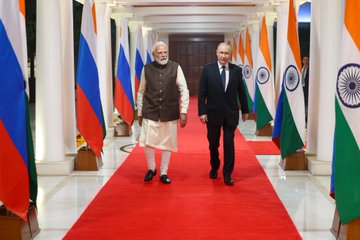
Prime Minister Narendra Modi receives Russian President Vladimir Putin at 7, Lok Kalyan Marg in New Delhi. (Image Modi on X)
In a sweeping article in Foreign Affairs, Finnish President Alexander Stubb says the post–Cold War global order is dying, with the next decade set to reshape geopolitics for generations.
By TRH Foreign Affairs Desk
New Delhi, December 4, 2025 — The world has changed more in the past four years than in the previous three decades, warns Finland’s President Alexander Stubb in a hard-hitting article published in Foreign Affairs. From Russia’s war in Ukraine to turmoil in the Middle East and Africa, Stubb writes that the post–Cold War era has decisively ended and the liberal, rules-based international order born after World War II is now “dying.”
According to Stubb, the very forces that were once expected to unite the world—trade, energy, technology and information—are now pulling it apart. Multilateral cooperation is giving way to multipolar competition, driven largely by the strategic rivalry between the United States and China. But he stresses that emerging middle powers across the global South—including India, Brazil, Saudi Arabia, South Africa and others—have become decisive “game-changers” with enough economic and geopolitical weight to tilt the global balance toward either stability or chaos.
Stubb argues that the next five to ten years will shape the international order for decades, calling it the West’s “last chance” to prove it can lead through dialogue, consistency and cooperation rather than domination and double standards. If cooperation gives way fully to competition, he warns, a world of even greater conflict looms.
Reflecting on history, Stubb recalls how the optimism following the fall of the Berlin Wall in 1989—often described as the “end of history”—proved short-lived. The 9/11 attacks, failed Western interventions in Afghanistan and Iraq, the 2008 global financial crash, and especially Russia’s full-scale invasion of Ukraine in 2022 shattered faith in the postwar order. He calls Moscow’s assault on Ukraine one of the gravest violations of the international system since World War II, made worse by the fact that Russia is a permanent member of the United Nations Security Council.
Stubb draws a sharp distinction between multilateralism and multipolarity. Multilateralism, he writes, is anchored in common rules applying equally to all states. Multipolarity, by contrast, is an oligopoly of power dominated by deal-making among a few major players, often at the expense of smaller nations. He warns that while multilateralism produces order, multipolarity risks disorder and conflict.
From Finland’s perspective as a small state bordering a historic imperial power, Stubb advocates what he calls “values-based realism”—a foreign policy that upholds democracy, human rights and the rule of law while recognizing geopolitical realities. He points to Finland’s hard-learned experience with “Finlandization” during the Cold War and its eventual decision to join NATO after Russia’s invasion of Ukraine as proof that values and interests must align.
Calling for urgent reform of global institutions, Stubb urges sweeping changes to the UN Security Council, the World Trade Organization, the IMF and the World Bank to reflect today’s power realities. Without such reform, he warns, the multilateral system will crumble, leaving behind a far more dangerous world of spheres of influence, chaos and open conflict.
Follow The Raisina Hills on WhatsApp, Instagram, YouTube, Facebook, and LinkedIn




About The Author