


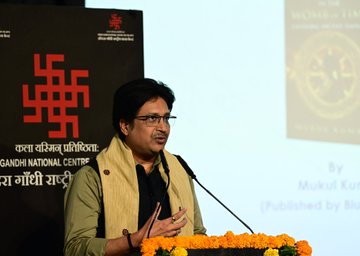
From a dissertation in Delhi to a book that seeks to liberate Indian feminism from the ‘White Man’s Burden’ — Mukul Kumar on serendipity, epiphany and the transcendence of writing about women
By MUKUL KUMAR
NEW Delhi, April 14, 2026 — Three words define the journey of this book: serendipity, epiphany and transcendence.
It began with serendipity — a moment in the present that quietly shapes an unexpected future. In 2017–18, while attending the Advanced Programme in Public Policy Administration at the Indian Institute of Public Administration, New Delhi, I was required to write a dissertation. I chose to explore the roots of Indian feminism in ancient India. At the time, it was merely an academic exercise; the idea that it would evolve into a full-fledged book had not even crossed my mind.
Then came the epiphany. One early morning, I woke with an unshakable thought: this work must become a book. I do not recount this to romanticise creativity, but to acknowledge the unpredictable rhythm of life — how certain ideas insist on being pursued.
A natural question arises: why would a man write about feminism? The answer lies partly in my academic training at Delhi University, where engagement with social questions like gender inequality is almost inevitable. But more deeply, it stemmed from a persistent curiosity — why feminism, and not masculinism? What historical processes created this imbalance?
To answer this, I traced the roots of gender inequality back to early human societies. Simone de Beauvoir’s The Second Sex offered a foundational framework. She distinguishes between “transcendence” — associated with men’s productive, outward labour — and “immanence,” linked to women’s repetitive domestic roles shaped by biology. This division, she argued, laid the groundwork for inequality in status and recognition.
Friedrich Engels’ The Origin of Family, Private Property and the State further illuminated how property relations shaped patriarchy. As men accumulated wealth, they sought to control women’s sexuality to ensure legitimate inheritance. Lise Vogel’s Marxist feminist analysis highlighted how women’s unpaid domestic labour sustained economic systems, while Judith Butler’s ideas on gender exposed how roles were socially constructed and reinforced.
Drawing from Marxist historical materialism, I arrived at a central hypothesis: if gender discrimination existed in ancient times, so must have resistance. Ancient literature, therefore, should contain traces of both oppression and defiance.
The exploration of ancient Indian texts confirmed this. The Rig Veda presents women like Gargi and Maitreyi as intellectual equals. Texts such as the Arthashastra and the Kamasutra depict women with agency in economic, social and even intimate spheres. These portrayals challenge the notion that ancient societies were uniformly oppressive.
Book on Vijay Raman, Pan Singh Tomar encounter fame, unveiled
At the same time, prescriptive texts like the Manusmriti and other Dharmashastras reflect a more restrictive social order. They codify gender hierarchies and limit women’s autonomy. Yet, read critically, even these texts reveal an underlying anxiety about women’s agency — suggesting that such control mechanisms emerged precisely because women exercised influence that needed to be curtailed.
The reality, therefore, is not linear. Ancient Indian society was marked by contradiction. Women were neither uniformly oppressed nor uniformly empowered. They were active participants in a complex, evolving social order.
A key motivation of this work is also decolonial. Much of the mainstream narrative places the origins of Indian feminism in the colonial period, when European reformers began critiquing practices like Sati. This framing risks portraying Indian women as passive recipients of external liberation. It overlooks the intellectual and social traditions within India that had already engaged with questions of gender.
Women in the Womb of Time seeks to reclaim those forgotten voices — not to glorify the past, but to broaden the historical imagination. It argues that Indian women were thinking, resisting and asserting themselves long before colonial intervention.
The study spans a vast timeline — from Vedic literature (circa 1750–500 BC) through the Manusmriti, Arthashastra and Kamasutra, up to the Gupta period. Across this arc, the representation of women shifts with changes in political structures, economic systems and philosophical ideas.
The book does not offer a simple conclusion. Instead, it invites readers — students, scholars and seekers — to engage with ancient texts as living documents, capable of provoking new questions.
Finally comes transcendence. For me, writing this book was not merely an intellectual exercise but a deeply reflective journey. It compelled me to examine my own assumptions and engage with voices often overlooked by history. In doing so, it offered a sense of quiet fulfilment — of giving expression to what has long remained unsaid.
Women in the Womb of Time is, ultimately, a humble attempt by a male writer to acknowledge the dignity, complexity and enduring presence of women across history.
(Mukul Kumar is a senior official in the Ministry of Railways. He has authored eight books.)
FAQ
Q: What is the book ‘Women in the Womb of Time’ about?
A: It is a scholarly work by Mukul Kumar that traces feminist voices and women’s agency in ancient Indian literature — from the Rig Veda through the Arthashastra, Kamasutra and Dharmashastras — arguing that a rich feminist discourse existed in India long before it was formally recognised.
Q: Who is Mukul Kumar?
A: Mukul Kumar is a civil servant and writer who developed this book from a dissertation written during the Advanced Programme in Public Policy Administration at the Indian Institute of Public Administration (IIPA), New Delhi.
Q: Why did a male writer choose to write about feminism?
A: Kumar explains that his Delhi University education sensitised him to feminist discourse. A deeper question — why feminism and not masculinism — drove him to understand the historical roots of gender inequality, tracing it through de Beauvoir, Engels, Vogel and Butler before diving into ancient Indian texts.
Q: What ancient Indian texts does the book examine?
A: The book spans Vedic literature (1750 BC–500 BC), the Upanishads, Manusmriti, Arthashastra, Kamasutra, Dharmashastras and Puranas — up to the Gupta period around the 7th century AD.
Q: What is the key argument of ‘Women in the Womb of Time’?
A: That ancient Indian literature — if studied seriously — offers a far richer feminist discourse than is currently acknowledged, and that Indian feminism must be liberated from the colonial narrative that positions European intervention as the starting point of women’s emancipation in India.
Books That Travel: Explorers, Talibs & a Dog on the Brahmaputra
Follow The Raisina Hills on WhatsApp, Instagram, YouTube, Facebook, and LinkedIn




