Will the US Attack Iran? Why a Full-Scale War Is Unlikely
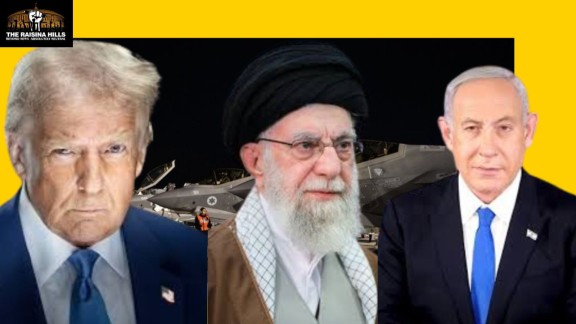
US-Iran civilian nuclear energy talks (Images X.com)
Military Build-Up in the Gulf Sparks Global Anxiety, But Trump’s Calculus Suggests Strategic Pressure — Not War
By TRH Op-Ed Desk
New Delhi, February 22, 2026 — Global anxiety is rising. Warships are positioned. Fighter jets are deployed. Diplomatic backchannels are active.
But will the United States really launch an attack on Iran?
According to Manish Anand, geopolitics analyst, in a monologue for The Raisina Hills, the answer is clear: “Despite visible military pressure and Israeli lobbying, the United States is unlikely to enter a direct war with Iran. Strategic coercion is not the same as strategic commitment.”
The Pressure on Washington
Israeli Prime Minister Benjamin Netanyahu has reportedly met US President Donald Trump multiple times over the past year. Tel Aviv’s strategic objective — regime change in Tehran — has intensified diplomatic pressure on Washington.
Meanwhile, US carrier strike groups including the USS Abraham Lincoln and the USS Gerald R. Ford have been deployed south of Iran in the Gulf region. Advanced fighter jets such as F-16s and F-35s are positioned across American bases in the Middle East.
On the surface, this appears like pre-war staging. But history offers caution.
Former US National Security Adviser John Bolton, in an interview with CNN, once observed that during Trump’s first term, decisions were rarely final until executed — and sometimes reversed even then. In 2021, plans to strike Iran were reportedly considered and then withdrawn.
Uncertainty is a hallmark of Trump-era decision-making.
The Missile Equation Changes Everything
The strategic complication lies in Iran’s missile capability. Tehran has expanded its ballistic and hypersonic missile programs. Some Western intelligence assessments suggest that Iran’s hypersonic systems could challenge existing American air defence shields.
An American aircraft carrier being struck would not merely be a battlefield loss — it would be a reputational shock to US military dominance.
Washington’s renewed insistence that Iran curb not only uranium enrichment but also its ballistic missile program signals a broader security concern. Nuclear talks once focused solely on enrichment levels. Now, missile capability has entered the negotiation arena.
This shift reflects lessons learned during recent Israel-Iran exchanges, where Iranian missile retaliation reportedly caused significant damage to Israeli installations — forcing de-escalation mediated by regional actors like Qatar.
The Gulf Factor
Qatar, Saudi Arabia, and the United Arab Emirates play delicate balancing roles. Many Gulf states have indicated reluctance to allow their airspace to be used for a direct US strike on Iran. Islamic solidarity, domestic political optics, and economic stability all factor into their hesitation.
Without full regional backing, a unilateral American war becomes far more complicated.
The Election Variable
Domestic politics cannot be ignored. The United States faces a high-stakes election cycle. War carries unpredictable economic and political consequences.
As Manish Anand notes: “Entering a Middle East war months before a US election would be a gamble with domestic and global consequences. Trump understands the cost of escalation.”
Strategic Signalling, Not War
Military deployment may be coercive diplomacy — a pressure tactic to force Iranian concessions in ongoing negotiations.
But a full-scale invasion or regime-change operation? Highly unlikely. The United States is projecting strength. Iran is projecting deterrence. Between the two lies negotiation — not necessarily war.
Follow The Raisina Hills on WhatsApp, Instagram, YouTube, Facebook, and LinkedIn




About The Author