Why NITI Aayog’s MSME Blueprint Stops Short of Real Change
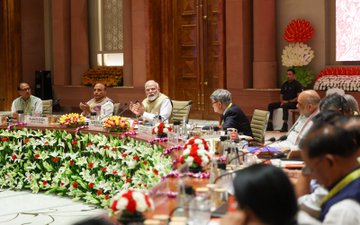
Tenth Governing Council meeting of Niti Aayog in New Delhi (Image Niti Aayog)
Why MSME scheme convergence under NITI Aayog risks becoming coordination theatre rather than real reform
By P. SESH KUMAR
New Delhi, January 29, 2026 — NITI Aayog’s January 2026 report, Achieving Efficiencies in MSME Sector Through Convergence of Schemes, sets out to address a problem that has long plagued India’s development architecture: too many schemes, too little coordination, and even less clarity about impact. The diagnosis is familiar and, broadly, accurate. India’s MSME ecosystem is littered with overlapping programmes, administered by multiple ministries, often targeting the same beneficiaries with marginally different incentives.
The report identifies 18 schemes under the Ministry of MSME alone and acknowledges overlaps with flagship initiatives run by other departments—Start-Up India under DPIIT, PMKVY under Skill Development, and rural skilling programmes under the Ministry of Rural Development. It also concedes a critical weakness: awareness among MSMEs is alarmingly low. Most entrepreneurs, especially at the micro and informal end, know of only one or two schemes, if any, despite being theoretically eligible for several.
Where the report is strongest is in mapping this clutter. It documents duplication in objectives, fragmentation in delivery, and the absence of a unified beneficiary journey. For policymakers, this mapping exercise is useful. But diagnosis, however accurate, is not reform. And it is precisely when the report moves from diagnosis to prescription that its limitations become apparent.
Convergence is offered as the central solution. The idea is appealing: rationalise schemes, reduce administrative waste, and create a seamless support system for MSMEs. Yet the report rarely confronts the hardest questions that real convergence demands. It does not estimate how much public money is lost annually to duplication. It does not name schemes that have outlived their relevance. Nor does it assess whether certain programmes continue to exist primarily because of bureaucratic inertia or political symbolism rather than measurable outcomes.
Instead, the report leans heavily on process reforms. Its flagship recommendation is an AI-enabled, single-window digital portal that would host all MSME-related schemes across ministries. In theory, such a portal could transform access. In practice, the report itself undermines its case by noting that nearly 90% of stakeholders have not meaningfully used existing MSME portals. This raises an obvious question: what changes this time?
Digital architecture is not a substitute for institutional trust, usability, or last-mile access. For a large segment of India’s MSMEs—especially micro enterprises in rural and semi-urban areas—portals are not gateways but barriers. Without a clear strategy to address digital literacy, assisted access, language constraints, and grievance redressal, a new portal risks becoming another well-designed but underused interface.
The report is noticeably more confident when convergence is confined within the MSME Ministry. It proposes merging overlapping cluster development schemes such as SFURTI and MSE-CDP, and subsuming ASPIRE into the newer MSME Innovative framework. These are sensible reforms, low on political risk and high on administrative logic. They suggest that convergence is possible—when turf battles are minimal.
However, the moment convergence crosses ministerial boundaries, ambition recedes. Flagship programmes housed in other ministries are treated delicately, if at all. Schemes linked to Minority Affairs, Tribal Affairs, textiles, and traditional industries barely figure in the analysis, despite their deep entanglement with livelihood-based MSMEs. This selective silence speaks volumes.
What emerges is a familiar pattern in Indian policymaking. Reform is articulated in principle but diluted in execution. Structural questions are deferred in favour of coordination mechanisms—committees, dashboards, portals—that give the appearance of action without forcing difficult trade-offs.
The tragedy is that MSMEs cannot afford cosmetic reform. They face real constraints: access to credit, technology adoption, market linkages, compliance burdens, and vulnerability to economic shocks. Fragmented support does not merely waste resources; it actively undermines enterprise growth by confusing entrepreneurs and dispersing accountability.
NITI Aayog’s report is a step toward acknowledging the problem. But acknowledgement is not enough. Without naming failures, retiring redundancies, and confronting political resistance to scheme rationalisation, convergence risks becoming another well-intentioned exercise that rearranges silos without dismantling them.
In Part II, we turn to the deeper reasons why convergence remains elusive—why political economy, conceptual confusion, and institutional incentives keep India trapped in a cycle of scheme proliferation without systemic clarity. (To be concluded…)
(This is an opinion piece. Views expressed are author’s own.)
Skilling the Numbers: A Critical Reading of CAG’s PMKVY Audit
Follow The Raisina Hills on WhatsApp, Instagram, YouTube, Facebook, and LinkedIn




About The Author