Why India Keeps Rearranging MSME Schemes Without a Fix
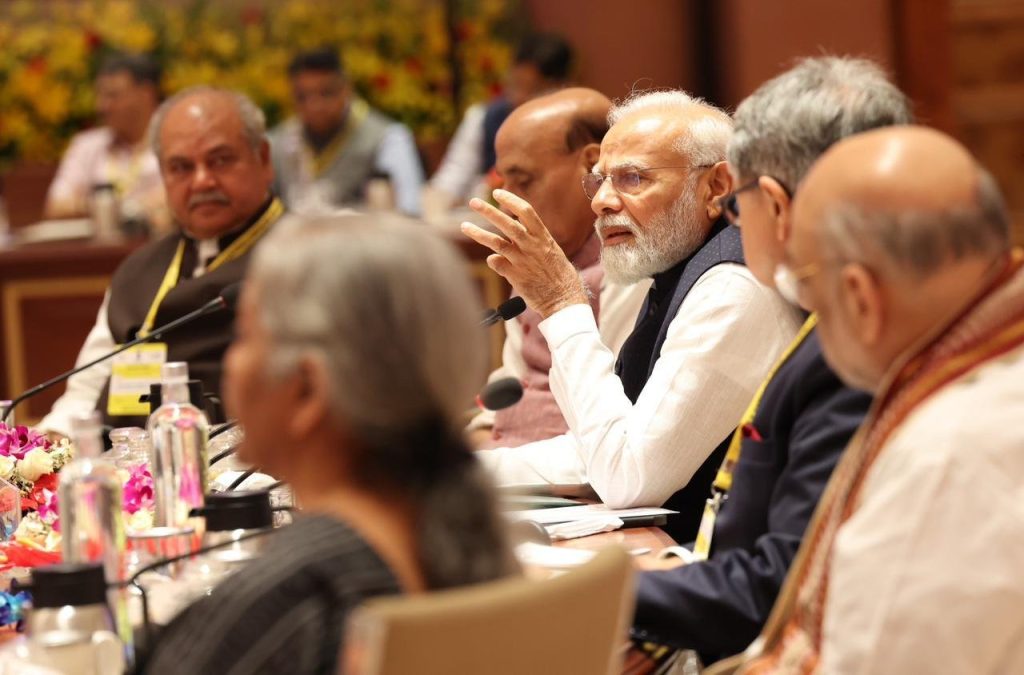
Image credit X.com @PMOIndia
The political economy blocking MSME scheme convergence—and why India refuses to shut failing programmes
By P. SESH KUMAR
New Delhi, January 30, 2026 — The persistent failure of convergence in India’s MSME ecosystem is often framed as an administrative challenge. In reality, it is a political and intellectual one. The Indian state has struggled not just to coordinate schemes, but to clearly define what different kinds of enterprises are meant to become—and which public interventions are appropriate at each stage.
Consider one of the most frequently cited examples of “overlap”: PMEGP and Start-Up India. Administratively, both promote entrepreneurship. Economically, they operate in entirely different worlds. PMEGP is designed to support subsistence-level self-employment and livelihood generation, often in semi-rural contexts. Start-Up India, by contrast, is a growth-oriented platform that celebrates scale, innovation, and even failure.
To label these schemes as duplicates is to misunderstand entrepreneurship itself. What appears as overlap is often the result of lazy categorisation, not flawed design. When livelihood enterprises, transitional firms, and high-growth startups are all justified using the same vague metrics—jobs created, youth empowered, units supported—distinct interventions begin to look redundant on paper.
This conceptual confusion is compounded by political incentives. In India’s governance structure, schemes are not merely policy tools; they are instruments of visibility, budgetary control, and electoral signalling. Every ministry seeks its own flagship, its own branding, its own constituency. Convergence, therefore, is not neutral housekeeping—it threatens turf, relevance, and authority.
This is why convergence proposals gravitate toward “soft” solutions: coordination committees, shared dashboards, and digital portals. These mechanisms allow ministries to appear cooperative without surrendering control. Hard convergence—merging schemes, pooling budgets, or shutting down underperforming programmes—requires political capital that few are willing to spend.
The omissions in the NITI Aayog report illustrate this tension. Schemes such as USTTAD (Minority Affairs), Van Dhan Yojana (Tribal Affairs), and statutory bodies like KVIC and the Coir Board remain largely outside the convergence frame, despite being central to livelihood entrepreneurship. Their absence suggests a bias toward what is administratively convenient rather than economically essential.
Equally problematic is the report’s treatment of outcomes. While it emphasises KPIs and monitoring frameworks, it relies heavily on proxy indicators—trainings conducted, beneficiaries registered, workshops organised. These metrics measure activity, not transformation. Independent, third-party evaluation of enterprise survival, income growth, or productivity gains remains marginal.
Without rigorous impact assessment, convergence risks becoming self-referential. Schemes appear successful because they report outputs, not because they change enterprise trajectories. In such an environment, rationalisation becomes difficult to justify, as every programme can claim some form of success.
What would real convergence require? First, intellectual clarity. The state must explicitly define an enterprise ladder—from subsistence to scale—and align schemes accordingly. Second, political resolve. Convergence must be backed by Cabinet-level mandates, pooled funding mechanisms, and enforceable inter-ministerial agreements. Third, transparency. The government must publicly disclose which schemes are merged, modified, or retired—and why.
Most importantly, convergence must be judged by outcomes, not architecture. A single portal matters only if ministries are compelled to use it and entrepreneurs find it genuinely accessible. Dashboards matter only if they are tied to independent audits and course correction.
India does not suffer from a shortage of MSME schemes. It suffers from a refusal to choose, sequence, and prioritise. Until convergence is grounded in intellectual honesty and political courage, it will remain what it has long been: a buzzword that rearranges silos, but never dismantles them.
(This is an opinion piece. Views expressed are author’s own.) (Concluded)
Follow The Raisina Hills on WhatsApp, Instagram, YouTube, Facebook, and LinkedIn




About The Author