Why DBT Theory Cracks When It Meets India’s PDS Reality
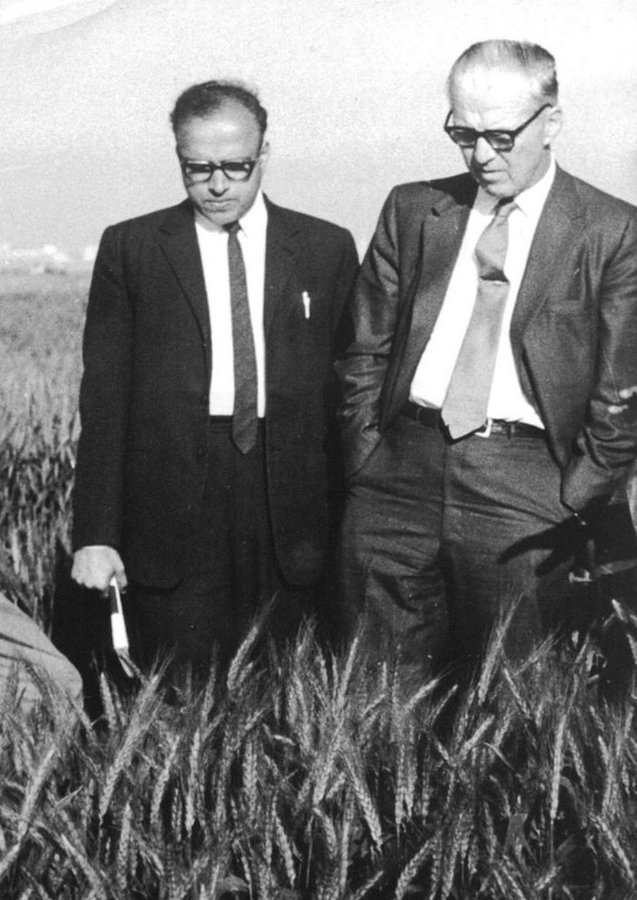
Prof. M. S. Swaminathan has worked closely with Dr. Norman Borlaug to ensure food security for India's population, said US Embassy.
A new economic framework makes a strong case against in-kind subsidies—but ignores inflation, federalism, exclusion, and political economy that decide DBT’s fate
By P. SESH KUMAR
New Delhi, January 10, 2025 — The paper by Kumar, Kumar, and Manglani (2025) presents a clean, internally coherent economic case for replacing in-kind subsidies with Direct Benefit Transfers (DBT), extending the monetisation logic applied to LPG to food, personal goods, and services distributed through India’s Public Distribution System (PDS). Anchored in classical welfare economics, Pigouvian price differentiation, and a familiar diagnosis of leakage, rent-seeking, and quality dilution under administered price regimes, the framework is analytically elegant and intuitively appealing.
However, its very neatness is also its limitation. The argument abstracts away from India’s administrative capacity constraints, federal political economy, financial exclusion, inflation dynamics, and behavioural responses—precisely the frictions that determine whether DBT reforms succeed in practice or unravel on the ground.
The Paper’s Real Strength: It Diagnoses the Disease Correctly
The authors deserve credit for stating plainly what decades of audits, evaluations, and lived experience have shown: price-based subsidy regimes distort incentives. By invoking Pigou’s framework of market segmentation and price differentiation, the paper explains with admirable simplicity why subsidised goods invite diversion, adulteration, rent-seeking, and silent quality degradation. The discussion of “psychological disequilibrium” among public service providers—where value exceeds price and therefore invites informal rationing or dilution—is not only theoretically sound but empirically validated by C&AG reports over several decades.
The paper is also at its strongest when it contrasts goods with services. Its argument that price differentiation fails more catastrophically in goods (where arbitrage and diversion are easy) than in services (where transferability is limited) is persuasive. The extension of the LPG DBTL (PAHAL) experience as proof of concept for monetisation is logically consistent, especially in highlighting reduced leakage, elimination of dual pricing, and improved beneficiary agency.
In short, the paper correctly identifies why PDS-style subsidies fail and why DBT appears attractive.
Where the Paper Begins to Overpromise: DBT as a Universal Solvent
Where the analysis weakens is precisely where policy seriousness should begin. The paper treats DBT less as an instrument and more as a panacea. The leap from LPG cylinders to food security is presented as almost frictionless, ignoring that LPG is an infrequent, lumpy purchase with clear market pricing, while food is a daily, inflation-sensitive necessity embedded in volatile local markets.
The assumption that beneficiaries will seamlessly convert cash into equivalent nutritional outcomes is asserted rather than examined. The paper does not engage with evidence on intra-household allocation, gendered consumption trade-offs, temptation goods, or distress diversion of cash during income shocks. By assuming rational, welfare-maximising behaviour, it abstracts away the very vulnerability that justifies subsidies in the first place.
Even more conspicuously absent is any serious treatment of food price inflation. Cash transfers shift price risk entirely onto the poor. When cereal prices spike due to climate shocks, export bans, or supply disruptions, a fixed DBT amount erodes in real time. The paper’s framework remains silent on indexation, counter-cyclical top-ups, or fiscal shock absorbers-issues that have dominated global debates on cash versus food support.
The Missing State: Administration Without Institutions
Perhaps the most striking omission is the near-total absence of the State as an administrative actor. The paper assumes that subsidy monetisation can occur simply by rerouting flows from FCI godowns to bank accounts. This ignores the institutional complexity of India’s fiscal federalism.
Food subsidy is a centrally funded but state-delivered programme under the National Food Security Act. States determine coverage, identification, grievance redressal, and last-mile delivery. The paper does not explain how DBT would operate across states with wildly divergent banking penetration, digital infrastructure, and administrative competence.
Equally troubling is the casual treatment of exclusion errors. While the paper acknowledges wrongful inclusion and exclusion under PDS, it fails to explain how DBT-dependent on Aadhaar seeding, bank accounts, and digital authentication-will not simply replace one form of exclusion with another. The lived experience of authentication failures, dormant accounts, delayed credits, and grievance fatigue is entirely absent.
The paper also treats financial inclusion as a static achievement rather than a fragile, usage-dependent capability. Having an account is not the same as being able to transact reliably, safely, and cheaply. Unfortunately, there is no really single all-encompassing objective, holistic, comprehensive and stinging all India Performance audit of DBT by C&AG in at least the last 8 years.
Audits Quoted, Lessons Ignored
It is ironic that while the paper cites multiple C&AG reports, it does not absorb their deeper lessons. Audit findings on DBTL, PDS, and food subsidy consistently emphasise not only leakage but also weak grievance redressal, delayed reimbursements, poor reconciliation, and accountability gaps. The paper’s proposed system significantly increases transaction complexity-monthly transfers, short-term bank advances, revolving credit flows-yet offers no auditability framework, no discussion of reconciliation risk, and no insight into how fiscal transparency would actually improve.
In effect, the paper replaces physical leakage with financial opacity and assumes that banks will magically absorb the risk without cost or distortion.
Political Economy: The Dog That Doesn’t Bark
Perhaps the most glaring silence is political economy. Food subsidies are not merely welfare instruments; they are political contracts. The paper treats resistance from fair price shop owners, state governments, and local intermediaries as irrelevant frictions rather than decisive veto points. It also underestimates the symbolic and political importance of food entitlement as a right under NFSA, reducing it to a technical price mechanism.
Any attempt to monetise food subsidies without acknowledging electoral incentives, state resistance, and public trust deficits is analytically incomplete.
What the Paper Ultimately Is-and Is Not
This paper succeeds as a theoretical critique of in-kind subsidies. It does not succeed as a policy blueprint for DBT in food and essential services. Its economic logic is elegant, but its institutional imagination is thin. It explains why the old system fails but does not convincingly demonstrate why the new system will survive contact with India’s administrative, political, and social realities. May be, the authors have deliberately left the policy details to the policymakers or they could come up with a second part of their paper.
The Way Forward: From Elegant Models to Dirty Hands
If DBT is to move beyond theory, future work must integrate economics with governance. This means explicit treatment of inflation indexing, state-wise readiness, grievance redressal capacity, auditability, fiscal risk-sharing, and political feasibility. Hybrid models-combining limited in-kind support with cash top-ups-deserve serious consideration instead of ideological dismissal.
Most importantly, DBT should be framed not as a replacement for the State’s responsibility in food security, but as a tool whose success depends entirely on institutional trust, fiscal discipline, and administrative competence.
Until then, monetising subsidies may reduce leakage on paper-while creating new fault lines that theory alone cannot seal.
(This is an opinion piece. Views expressed are author’s own)
Follow The Raisina Hills on WhatsApp, Instagram, YouTube, Facebook, and LinkedIn




About The Author