Why Bihar’s 2025 Election Is a High-Risk Contest: DeKoder Study
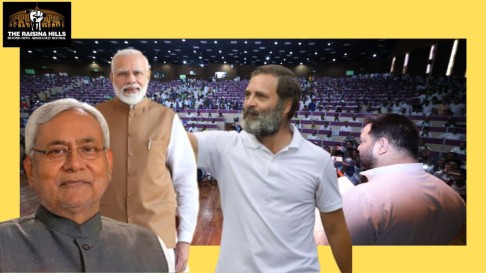
Bihar CM Nitish Kumar, PM Narendra Modi, Congress leader Rahul Gandhi, and RJD leader Tejashwi Yadav Images X.com)
A 75-year study reveals Bihar’s unique three-phase pattern of voter behaviour — from post-Independence optimism to today’s moderate pro-incumbency — as Nitish Kumar faces a volatile and unpredictable electorate.
By TRH Political Desk
New Delhi, November 8, 2025 — DeKoder’s latest analysis on the Bihar Assembly elections has shed light on long-term voter behaviour trends that could shape the 2025 contest. Contrary to perceptions of deep anti-incumbency, Bihar has shown a steady shift toward pro-incumbency over the past two decades — though the state remains among India’s most electorally volatile.
According to the study, Bihar’s electoral history can be divided into three clear phases. In the first 25 years after Independence, voters consistently returned incumbents to power, reflecting optimism about governance — a period of 100% pro-incumbency. The next 25 years (1977–2002) marked a sharp reversal, with only 33% of governments re-elected amid public anger and instability. Since 2002, however, Bihar has entered a phase of moderate pro-incumbency, with about 60% of governments voted back.
This mirrors a broader national shift. Across 260 state elections since Independence, India has evolved from an 82% pro-incumbency rate post-1947 to a near 50-50 equilibrium today — a balance between continuity and change. “Bihar, at 60%, ranks slightly above the national average, yet remains highly unpredictable due to its electoral volatility,” said Prannoy Roy in his analysis for DeKoder.
Even small vote swings in Bihar can cause seismic seat shifts, he stated. “A mere three-percent drop in vote share could cost the ruling NDA up to 14% of seats — roughly 34 constituencies,” added Roy. DeKoder ranks Bihar as India’s seventh most volatile state, underscoring that Nitish Kumar’s NDA cannot rely on pro-incumbency alone.
At the candidate level, trends are mixed. “The BJP-JD(U) alliance shows mild anti-incumbency, with new candidates performing slightly better (65% win rate) than sitting MLAs (57%). For the RJD-Congress bloc, incumbents fare far better — winning four times as often as new candidates — suggesting strong local loyalty but weak brand expansion,” added Roy.
Gender dynamics remain a decisive factor. “Nitish Kumar continues to enjoy a strong pro-women image, bolstered by initiatives like the 2007 cycle scheme, 2016 prohibition policy, and the recent ₹10,000 pre-election transfer to women voters,” he added. Bihar’s regions with higher female turnout — such as Kosi and Seemanchal — strongly favour the NDA, while areas where men dominate the polls, like Patna and Magadh, tilt toward the Mahagathbandhan.
Another factor at play is the shortened election schedule. The 2025 Assembly polls will be held in just two phases — a sharp reduction from five in 2015 and six in 2010. DeKoder’s review of past elections suggests that multi-phase polling often hurts the NDA, as longer campaigns tend to erode its momentum.
As the campaign heats up, Bihar’s voters — poorer on average than most Indians but electorally decisive — could once again confound predictions. With its volatile electorate, gender-driven swings, and a wafer-thin margin for error, this year’s contest may prove one of the most unpredictable in recent memory.
Follow The Raisina Hills on WhatsApp, Instagram, YouTube, Facebook, and LinkedIn




About The Author