Why an Airport Assault Raises Questions About Flight Safety
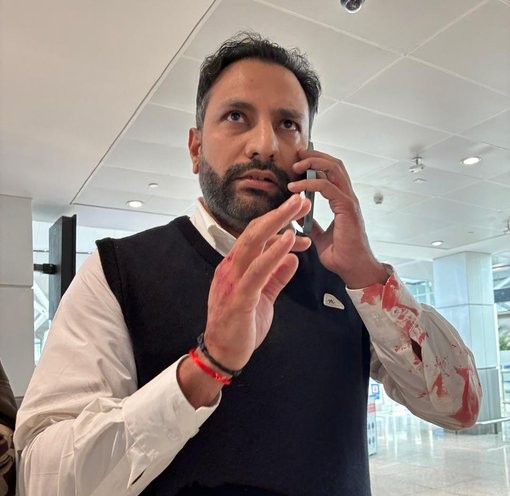
Air India Express suspends Capt. Vijender Sejwal for violence against a passenger at Delhi airport. (Image Ankit Dewan on X.com)
An Air India Express pilot’s alleged violence at Delhi Airport forces regulators to confront a hard truth about trust, temperament, and accountability
By TRH News Desk
New Delhi, December 21, 2025 — Airports are meant to be among the safest public spaces in the country. When violence erupts there—especially involving those entrusted with hundreds of lives in the air—it ceases to be a mere altercation and becomes a question of national safety culture.
The December 19 incident at Delhi’s IGI Airport Terminal 1, involving Air India Express Captain Virender Sejwal and passenger Ankit Dewan, is deeply disturbing. According to Dewan, the confrontation began over queue-jumping in a PRM security lane meant for families with infants. It allegedly escalated into verbal abuse and then physical assault, leaving Dewan bloodied in front of his wife and children. His seven-year-old daughter, witnessing her father being attacked, remains traumatised.
The images and videos circulating online are shocking not just for the violence they depict, but for what they symbolise: a catastrophic failure of restraint. As Army veteran KS Dhillon bluntly put it, someone who cannot control rage on the ground cannot be trusted in the skies.
Air India Express acted swiftly by removing the pilot from duty, and the Ministry of Civil Aviation has ordered an inquiry. But deeper questions remain unanswered. Why did CISF personnel fail to de-escalate the situation? Why was a passenger allegedly pressured into signing a letter waiving his right to pursue the matter? And why should justice depend on a traveller’s ability to absorb financial loss?
Aviation safety is not only about machines and protocols—it is about human temperament. A pilot’s licence is not just a qualification; it is a moral contract with the public. If that trust is broken, grounding must not be symbolic. It must be absolute, transparent, and enforced.
Follow The Raisina Hills on WhatsApp, Instagram, YouTube, Facebook, and LinkedIn




About The Author