Whither Internal Democracy in the BJP as Dissent Dies
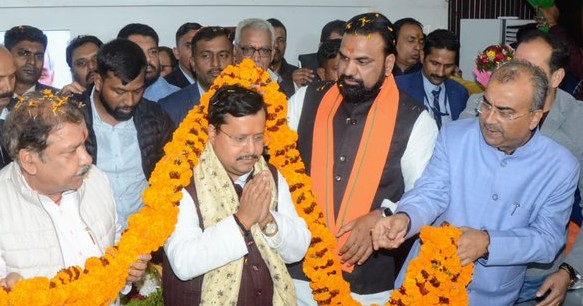
Bihar BJP fetes Nitin Nabin on his appointment as national working president of the party (Image BJP Bihar on X)
As the BJP repeatedly appoints ‘working presidents’, questions grow over internal democracy, constitutional norms, and decision-making under strong central leadership
By MANISH ANAND
New Delhi, January 17, 2026 — The BJP and the Congress are India’s two national political parties with almost pan-India presence. The Congress had held election for the post of the party president in 2022. The election process was widely publicised. In the end, the election for the top post in the Congress was contested by party veteran Mallikarjuna Kharge and flamboyant MP from Thiruvananthapuram Shashi Tharoor.
Tharoor was a challenger to Kharge, who was given a popular label of a nominee of the Gandhi family. Both campaigned and canvassed. Tharoor even unveiled his action plan for the Congress. In the end, Kharge won, and Tharoor lost. The Congress, India’s main Opposition party, was able to hold election in a true letter and spirit.
Under Section 29A of the Representation of People’s Act, 1951, the political parties are mandated to reveal the details of office bearers, their tenures, and mention that they would hold organisational elections for electing the functionaries. India is world’s largest democracy. The Constitution of India also enshrines democracy in its preamble. As India is a democratic republic, boldly stated in the Preamble of the Constitution, the political parties must also abide by democracy in their functioning. At least, this is the objective of the Section 29A of the RPA, 1951.
But the BJP for the first time in its short history appointed a working president in 2019. The decision is made in the name of the BJP’s parliamentary board. Nadda became the working president, and he almost stayed with the same decision for six months until the party called a meeting of the national council to endorse his “election.” Afterwards, his one term in the office of three years went on extensions. In a single term, Nadda stayed as the BJP president for six years.
Nadda’s term also saw that the mandate of the party constitution’s “one man, one post” was conveniently ignored. He is still the BJP president, while also being a Union Minister. He’s not alone. C. R. Patil also held on to the post of the Gujarat unit BJP president while also being a Union Minister. Thus, norms as clearly spelt out in the party’s constitution have been adjusted to suit the requirements of the party’s top brass in recent years.
Why BJP began appointing working presidents?
The BJP’s top brass is widely known within the party circles as a description for Prime Minister Narendra Modi and Union Minister for Home Affairs Amit Shah. Till the tenure of Shah as the BJP president, the party almost followed the schedule of holding a meeting of the national executive for six months. But situations began changing after the 2019 Lok Sabha elections.
The official BJP website mentions a meeting of the national executive in 2023. The BJP’s last national council meeting was held in 2024 at Bharat Mandapam in New Delhi. Now, the BJP observers believe that the party can summon a national council or executive meeting whenever it’s convenient for the party’s top brass or they may remain forgotten.
The BJP parliamentary board meetings are also now held unannounced and no photographs are shared with the public or the media. Only decisions taken by the parliamentary board, such as an appointment of a working president, are made public. The 11-member parliamentary board of the BJP also has not seen any changes since 2022.
Thus, one may conveniently lean on conclusion that the decision-making process in the BJP has now narrowed. The semblance of giving a sense of internal democracy in the BJP also lacks publicly available endorsement.
The 2019 decision of the BJP to appoint a working president shouldn’t be seen as an exception, but as the beginning of a trend. Nabin’s appointment as the BJP working president confirms that the trend is taking a shape. While the BJP top brass also is popularly described as commanding firm leadership of the party, there is always a scope of someone dropping to pick up the form to contest the election for the post of the party president and hit the headlines.
The BJP’s ‘Margdarshak Mandal’, not known to have met even once after its constitution, already gave hints that the party has leaders in the ranks who can go hyperbole with their sense of discontents. This was affirmed after former Union Minister and ex-MP from Buxar R. K. Singh levelled serious allegations of corruption against the NDA government in Bihar during the midst of the state Assembly elections. As the BJP evolves into a party with “strong central leadership,” the trend of appointing a working president reshapes the old party convention of “consensus-led selection” of the chief of the organisation.
(Author is a senior Delhi-based journalist, who has been tracking affairs of the BJP and the RSS for over two decades)
Follow The Raisina Hills on WhatsApp, Instagram, YouTube, Facebook, and LinkedIn




About The Author