When Merit Hits Zero: NEET-PG and Collapse of Specialist Training
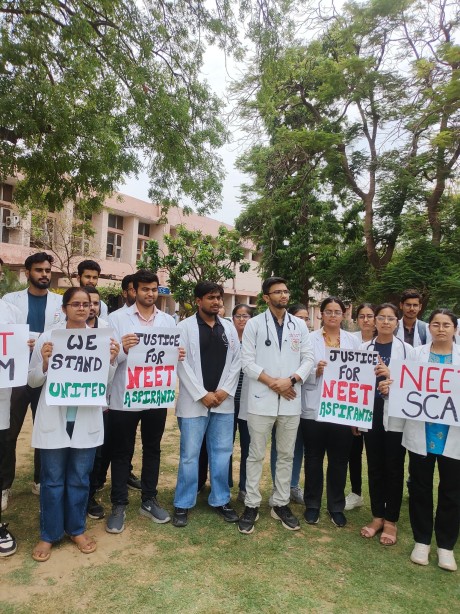
Image credit X @BitthuPankaj
The NEET-PG zero-percentile decision exposes deep regulatory failure as India dilutes specialist training standards to fill vacant seats—putting patient safety at risk.
By P. SESH KUMAR
New Delhi, January 15, 2026 — The decision to slash the NEET-PG qualifying percentile to near zero in 2025–26 marks a troubling inflection point in India’s medical education system. Triggered by nearly 18,000 vacant postgraduate seats, the move seeks to solve a numerical problem while ignoring a structural disease: the unchecked proliferation of PG seats—largely in private medical colleges—without commensurate clinical load, faculty depth, or infrastructure.
Lowering cut-offs to absurd levels converts a national merit examination into a mere eligibility ritual. Vacancies persist despite repeated relaxations. The government colleges are largely not the source of the problem. This episode reveals about regulatory failure in postgraduate medical education. Seat filling cannot be allowed to trump standards in specialist training, while patient safety and public trust are at stake.
The spectacle is hard to miss and harder to defend. A national entrance examination for postgraduate medical education—once the last redoubt of meritocracy in Indian medicine—has been pushed to a point where scoring minus 40 out of 800 is deemed “qualifying.” When the National Board of Examinations in Medical Sciences (NBEMS), acting on directions from the Ministry of Health and Family Welfare, lowered the NEET-PG qualifying percentile to zero for reserved categories and to single digits for others, the official justification was blunt: nearly 18,000 of about 70,000 PG seats remained vacant after two rounds of counselling. Seats had to be filled. Numbers had to look better.
But this obsession with arithmetic hides a deeper malaise. A qualifying cut-off is not a charity line; it is supposed to represent a minimum academic and clinical readiness to enter specialist training. Once that threshold collapses, the exam ceases to be a filter of competence and becomes a formality-an entry token into a counselling process where desperation, not preparedness, sets the tone.
Officials were quick to reassure that this move merely expands participation and that actual seat allotment still follows rank and merit. That is a technical truth and a substantive evasion. In a system where thousands of seats remain vacant even after multiple rounds, lowering eligibility is not about healthy competition; it is about scraping the bottom of the rank list to populate institutions that candidates actively avoid.
The key question therefore is not why the cut-off was reduced, but why so many seats remain vacant year after year despite repeated relaxations. Last year, even after lowering qualifying percentiles, more than 4,000 PG seats went unfilled. This year, the number has ballooned dramatically. The answer lies not in student reluctance but in institutional reality.
A close look at counselling outcomes over recent years shows a consistent pattern. Government medical colleges-especially central institutes, older state colleges, and well-established teaching hospitals-are almost entirely filled in the first or second round. Vacancies in these institutions are rare and usually limited to a handful of non-clinical or less preferred broad specialties, often in remote locations. Estimates from counselling data and state disclosures suggest that vacancies in government colleges typically form only a small fraction of total unfilled seats, often in the low hundreds nationwide, not thousands.
The bulk of the 18,000 vacant seats sits elsewhere-in private medical colleges, many of them newly permitted, rapidly expanded, or repeatedly flagged for deficiencies. These are institutions where patient footfall is thin, faculty rosters are stretched or borrowed, infrastructure exists more on paper than on wards, and clinical exposure is uneven at best. Students know this. So do parents. So do junior doctors who have already lived through an underwhelming MBBS experience and are unwilling to gamble again, this time with their specialist training.
Lowering the cut-off does nothing to change these ground realities. A radiology, medicine, surgery, or pediatrics resident cannot be trained on empty wards, with skeletal faculty, or with token procedures logged to satisfy inspection checklists. Postgraduate medical education is apprenticeship by immersion. Without volume, supervision, and institutional culture, it degenerates into a degree-granting exercise divorced from competence.
That is why the outrage from within the profession has been visceral. Voices from across specialties have called the zero-percentile decision what it plainly looks like: dilution dressed up as reform. When leaders of resident and young doctor associations argue that “merit cannot have negative value,” they are not being rhetorical. They are pointing to the existential purpose of a national entrance exam. If a candidate with a deeply negative score is deemed eligible, what exactly is the exam certifying-knowledge, readiness, or mere attendance?
The irony is that the justification offered by supporters of the move undermines its own logic. The Indian Medical Association (IMA) argued that filling seats would reduce the workload on existing residents and strengthen teaching hospitals. That may be true in hospitals that already function as genuine teaching centres. But in under-performing private colleges, additional residents do not reduce workload; they inherit dysfunction. Overworked residents in public hospitals are a symptom of skewed service distribution, not a shortage of degree-seeking trainees in sub-standard institutions.
Equally telling is the official reassurance that all candidates are already MBBS graduates who have completed internships and are therefore “recognized medical practitioners.” This is a dangerously low bar for specialist training. An MBBS degree certifies basic medical competence, not readiness for independent specialization. Postgraduate education is where errors cost lives in real time. Standards here cannot be negotiated down to salvage sunk investments in bricks, mortar, and regulatory approvals.
Organizations like Federation of All-India Medical Association have therefore raised a more uncomfortable but necessary question: why not reduce seats instead of reducing standards? Why continue to approve and retain PG seats in colleges that consistently fail to attract candidates unless eligibility norms are bent out of shape? Why not conduct an additional examination cycle, as suggested by several professional bodies, rather than hollow out the credibility of the main one?
The silence on these questions is revealing. Expanding PG seats-especially in the private sector-has become a policy goal in itself, untethered from training capacity. Once seats are sanctioned, there is immense political and financial pressure to ensure they are filled, regardless of quality. Regulators then find themselves firefighting the consequences of their own permissiveness, using percentile cuts as the extinguisher.
In this context, the role of the Medical Counselling Committee (MCC) becomes purely administrative-managing rounds, stray vacancies, and revised eligibility lists—while the deeper regulatory failure remains unaddressed. Counselling mechanisms cannot compensate for systemic dilution upstream.
The tragedy is that this erosion happens incrementally. Each year’s cut-off reduction is justified as a one-time exception. Each year’s vacancy is blamed on candidate behavior. Over time, the extraordinary becomes routine. A zero-percentile cut-off, once unthinkable, is now defended as pragmatic governance.
Lessons and the Way Forward
India does not suffer from a shortage of medical graduates willing to specialize; it suffers from a surplus of poorly grounded postgraduate seats. The first lesson is that seat numbers must follow training capacity, not the other way around. Persistent vacancies are a diagnostic signal, not a logistical inconvenience. They point to colleges that should be downsized, merged, or stripped of PG recognition until they demonstrate adequate patient load, faculty strength, and clinical outcomes.
Second, eligibility thresholds must retain meaning. A national entrance exam that certifies readiness for specialist training cannot be allowed to degenerate into a symbolic gateway. If vacancies remain after reasonable cut-offs, the correct response is a supplementary examination or a delayed cycle-not percentile nihilism.
Third, government colleges should not be conflated with the vacancy problem. Evidence consistently shows that public institutions, despite their many stresses, remain the backbone of credible postgraduate training and are largely filled on merit. Policy responses must therefore be targeted, not blanket.
Finally, regulatory credibility demands transparency. The publication of college-wise vacancy data, linked explicitly to inspection findings, faculty numbers, and patient statistics, would force an honest reckoning. Without that, lowering cut-offs will remain the easiest-and most damaging-escape route.
A country that entrusts its sick, its children, and its elderly to specialists trained under its watch cannot afford to pretend that seat filling is the same as system building. When merit hits rock bottom, patient safety is never far behind.
(This is an opinion piece. Views expressed are personal)
Follow The Raisina Hills on WhatsApp, Instagram, YouTube, Facebook, and LinkedIn




About The Author