When Labels Lie: How Object Head Mischief Warps Fiscal Picture

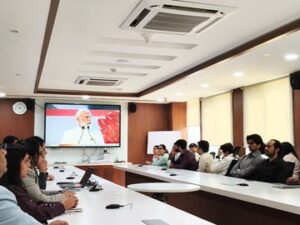
PM Narendra Modi chairs 10th Governing Council Meeting of Niti Aayog in New Delhi on Saturday (Image credit Hemant Soren, X)
If a government can improve its deficit without improving services, assets, or outcomes, the problem is not economics—it is accounting. A home loan taken for paying grocery bills while showing as expenses for home repair situation faces state finances.
By P. SESH KUMAR
New Delhi, January 11, 2026 — In continuation of my earlier post titled ‘Hide and Seek: CAG’s Uniform Object Heads Test FRBM Honesty’ let me attempt to furnish some illustrations of misuse of ‘Object head’ classification that misleads and distorts the state of finances of Government for ease of appreciation of the implications.
Let us consider a State government that announces with pride that it has eliminated its revenue deficit. On paper, the numbers look impressive. Let us look closely at how the spending can be labelled.
Illustration 1: Borrowing for Salaries-But Calling It “Capital”
A State faces ballooning salary and pension bills. Under fiscal pressure, it raises loans (through PSUs, SPV, and other means) and uses the funds to pay salaries and routine administrative expenses. Instead of booking this spending under “Salaries” or “Office Expenses” (revenue expenditure), the payments are quietly parked under “Capital Outlay on Other Administrative Services.”
To a layperson, this is like using a housing loan to pay grocery bills and calling it “home improvement.”
The immediate impact is dramatic:
- Revenue deficit appears lower-or disappears
- Fiscal deficit looks “development-oriented”
- Legislators believe borrowing is creating assets
In reality, no asset is created, and future taxpayers inherit debt incurred merely to keep the lights on.
Illustration 2: Grants Disguised as Loans to Avoid Deficit Pressure
A State wants to support a loss-making power utility. If it gives a grant, it worsens the fiscal deficit. So instead, the money is booked as “Loans and Advances to State PSUs.”
On paper, this looks prudent-a recoverable loan, not a handout.
In reality, everyone knows the loan will never be repaid.
For a layman, this is like calling pocket money given to a child a “recoverable personal loan” to look financially disciplined.
The consequence:
- Fiscal deficit is artificially suppressed
- Debt statistics look cleaner
- True subsidy burden is hidden
Years later, when the loan is waived, the damage surfaces-but by then the political and fiscal credit has already been claimed.
Illustration 3: Offloading Expenditure Through “Grants-in-Aid”
A State undertakes a major welfare or infrastructure programme. Instead of spending directly, it routes funds as “Grants-in-Aid to autonomous bodies or societies.”
The moment money is released as a grant, the State’s books show the expenditure as “completed,” even though:
- The society may not spend it for years
- Funds may sit idle in bank accounts
- Outcomes are uncertain or delayed
To a citizen, this is like declaring his house repaired the moment he transfers money to a contractor-without checking whether any work happened.
The result:
- Year-end deficit targets are met
- Cash balances quietly pile up outside the Consolidated Fund
- Legislative oversight weakens
Illustration 4: Revenue Receipts Inflated Through “Extraordinary Items”
Some States record one-off receipts-such as special compensation, asset monetisation proceeds, or upfront lease premiums-under regular revenue receipts.
This creates a feel-good headline: “Revenue Surplus Achieved.”
But these receipts are non-recurring and cannot fund recurring expenses.
For a layman, it is like selling family jewellery and declaring our monthly income has increased.
The distortion leads to:
- Unsustainable spending commitments
- Illusion of structural fiscal strength
- Painful corrections in later years
Illustration 5: “In-Transit” and Suspense Heads-The Fiscal Parking Lot
Expenditures that should be classified properly are parked under “Suspense,” “Remittances,” or “Deposits”-sometimes running into thousands of crores.
These heads act like a dark basement where inconvenient expenses are stored temporarily-and sometimes permanently.
To the public eye:
- Expenditure appears lower
- Deficit numbers look compliant
- Reconciliation is postponed indefinitely
To a layperson, it resembles keeping unpaid bills in a drawer and claiming we have no expenses.
In government accounting, the hierarchy matters: Major Head-Sub-Major-Minor Head -Sub-Head -Object Head
The minor head answers “what type of programme or service is this?” The object head answers “what exactly was the money spent on?”
When salaries are shown as “capital outlay,” the minor head may still read “Capital Outlay on General Services” or “Administrative Services.” On the surface, that looks defensible.
The real mischief happens when the object head underneath records wages, salaries, office expenses, or routine maintenance-items that are inherently revenue in nature-while sitting inside a capital minor head. That is what converts consumption into “investment” on paper.
Similarly, when support to a loss-making PSU is shown as a “loan,” the minor head is indeed “Loans and Advances to State PSUs.” But the decisive misrepresentation lies in the object head, which treats what is economically a grant or subsidy as a recoverable financial asset, even when recovery is implausible.
In the grants-in-aid example, the minor head “Grants-in-Aid” may be technically correct, but the object head treatment-combined with absence of utilisation tracking-allows expenditure to be declared complete even when no service is delivered. The fiscal illusion is sustained not by the programme label but by how the transaction is finalised and closed at the object level.
Suspense and remittance parking works the same way. The minor head provides the parking slot; the object head keeps the expense from hitting the revenue or capital account where it belongs, thereby delaying its impact on the deficit.
Why this distinction matters for the uniformity debate
Uniform minor heads already exist to a large extent across the Union and States. What varies—and what enables mischief—is the granularity, interpretation, and operation of object heads.
That is precisely why the current reform focus is on object heads, not minor heads. Without object-level uniformity and discipline, two States can show identical minor heads and still present radically different fiscal realities.
Bottom line (in plain terms)
Think of the minor head as the chapter title and the object head as the actual expense line.
You can keep the chapter title honest and still lie in the lines below. So yes—some manoeuvres begin with minor head choices, but the decisive distortion of deficits, debt, and FRBM compliance happens at the object head level. That is where fiscal truth is either preserved—or quietly rewritten.
Why These Tricks Matter for FRBM and Democracy
Each of these misclassifications may look technical, but together they:
- Undermine the credibility of FRBM targets
- Mislead legislators voting on budgets
- Distort Finance Commission assessments
- Misprice State Development Loans in markets
- Shift today’s consumption burden onto future generations
Most importantly, they replace fiscal truth with fiscal theatre.
Why Uniform Object Heads Are Necessary—but Not Sufficient
Uniform Object Heads make such tricks harder to perform and easier to detect, but only if:
- New expenditure items are periodically standardised
- Deviations are disclosed transparently
- Classification changes are explicitly explained
- Audit reports flag classification-driven deficit improvements
Otherwise, the mischief simply migrates from different heads to creative interpretations of the same head.
The Bottom Line (Layman’s Test)
If a government can improve its deficit without improving services, assets, or outcomes, the problem is not economics—it is accounting.
Uniform Object Heads are the first step in fixing that. Relentless transparency is the second.
(This is an opinion piece. Views expressed are author’s own)
Follow The Raisina Hills on WhatsApp, Instagram, YouTube, Facebook, and LinkedIn




About The Author