What America’s Shutdown Reveals About Myth of Its Democracy
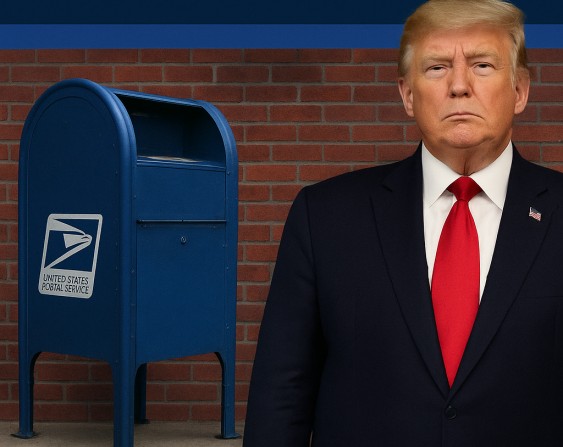
US President Donald Trump and suspension of postal shipments! (Image TRH)
As Washington’s record-breaking shutdown paralyzes the world’s “model democracy,” former Kyrgyz Prime Minister Djoomart Otorbaev questions whether America’s political system still deserves to be emulated.
By TRH Foreign Affairs Desk
New Delhi, November 10, 2025 — In what may be the most damning critique yet of America’s political paralysis, Djoomart Otorbaev, former Prime Minister of the Kyrgyz Republic, has written a scathing reflection on LinkedIn titled “The United States of Dysfunction.” His argument is both simple and uncomfortable: that the United States — long self-anointed as the world’s democratic exemplar — is now a case study in how democracies fail from within.
For forty days, the U.S. government has been shut down — the longest in its history. Federal offices are dark, airports are understaffed, soldiers and civil servants alike are working without pay. By Otorbaev’s count, 1.4 million uniformed personnel and nearly as many civilian workers have been directly affected, with millions more suffering from the ripple effects of suspended public services and halted benefits.
“How can a country claim to safeguard its citizens’ security when its soldiers and police officers work without pay?” Otorbaev asks. “What kind of democracy is it where citizens become hostages of political ego?”
His words land hard because they capture something that many Americans themselves are reluctant to admit: that the very machinery of U.S. governance — its vaunted ‘checks and balances’ — is now weaponized against itself. What was designed to prevent tyranny has evolved into a system of mutual paralysis, one that collapses whenever partisan hostilities reach their cyclical peak.
On November 9, the U.S. Senate narrowly passed a bill to end the shutdown, 60 to 40. The legislation still requires House approval and the president’s signature — neither of which, given the tenor of Washington politics, can be taken for granted.
The immediate cause of the standoff — disputes over Obamacare subsidies and Medicaid funding — is itself emblematic. What should have been a debate about healthcare for America’s poorest citizens became yet another trench line in the endless culture war between Democrats and Republicans. In Otorbaev’s reading, this is not governance; it is political theatre performed at the expense of the governed.
Economists are already quantifying the damage. Oxford Economics estimates the shutdown has shaved 0.1–0.2% off U.S. GDP each week, with the potential for a 2.4% quarterly contraction if it drags on. But the real losses are moral, not fiscal. The nation that lectures the world on fiscal responsibility and institutional strength cannot even keep its own lights on.
Since the Budget Act of 1976, America has endured 22 government shutdowns — a staggering statistic for the supposed steward of global democratic norms. Otorbaev’s essay is, at its core, a mirror held up to that contradiction: a “beacon of freedom” flickering under the weight of its own dysfunction.
For decades, Washington has positioned itself as a teacher of governance to Africa, Asia, and Latin America. But perhaps, as Otorbaev suggests, it is time for the world to reconsider its syllabus. “The myth of American democracy,” he writes, “is collapsing — not under foreign pressure, but under the weight of its own contradictions.”
As the shutdown drags on, the question he poses reverberates far beyond U.S. borders: When the world’s leading democracy cannot govern itself, who still believes in its light?
Follow The Raisina Hills on WhatsApp, Instagram, YouTube, Facebook, and LinkedIn




About The Author