West Bengal’s Demography: Muslim Share Eyes Pre-Partition Days
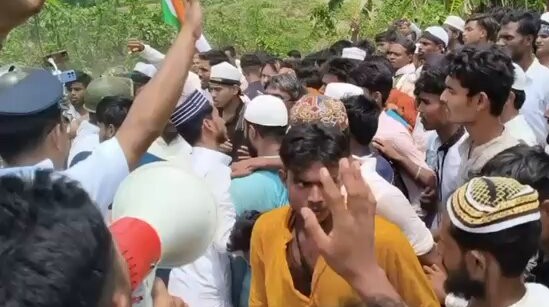
West Bengal’s Muslim population has risen steadily since 1971, reversing Partition-era trends. This op-ed examines demographic shifts. (Image X.com)
A decades-long demographic change—shaped by migration, political appeasement, and uneven development—is redefining West Bengal’s electoral math and social landscape.
By NIRENDRA DEV
New Delhi, December 5, 2025 — West Bengal’s relationship with its Muslim population has always carried layers of contradiction. What began with the demographic churn of 1971 was later shaped by decades of political “appeasement” under both the Left Front and Mamata Banerjee. Today, the state—much like Assam—is witnessing an unmistakable quickening of religious demographic change.
According to the 2011 Census, Muslims constituted about 27% of West Bengal’s population. Current estimates place the figure between 30% and 33%, suggesting that the state may soon return to its pre-Partition demographic profile. The impact of the partial population transfer of 1947—never as complete as in the northwest—has been steadily negated.
The growth gap between Hindus and Muslims highlights the trend. Between 2001 and 2011, Muslims grew by 21.8%, compared to just 10.8% for Hindus. The decadal gap has remained consistently wide since the 1970s. The Muslim share rose from 20.5% in 1971 to 27% in 2011—an accretion of nearly seven percentage points in four decades.
This rise is not uniform. The sharpest demographic shifts are concentrated along two belts: the Dinajpur–Maldah–Murshidabad–Birbhum region bordering Bangladesh’s Rangpur and Rajshahi divisions; and the North and South 24 Parganas–Kolkata–Howrah arc opposite Khulna.
Muslims now form a majority—around 52%—in the first belt. In 1951, their share there was under 40%. In total, nearly a crore Muslims reside in Uttar Dinajpur, Dakshin Dinajpur, Maldah, Murshidabad and Birbhum, and another 77 lakh in the 24 Parganas–Kolkata zone.
These trends carry political implications. The RSS’s election strategy remains focused on consolidating Hindu votes in high-Muslim seats, while the BJP in Bengal has simultaneously attempted a “Muslim outreach”. State BJP president Samik Bhattacharya has argued that the party is not against “rashtravadi Indian Muslims”, only “infiltrators”—a message aimed at countering the perception of hostility.
Yet socio-economic challenges persist. Lower literacy, educational backwardness and uneven development continue to disadvantage the community. The long-debated issue of cross-border influx adds further complexity to governance and social cohesion.
West Bengal’s demographic trajectory—accelerating since 1971—indicates that the Muslim share may soon return to pre-Partition levels. The state now sits at the cusp of a profound demographic rebalancing whose political and administrative consequences will shape its future.
(This is an opinion piece, and views expressed are those of the author only)
Follow The Raisina Hills on WhatsApp, Instagram, YouTube, Facebook, and LinkedIn




About The Author