West Bengal Elections: BJP Faces Bengal’s Cultural Resistance
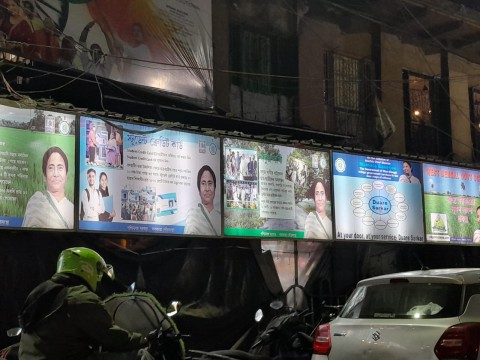
Hoardings of West Bengal Mamata Banerjee in Kolkata (Image Nirendra Dev)
As Amit Shah prepares for a multi-state electoral marathon, West Bengal emerges as the ideological fault line between Hindutva consolidation and Bengali cultural identity.
By NIRENDRA DEV
Kolkata, January 21, 2026 — For BJP poll managers—and chief strategist Amit Shah in particular—the election calendar is once again unforgiving. The party is already in full campaign mode in Assam, West Bengal, and Kerala, while quietly preparing for the high-stakes Uttar Pradesh battle alongside Manipur, Punjab, Uttarakhand, and Goa, all due by March 2027. Gujarat and Himachal Pradesh will follow by the end of that year.
Yet among these, West Bengal stands apart.
In Mamata Banerjee-ruled Bengal, the BJP believes the contest transcends routine electoral arithmetic. For the saffron party, it is a battle to “protect civilisational values.” Over the last decade, the BJP has steadily worked to make its ideological triad—Hindu-Hindi-Hindustan—socially acceptable across large swathes of India. The success in municipal politics in Mumbai is cited internally as proof that slogans once dismissed as regional—like “Jai Shri Ram”—now carry national resonance.
“In Bengal, BJP politics is viewed through a different prism,” says Ronojit Sanyal of Kolkata’s Kharda region. “The party has succeeded in projecting the Pishi–Bhaipo (Mamata–Abhishek Banerjee) duo as symbols of corruption, tyranny, and dynastic ambition.”
Against an electorate fragmented by caste and religion, the BJP has previously demonstrated its ability to stitch together a pan-Hindu vote in electorally crucial states. Translating less than one-third of the vote share into a parliamentary majority in 2014 and 2019 was not accidental—it reflected Narendra Modi’s personal charisma, disciplined organisation, and selective deployment of Hindu nationalist tropes where they resonated most.
But challenges never pause.
In Bengal, the SIR issue has resurfaced following Supreme Court interventions. BJP strategists are recalibrating to counter Mamata Banerjee while also navigating Kerala’s entrenched Left ecosystem. In Uttar Pradesh, the Modi–Yogi combine is preparing to once again sell the promise of the “double-engine sarkar.” Elsewhere—Uttarakhand, Goa, and Manipur—each state demands a bespoke strategy. In Manipur, the unresolved trauma of the 2023 Kuki–Meitei clashes continues to haunt the BJP’s credibility.
Looking ahead, pre-poll moods are already forming in Nagaland, Tripura, and Meghalaya (2028), as well as Karnataka. Yet the deeper story lies elsewhere.
Since Modi became Prime Minister more than 11 years ago, India has undergone a silent cultural transformation—anti-elite, anti-English, and increasingly anti-intellectual. Modi’s 2025 call to end India’s “western mindset” by 2035 only reinforced this shift. Ironically, the regime has also produced a new elite—provincial, pro-Hindi, and unapologetically majoritarian.
In Bengal, this transformation collides with a strong sense of linguistic and cultural selfhood. What once empowered Mamata Banerjee—anti-Left liberalism—made her nearly invincible. Today, however, Hindutva forces want to challenge the Trinamool Congress head-on.
Thus, the West Bengal Assembly Election 2026 is increasingly framed as a contest between native Bengali culture and the BJP’s Hindi–Hindu push.
Perhaps the most striking irony is political convergence. A party long accused of Muslim appeasement now speaks loudly about building a Jagannath temple. Mamata Banerjee’s outreach to Hindu voters—once unthinkable—has earned her the label of a “seasonal Hindu.”
Bengal is changing. So is India. And the question 2026 will answer is not merely who wins power—but whose idea of India prevails.
(This is an opinion piece. Views expressed are author’s own)
Follow The Raisina Hills on WhatsApp, Instagram, YouTube, Facebook, and LinkedIn




About The Author