Was India’s Trade Deal with US Costly as Trump Tariff Collapses?
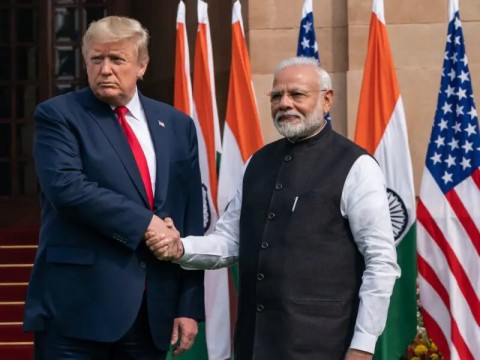
US President Donald Trump & India PM Narendra Modi (Image credit X.com, File)
Geopolitics analyst Manish Anand says the US Supreme Court’s decision striking down Donald Trump’s tariff policy raises tough questions for Prime Minister Narendra Modi’s trade strategy.
Op-Ed | The Raisina Hills
New Delhi, February 21, 2026 — The US Supreme Court’s decision to strike down the tariff framework advanced by US President Donald Trump has triggered fresh geopolitical tremors. But in India, the focus has shifted to a different question: Did New Delhi move too quickly on the India-US interim trade deal?
Geopolitics analyst Manish Anand, speaking in a special monologue for The Raisina Hills, framed the debate sharply. “When the legality of Trump’s tariffs was already under challenge in US courts, why did India not wait for the Supreme Court’s final word before endorsing the interim trade understanding?”
Anand argued that timing is central in geopolitics. With lower US courts having questioned the tariff doctrine, and the Supreme Court hearing underway, he suggested India could have exercised greater strategic patience. “If the tariff framework itself was uncertain, the urgency to commit to expanded US imports required deeper scrutiny,” Anand said.
The interim understanding reportedly envisions scaling US exports toward a $500 billion trajectory over five years — a figure that has sparked debate among policy watchers. Anand raised concerns about domestic preparedness.
“Is India’s economy in a position to absorb a dramatic rise in US imports without impacting farmers and industry? Strategic autonomy must not become tactical concession,” he remarked.
Following the court’s ruling, a uniform 10% global tariff baseline has reportedly applied broadly — flattening earlier differential pressures. Countries that resisted maximal demands are no longer facing punitive slabs.
That shift, Anand believes, changes the optics. “When the pressure architecture collapses judicially, questions naturally arise about concessions made under that pressure,” he said.
Energy policy also enters the debate. India had benefited from discounted Russian crude in recent years. A pivot toward higher-cost US energy imports, Anand noted, has fiscal and logistical implications. “Cheap energy strengthens growth. Expensive energy narrows fiscal space. Trade decisions are never isolated from macroeconomic consequences,” he stated.
Supporters of Prime Minister Narendra Modi argue that deeper alignment with the world’s largest economy brings long-term advantages in technology, defence, and supply chains. India has historically balanced defence procurement among France, Russia, and the US — maintaining diversification rather than dependency.
Yet, as Anand underscored, perception matters in politics. “Strategic autonomy has defined India’s foreign policy for two decades. The India-US interim trade deal now tests that doctrine’s credibility.”
With Parliament expected to debate the issue in upcoming sessions, opposition parties are likely to question whether India conceded more than necessary. “In geopolitics, timing is power,” Anand concluded. “And this timing will now be examined from Parliament to the public square.”
(This is an opinion piece. Views expressed are those of Manish Anand.)
Supreme Justice Neil Gorsuch Draws Red Line in Tariff Verdict
Follow The Raisina Hills on WhatsApp, Instagram, YouTube, Facebook, and LinkedIn




About The Author