Venezuela, War, and Power: Rubio–Duckworth Clash in Senate
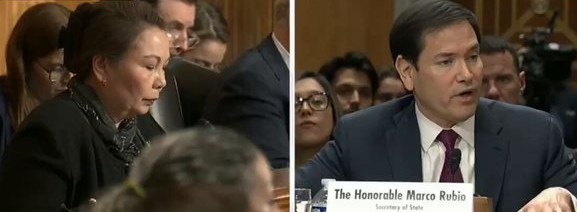
Rubio–Duckworth Clash Exposes a Dangerous Grey Zone in Use of Executive Power in the US (Image X.com)
As the Alien Enemies Act resurfaces, the US blurs the line between crime, war, and executive power
By TRH Op-Ed Desk
New Delhi, January 29, 2026 — “Are we currently at war with Venezuela?”
That deceptively simple question from Senator Tammy Duckworth (D-Illinois) triggered one of the most revealing exchanges in recent Senate testimony, as Secretary of State Marco Rubio struggled to draw a clean line between war, crime, and presidential power.
Rubio’s answer was formally cautious but substantively alarming. “No, we’re not in a state of war with Venezuela,” he said—before repeatedly describing narco-trafficking gangs and criminal networks operating from the region as forces that are “waging war on the United States.”
The tension centered on the administration’s invocation of the Alien Enemies Act, a statute the US Supreme Court has historically treated as a wartime power. Duckworth noted that the law has only been used during the War of 1812, World War I, and World War II—periods that also saw the internment of thousands of innocent civilians.
“Are you really arguing that the president should be able to wield an internment law?” Duckworth asked.
Rubio insisted he was not advocating internment, but argued that the US is confronting “irregular groups” with “state-like capabilities” that pose a grave national security threat. “They are enemy combatants,” he said, framing criminal gangs and cartels in explicitly military terms.
Duckworth pushed back sharply, citing findings that many deported under this framework had no criminal records and were legally present in the US. “If the administration is willing to lie about who it’s targeting,” she warned, “what protections do totally innocent people have against abuse?”
At stake is more than immigration enforcement. The exchange exposed a deeper shift in American doctrine: redefining war without declaring it, and invoking wartime powers without battlefield accountability. Rubio acknowledged that “every president retains the right” to use military force against imminent threats—even in Venezuela—while stressing that the administration does not “anticipate” boots on the ground.
That ambiguity is precisely the concern. Americans weary of “forever wars” hear familiar language—threats, imminence, exceptional powers—without the constitutional clarity that once separated policing from warfare.
The question Duckworth posed remains unanswered: if this is not war, why are wartime laws being revived?
Follow The Raisina Hills on WhatsApp, Instagram, YouTube, Facebook, and LinkedIn




About The Author