


By S. JHA
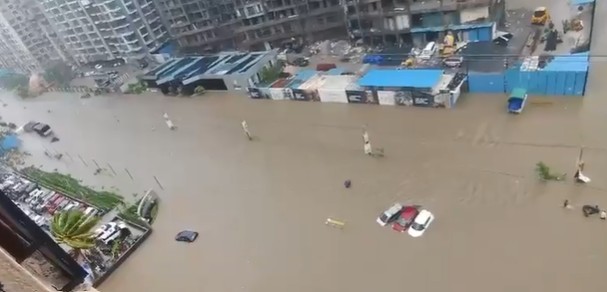
Vasai-Virar — home to lakhs of Mumbai’s daily commuters — is underwater again this monsoon. 220+ rescued, 100+ trains cancelled, and residents asking why this keeps happening every year.
Mumbai, July 7, 2026 — Every weekday, before the sun is properly up, lakhs of people pour out of Vasai, Nalasopara, and Virar and onto Western Railway platforms, headed for jobs in Mumbai’s offices, shops, and factories. It’s one of India’s largest daily human migrations, invisible to most of the country because it happens quietly, on time, morning after morning. This week, it simply stopped.
Heavy monsoon rain has once again submerged large parts of the Vasai-Virar belt, a fast-growing municipal corporation area roughly 40 kilometers north of Mumbai that has become a residential lifeline for the city’s workforce, largely because it’s more affordable than housing within Mumbai itself.
According to Bombay Samachar’s English edition, the flooding this week left thousands of residents struggling with flooded roads, waterlogged homes, and disrupted train services, with familiar scenes of submerged roads, stalled vehicles, and shuttered shops returning across the region.
The Areas Underwater
The worst-hit localities read like a map of where Mumbai’s commuter workforce actually lives: Achole, Tulinj, Pelhar, Nalasopara East and West, Vasai East, Pragati Nagar, and Virar East were among the neighborhoods that went under, per Bombay Samachar’s reporting. These aren’t fringe pockets — they’re dense residential belts that exist specifically because they offer commuting distance to Mumbai at a fraction of the city’s housing costs.
The Free Press Journal reported a stark rainfall figure behind the crisis: Vasai-Virar recorded 150 mm of rain in just 24 hours after three days of continuous downpours, a deluge severe enough that five vehicles were swept away in Vasai East, with two people rescued from the floodwaters.
The same report noted that Municipal Commissioner Prithviraj B.P. faced visibly angry residents during an on-ground inspection of the affected areas — a scene that has become almost ritual during Mumbai’s monsoon season.
When the Trains Stop, So Does the City’s Workforce
For a region defined by its commute, the railway disruption is the story within the story. The Free Press Journal’s coverage of Monday’s rail chaos documented the scale of the breakdown: waterlogging on the Western Railway’s Vasai-Dahanu stretch, combined with landslides elsewhere on the network, led to roughly 100 suburban local trains cancelled and another 120 delayed by evening.
Long-distance services were hit even harder, with 16 trains cancelled outright between Vasai and Dahanu and dozens more short-terminated, rescheduled, or diverted.
The human cost of that disruption showed up in commuters’ own accounts. The Free Press Journal quoted one passenger, Shruti More, describing her Monday morning: “It took me almost three hours to reach Churchgate from Virar.”
For someone whose entire day depends on a predictable train schedule, three hours instead of one isn’t an inconvenience — it’s a missed meeting, a docked wage, or in her case, a delayed start to what she called an important office meeting.
Bombay Samachar’s reporting captured the broader pattern: waterlogging near the tracks between Vasai Road and Virar —one of the busiest railway stretches in the Mumbai Metropolitan Region — slowed trains during peak hours, leaving thousands of office-goers and students facing long waits, while railway officials monitored water levels to keep passengers safe.
The Rescue Operation
This wasn’t just a traffic and train story — it became a rescue operation. Bombay Samachar reported that National Disaster Response Force (NDRF) teams, alongside local authorities and emergency services, evacuated residents trapped in flooded areas, with more than 220 people rescued in total. Separately, other reporting on the district noted more than 100 additional villagers were pulled from flood-hit areas of Vasai with NDRF assistance during the same monsoon cycle.
Bombay Samachar’s report also noted with sober restraint that the heavy rains led to loss of life in separate incidents across the district — a reminder, the outlet wrote, of how dangerous monsoon flooding can become.
Why This Keeps Happening
What makes this year’s flooding land differently is the growing public argument over whether it was preventable. Bombay Samachar’s coverage laid out the accountability angle directly: residents and opposition leaders have questioned whether adequate pre-monsoon drainage work was actually completed, with allegations reaching the Maharashtra Legislative Assembly over the quality of drain desilting projects and how public money was spent.
In response, the state government has ordered an inquiry into the Vasai-Virar City Municipal Corporation’s (VVCMC) desilting work — though, as the outlet was careful to note, these remain allegations under investigation rather than established findings.
The structural explanation runs deeper than any single season’s rainfall. Bombay Samachar cited an earlier IIT Bombay study that found rapid, unchecked urban development in the region has narrowed natural water channels and outpaced drainage infrastructure, especially around the Vasai railway yard.
Put simply: the area has added thousands of new housing developments to accommodate Mumbai’s overflow workforce, but the drains meant to carry away rainwater haven’t grown at anywhere near the same pace.
A Commuter Belt Without a Safety Net
That infrastructure gap has a political dimension too. One regional outlet’s analysis argued that Vasai’s flooding exposes a deeper disparity in disaster preparedness compared to Mumbai proper — pointing out that the region’s civic disaster budgets remain a fraction of what Mumbai’s municipal corporation commands, even though its natural drainage — creeks, wetlands, and mangrove buffers — has been steadily built over in recent years.
Whether or not one accepts that framing in full, the underlying fact is hard to dispute: a belt of the Mumbai Metropolitan Region that sends lakhs of workers into the city every day still lacks the kind of early-warning systems and flood infrastructure that older, wealthier parts of the metropolitan area take for granted.
For the lakhs of people who call Vasai-Virar home precisely because it lets them afford a life within reach of Mumbai’s job market, this week’s floods aren’t an abstract climate story — they’re missed wages, stranded commutes, and homes standing in muddy water for the second, third, or fourth monsoon in a row. Until the region’s drainage infrastructure catches up with its explosive growth, residents say, the same question will keep resurfacing with every heavy spell of rain: who is actually responsible for making sure this doesn’t happen again?
Kolkata Floods After Record Rainfall: Politics, Pain, and Punditry
Follow The Raisina Hills on WhatsApp, Instagram, YouTube, Facebook, and LinkedIn




