


By S. JHA
A summer of record heat is killing people in Uttar Pradesh, Telangana, and beyond — while thousands of kilometres north, the Himalayan ice that feeds India’s rivers is quietly collapsing.
Mumbai, May 24, 2026 — A summer of record heat is killing people in Uttar Pradesh, Telangana, and beyond — while thousands of kilometres north, the Himalayan ice that feeds India’s rivers is quietly collapsing.
On the afternoon of May 23, 2026, temperatures in Sirpur (T) in Telangana’s Asifabad district hit 46.5°C — making it one of the ten hottest places in all of India that day. By evening, at least 34 people had died from heatstroke across the state. The next day, that toll climbed again.
“A brutal heatwave sweeping across Telangana has claimed at least 34 lives as temperatures soared above 46 degrees Celsius in several districts, with Khammam emerging among the 10 hottest places in India,” reported Siasat.com on May 23, 2026. The victims included elderly residents, students, farmers, agricultural labourers and daily wage workers from more than a dozen districts.
By May 24, the combined two-day death toll for Telangana and neighbouring Andhra Pradesh had crossed 40, according to The Week (May 24, 2026), with temperatures reaching up to 46°C. The Meteorological Department issued red alerts for Karimnagar, Peddapalli, Jayashankar Bhupalpally, Mulugu, Khammam, Nalgonda, Suryapet, Warangal, Hanumakonda, and other districts.
The Undercounting Problem
The condolence message by Russian President Vladimir Putin for more than 100 deaths in Uttar Pradesh due to storm and abrupt weather changes brought the spotlight on the under reporting by the state governments. The trend is old. States under report. But the National Crime Research Bureau brins out true picture later.
In 2024, the NCRB revealed a 127.9 percent increase in heat stroke and sunstroke deaths nationwide — from 804 in 2023 to 1,832 in 2024. Uttar Pradesh recorded 352 of those deaths. UP is not alone. Other states also have in the past under reported reasons for deaths.
Uttar Pradesh: Furnace of the Indo-Gangetic Plain
India’s most populous state has been in the furnace for weeks. The IMD has placed UP under active heatwave warnings, with cities like Orai and Auraiya recording extreme highs. BusinessToday (May 18, 2026) reported the IMD issuing widespread heatwave alerts across northern, central, and eastern India, naming Delhi, Rajasthan, Punjab, Haryana, Uttar Pradesh, Madhya Pradesh, Vidarbha, Chhattisgarh, Bihar and Telangana among regions under warning.
Agra, in western UP, has repeatedly crossed the 46°C mark. Ballia and Bundelkhand — historically among the state’s most heat-exposed districts — are again seeing heat-related hospital admissions spike. UP’s power demand has hit record highs as residents reach for every available fan and cooler.
Why 2026 Is This Bad
Scientists say it is not a single cause but a convergence of forces. Climate change is raising the baseline. India’s annual average temperature has risen by 0.15°C per decade between 1951 and 2016, and the trajectory is accelerating. BusinessToday (May 2026) summarised the scientific consensus: “Long-term global warming is raising baseline temperatures across the planet. This means heatwaves are becoming more frequent, more intense and longer lasting.”
The heat dome effect is trapping superheated air over the Indo-Gangetic plains, preventing the normal atmospheric mixing that would bring relief at night. Warm night conditions compound daytime heat stress — the body never recovers.
A possible Super El Niño is amplifying the crisis. Meteorological assessments indicate a potential “Super El Niño” developing in 2026. This is known to disrupt global weather systems. Consequences include reduced rainfall and increase land surface heating.
The early onset is itself a warning sign. The IMD noted that extreme heat arrived weeks ahead of historical norms in 2026. “There has been evidence of extreme heat occurring sooner than expected in many regions of India, and the severity of the extreme heat continues to escalate,” reported NewsX (May 2026).
The IMD’s seasonal outlook for April to June 2026 specifically warned of “above-normal heatwave days” over parts of east, central, northwest India and the southeast peninsula, according to a Press Information Bureau advisory.
Meanwhile, in the Mountains: Glaciers Are Collapsing
Turn your attention north — to Uttarakhand, where India’s major rivers are born — and the story becomes more urgent.
On August 5, 2025, a violent wall of water, rocks, and mud slammed into Dharali village in Uttarkashi district, destroying homes, hotels, and markets along the Khir Gad stream before it met the Bhagirathi River. The initial explanation was a cloudburst. It was not.
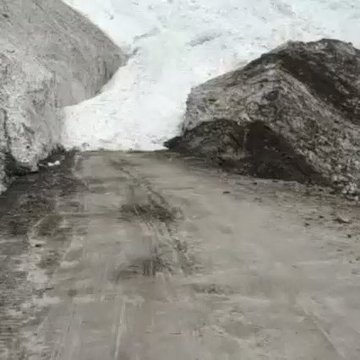
A subsequent study by ISRO scientists, published in NPJ Natural Hazards, found no evidence of the extreme rainfall that would have been needed to cause such flooding. Instead, ISRO researchers — using satellite imagery, high-resolution digital elevation models, and publicly available video — determined the real trigger: a 69-million-kilogram ice patch on the Srikanta Glacier had suddenly collapsed.
The ice mass, located at an altitude of around 5,220 metres, had been exposed by the thinning of its protective snow cover — a direct consequence of warming temperatures. “As deglaciation advances, ice-patch instability in nivation zones is a growing and under-recognised threat across high-mountain catchments,” the ISRO researchers warned.
One Crisis, One Cause
These two catastrophes — the heatwave deaths in the plains and the glacial collapse in the mountains — are not separate events. They are two manifestations of the same phenomenon.
The same rising temperatures that are sending thermometers past 46°C in Telangana are stripping the protective snow cover from glaciers at 5,000 metres, exposing unstable ice to summer ablation. The same carbon emissions that are intensifying pre-monsoon heat waves are loading the atmosphere with the energy that is rewriting Himalayan geology.
In the short term, melting glaciers temporarily increase river flows — providing false comfort before the water runs out permanently. In the long term, the Ganga and Yamuna, which hundreds of millions of people depend on, face a future of diminishing glacial input.
“Cloudbursts, sudden intense rainstorms, lightning strikes, glacial lake eruptions, heat and cold wave surges” are all increasing in frequency and intensity, noted India Water Portal, adding that “the speed at which they are melting is worrying.”
The Republic of Smog: Why Delhi Still Chokes as India Looks Away
Follow The Raisina Hills on WhatsApp, Instagram, YouTube, Facebook, and LinkedIn




