UGC Regulations: Are ‘Andhabhaktas’ Finally Questioning Modi?
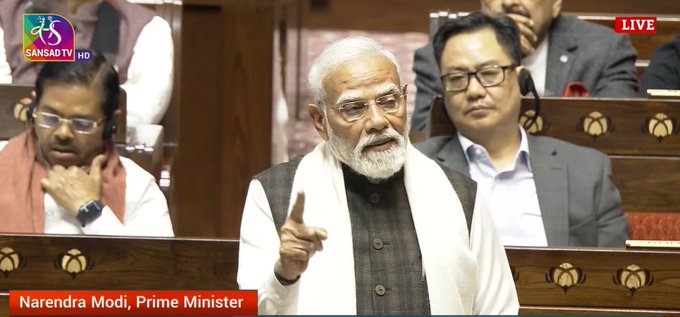
Prime Minister Narendra Modi in Rajya Sabha on Thursday (Image Sansad TV)
The UGC Regulations 2026 controversy has triggered rare dissent among Narendra Modi’s staunchest supporters, raising uncomfortable questions on caste laws, reservations and governance.
By RAVI SHANKER KAPOOR
New Delhi, February 20, 2026 — Till recently, it seemed that ideological blindness was permanent. The assumption held that the politically committed — whether on the Left or within Hindutva ranks — rarely question their own side. The UGC Regulations 2026 controversy, however, may have disrupted that certainty.
The UGC Regulations 2026 controversy has triggered rare and visible dissent among Prime Minister Narendra Modi’s most loyal supporters.
For decades, ideological camps have resisted introspection. Critics of global communism often cite the catastrophic human toll under regimes in the Soviet Union, Mao’s China and Cambodia. Yet, many Left adherents continue to defend their philosophical foundations. On the other side of India’s political spectrum, supporters of Narendra Modi and the Bharatiya Janata Party have often been accused of unwavering loyalty — backing government decisions regardless of controversy.
That perception has been challenged.
The recently notified University Grants Commission (Promotion of Equity in Higher Education Institutions) Regulations, 2026 have drawn sharp criticism not only from opposition voices but also from sections of the BJP’s traditional support base. Social media spaces once defined by reflexive endorsement are now witnessing pointed questions.
The debate has expanded beyond higher education. Critics are revisiting long-standing issues such as the Scheduled Castes and Scheduled Tribes (Prevention of Atrocities) Act, 1989 and the broader architecture of caste-based reservations. Questions that were once whispered are now being asked aloud: Should affirmative action benefits extend indefinitely to economically secure families within reserved categories? Should income or economic criteria play a larger role?
The cultural resonance of this churn recalls Plato’s allegory of the cave in The Republic — where prisoners mistake shadows for reality until one breaks free and sees the world differently. Whether the UGC regulations amount to a political “shock therapy” or simply a policy misstep, they appear to have unsettled previously unquestioned loyalties.
This does not necessarily signal ideological conversion. Nor does it mean wholesale rejection of the government’s agenda. But it suggests something politically significant: a willingness to scrutinise power from within.
For a decade, Modi’s political dominance has rested not only on electoral arithmetic but also on narrative control and committed voter alignment. If segments of that alignment begin demanding accountability rather than offering automatic endorsement, governance becomes more complex.
Democracies mature when supporters ask questions, not just opponents. The UGC Regulations 2026 controversy may not transform loyalists into philosophers. But if it fosters even incremental critical engagement, it alters the political equation — and that could make life more challenging for the government going forward.
(This is an opinion piece. Views expressed are author’s own. This article is brought in collaboration with The Hindu Chronicle.)
UGC Equity Regulations 2026: When ‘Equity’ Turns Into Ideology
Follow The Raisina Hills on WhatsApp, Instagram, YouTube, Facebook, and LinkedIn




About The Author