Trump’s ‘Peace Board’: Why India’s Caution Reflects Prudence
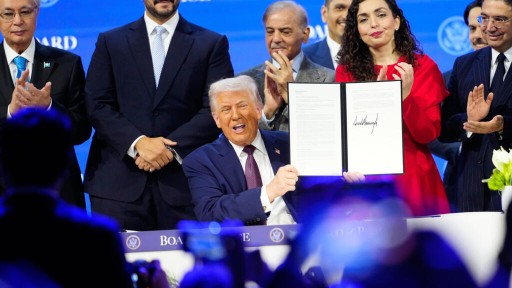
US President Donald Trump at unveiling of Board of Peace for Gaza in Davos on Thursday (Image X.com)
A mandate without multilateral authorisation raises questions India cannot afford to ignore
By TRH World Desk
New Delhi, January 22, 2026 — The unveiling by US President Donald Trump of a new Board of Peace—involving representatives from approximately 20 countries and presented as a mechanism to support reconstruction in Gaza—has generated significant international discussion. According to public statements made by US officials, the initiative is intended to operate “in coordination” with the United Nations. However, no formal UN resolution, charter document, or treaty-based mandate for such a body has been placed in the public domain as of this writing.
“This absence is central to the legal and diplomatic concerns being raised by analysts, former diplomats, and international law scholars. These concerns are not assertions of intent or motive, but observations grounded in established principles of international governance,” said Manish Anand, a geopolitics commentator, in a monologue on the YouTube channel of The Raisina Hills.
In the post–Second World War international system, legitimacy in peacebuilding and reconstruction flows primarily from multilateral authorisation—most commonly via the UN Security Council or, in certain cases, the UN General Assembly.
Publicly available information suggests that the proposed board is not a UN subsidiary organ, nor has it been endorsed by any recognised multilateral forum such as the G7, G20, or Non-Aligned Movement. “While several countries—many from the Islamic world—have chosen to participate, four of the five permanent members of the UN Security Council are not involved. Major global and regional actors, including India, the United Kingdom, France, Germany, Brazil, and South Africa, have so far maintained distance,” added Anand.
This pattern, noted by multiple diplomatic observers, indicates caution rather than consensus, he stressed.
“In India, debate has focused on whether non-participation could complicate relations with Washington, particularly amid ongoing trade negotiations. Former Indian diplomats, speaking in personal capacities and cited in Indian media, have offered a countervailing view: that participation in an executive-led, non-mandated initiative could weaken India’s long-standing commitment to rules-based multilateralism,” added Anand.
India’s official foreign policy doctrine has consistently emphasised respect for international law, UN primacy, and negotiated political solutions—including support for a two-state framework in West Asia.
“It is also relevant, analysts note, that President Trump has previously expressed scepticism toward multilateral institutions, including the UN, in other contexts. While such statements do not determine the legal status of the current initiative, they form part of the broader interpretive environment in which states assess risk, precedent, and long-term implications,” argued Anand.
India’s present restraint should therefore be understood as a legally conservative position rather than an ideological one, he asserted. “It preserves alignment with internationally recognised processes while avoiding endorsement of an initiative whose scope, authority, and accountability mechanisms remain undefined,” Anand noted.
In international diplomacy, participation confers not only influence but also implied legitimacy, he added. “Until the legal basis of the proposed board is clarified through formal multilateral channels, India’s decision to wait aligns with both precedent and principle,” argued Anand.
In matters of peace, reconstruction, and sovereignty, process is not procedural—it is foundational, he added.
(Manish Anand hosts discussions on geopolitics on YouTube channel of The Raisina Hills)
Follow The Raisina Hills on WhatsApp, Instagram, YouTube, Facebook, and LinkedIn




About The Author