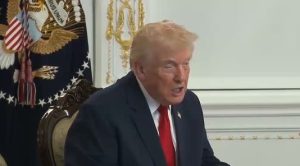
Trump’s New Security Doctrine Pits the US Against Europe
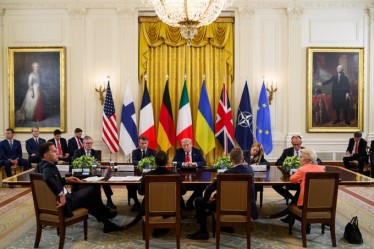
US President Donald Trump hosts Ukrainian President Zelenskyy and European allies at the White House! (Image The White House)
In his GZERO analysis, Ian Bremmer warns that Trump’s National Security Strategy marks a historic break: a weaker EU is now framed as serving US interests, leaving Europe to confront migration, defence spending and Ukraine’s war largely alone.
By TRH Foreign Affairs Desk
New Delhi, December 8, 2025 — The global debate over the United States’ new National Security Strategy (NSS) has intensified, with political scientist Ian Bremmer warning that the document represents the most dramatic rupture in transatlantic relations in decades. In a detailed analysis for GZERO, Bremmer says the strategy lays bare a historic shift: the Trump administration views a strong, united Europe as contrary to American interests.
Bremmer argues that the divergence between President Donald Trump and previous US presidents—Republican and Democrat—is clearest on Europe. For generations, NATO and the transatlantic compact were treated as Washington’s most valuable alliances. But Trump, he says, sees a “coordinated Europe” as a competitor capable of resisting American demands. “Together the Europeans are the size of the United States,” Bremmer notes, with regulatory and trade power that often clashes with Washington’s agenda.
In a striking detail, Bremmer highlights that Europe is mentioned twice as often as China in the NSS—an unprecedented indicator of where the Trump administration perceives its biggest strategic friction.
Even more startling: the Kremlin has publicly welcomed the document, aligning itself with Trump’s NSS. For Bremmer, that alone should ring alarm bells about the geopolitical consequences of weakening Europe.
Europe’s internal struggles are real—but their fix is not fragmentation
Bremmer acknowledges that European leaders themselves recognise deep structural problems—from migration mismanagement to bureaucratic paralysis and sluggish innovation. That self-critique spans the political spectrum, from France to Germany to Italy. Even EU Commission President Ursula von der Leyen has embraced tougher migration controls and regulatory reform.
But Europe’s response, he stresses, is to become stronger, not weaker. The Draghi plan for competitiveness, the shift toward tighter borders and the political rejection of “exit” movements—including France’s National Rally abandoning Frexit—reflect a broad consensus that EU strength is essential for global relevance.
Brexit’s fallout has only reinforced this view: most Britons now believe it was a mistake.
Ukraine changes everything
The NSS arrives at a moment when Europe is carrying the weight of the war in Ukraine. “The US is spending almost no taxpayer money on Ukraine now,” Bremmer says, noting that European governments are funding nearly the entire Ukrainian state and military effort. That financial leverage gives Europe influence—and veto power—over wartime outcomes, regardless of Trump’s personal diplomacy with Putin or Zelenskyy.
But with Trump advisers JD Vance and Stephen Miller driving NSS drafting and reshaping policy away from traditional Republican views, European governments are beginning to see the United States not just as unreliable, but potentially adversarial.
The coming months, Bremmer argues, will force Europe into existential decisions about autonomy, defence, and the future of NATO. The 2026 Munich Security Conference, he adds, may be the stage where Europe finally acknowledges the end of the old transatlantic era.
‘Europe Must Grow Up’: Adviser Warns Zelenskyy’s UK Visit Pitfalls
Follow The Raisina Hills on WhatsApp, Instagram, YouTube, Facebook, and LinkedIn




About The Author