Trump’s Mixed Signals to India: A Call, a Snub, and a Warning
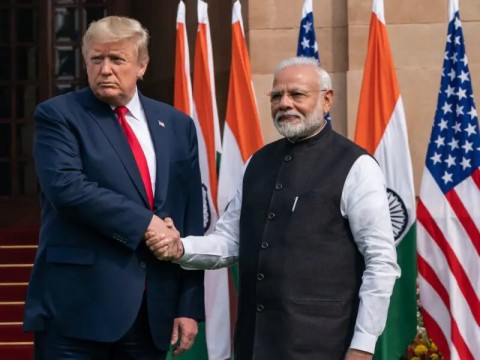
US President Donald Trump & India PM Narendra Modi (Image credit X.com, File)
Manish Anand analyses why Donald Trump’s outreach to Prime Minister Narendra Modi masks deeper fault lines—from tariffs and critical minerals to Pakistan’s military upgrade and India’s quiet exclusion from key US-led forums.
By TRH Foreign Affairs Desk
New Delhi, December 13, 2025 — A phone call can warm headlines—but geopolitics is judged by invitations, tariffs, and weapons transfers. The latest telephonic conversation between US President Donald Trump and Prime Minister Narendra Modi certainly produced a positive optic. New Delhi conveyed cooperation. Washington responded politely. Yet, beneath the diplomatic pleasantries, a series of sharp negative signals has unsettled India’s strategic community.
The contradiction is glaring: dialogue on one hand, downgrade on the other.
The Snub That Spoke Louder Than Words
Even as Trump spoke to Modi, Washington convened a strategic meeting on critical minerals, inviting Japan, South Korea, Australia, the UAE, and several others—but not India. This omission matters. Critical minerals are the backbone of future power: semiconductors, EVs, defence supply chains, and clean energy. Excluding India from such a platform is not an administrative oversight; it is a geopolitical message.
The discomfort deepens when viewed through alliance geometry. Three Quad members—the US, Japan, and Australia—were invited. India alone was left out. Similarly, in the I2U2 framework (India, Israel, US, UAE), two partners were welcomed while India was sidelined. This selective inclusion signals a recalibration, not an upgrade, of India’s place in Trump’s strategic order.
Tariffs, Pressure, and a Hard Indian Line
Trade remains the sharpest pressure point. The 50% tariff burden imposed by the US on Indian exports continues, with negotiations yielding little visible progress. America’s Trade Representative, Jamieson Greer, told the US Senate that India is a “very tough nut to crack”—a phrase that reveals frustration in Washington and firmness in New Delhi.
India, according to recent inputs, has made a conditional offer: reduce or remove tariffs on select US exports—industrial goods, apple, walnut, etc.,—but only if Washington withdraws its punitive duties, including the 25% penalty linked to India’s Russian oil purchases. New Delhi has drawn a red line: no piecemeal concessions, only a comprehensive bilateral trade agreement.
The US remains India’s largest export market, and recent data shows a dip in Indian exports. Yet India is hedging—diversifying into Asia, the Gulf, and the UAE—absorbing short-term pain to defend long-term strategic autonomy.
Pakistan’s Upgrade: The Red Flag
Nothing alarms Delhi more than Washington’s decision to approve an $800 million upgrade package for Pakistan’s US-origin fighter jets. These aircraft were used against India during Operation Sindoor.
The timing is troubling. At a moment when the US claims to see India as a “critical partner” in the Indo-Pacific, it is deepening military cooperation with Pakistan. Even the Baloch National Liberation Army has written to Trump, warning that American weapons are routinely used against civilians in Balochistan and to suppress dissent.
For India, this is not abstract geopolitics—it is a direct security concern.
Trump’s Provocative Diplomacy Meets Modi’s Swadeshi Triumphalism
Quad, Leadership, and the Missing Summit
There is another unresolved question: the Quad Leaders’ Summit. India has to host it. But without Trump’s participation, the summit cannot materialise. Delay now risks dilution. A Quad without visible US commitment weakens deterrence in the Indo-Pacific—precisely when China’s assertiveness is peaking.
Meanwhile, Trump’s National Security documents continue to describe India as indispensable. But documents do not deter adversaries—decisions do. And the decisions so far suggest hesitation, if not regression.
Mexico, Tariffs, and Proxy Pressure
Adding to the unease is Mexico’s sudden imposition of a 50% tariff on Indian goods—a move that has baffled Indian diplomats. The prevailing view in Delhi is that Washington leaned on Mexico, using indirect pressure to force India into trade flexibility. If true, it signals a harder, more transactional Trump doctrine toward India.
Signals That Don’t Add Up
The pattern is unmistakable:
– Friendly phone call
– Strategic exclusion
– Persistent tariffs
– Pakistan’s military upgrade
– Quad uncertainty
This is not alignment. It is leverage politics.
India’s diplomatic establishment is concerned not because engagement has stopped—but because clarity has vanished. Trump’s seriousness toward India appears episodic, not structural. In an Indo-Pacific that demands consistency, ambiguity is dangerous.
India is holding firm—on trade, on Russia, on strategic autonomy. But firmness alone cannot substitute for alignment. The coming months will test whether Trump views India as a partner to be empowered or a player to be pressured.
The phone call was polite. The signals were not.
Missed Opportunity? Modi’s Retreat amide Trump and Xi Detente
Follow The Raisina Hills on WhatsApp, Instagram, YouTube, Facebook, and LinkedIn




About The Author