Trump’s Jungle Raj: Will India Stand for Justice or Bow to Strength?
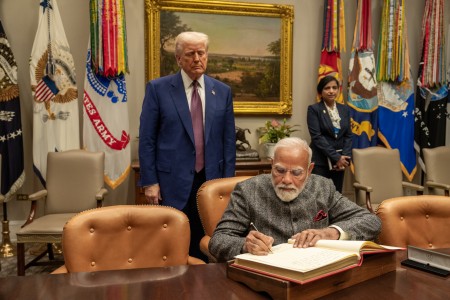
PM Narendra Modi with US President Donald Trump. Image credit White House
As Donald Trump revives brute-force geopolitics, Plato’s warning from The Republic returns to haunt the world — and India’s moral test has arrived.
By MANISH ANAND
New Delhi, January 11, 2026 — In Plato’s The Republic, written centuries before the modern nation-state was born, a disturbing argument is made through the character of Thrasymachus: justice has no intrinsic value; power does. If injustice is carried out on a large enough scale, by a strong enough ruler, it ceases to be immoral and instead becomes “masterly.”
For centuries, philosophers dismissed this as cynical rhetoric. Today, under the long shadow of Donald Trump, it is beginning to look like a doctrine of global conduct.
Welcome to what many analysts are now calling Trump’s “jungle raj” of geopolitics — a world where might openly claims moral legitimacy, borders are treated as negotiable, and silence replaces resistance.
From threats of seizing Greenland to weaponising Panama, hinting at intervention in Venezuela, bullying Mexico, and casually floating regime change in Colombia — Trump’s rhetoric is no longer diplomatic theatre. It is a declaration that power alone defines justice.
And the world is watching — quietly.
Even the United Kingdom, once the empire “on which the sun never set,” has responded with conspicuous restraint. In the British Parliament, Prime Minister Keir Starmer was publicly accused by his own MP of behaving like “Trump’s lapdog.” Yet London remains largely muted.
This silence is not accidental. It reflects a deeper, older fear — the fear Plato identified: challenging power invites consequences; applauding it ensures survival.
History’s Warning: Nixon, Kissinger and the China Gamble
This is not the first time the world has faced such a moral collapse.
In the 1970s, Peter Wehner writing in The Atlantic reminds, the United States was divided between two visions. President Richard Nixon and his strategist Henry Kissinger believed morality, human rights, and justice were expendable if power could be consolidated. Their embrace of China — ignoring Communist Party repression — transformed global economics.
China became the world’s factory. American corporations thrived. And Beijing rose to become the world’s second-largest economy.
But the cost was silence on injustice — a Faustian bargain whose consequences are still unfolding.
Ronald Reagan later reversed course, adds Wehner. “In 1988, he met Soviet dissidents, openly raised human rights violations, and insisted that power without moral restraint becomes a rogue force,” argued Wehner.
History judged Reagan kindly.
Trump’s America: Power Without Moral Brake
Today’s America appears to have forgotten Abraham Lincoln’s promise — that the United States would be the “last, best hope” for moral leadership.
Trump’s threats — turning Canada into the 51st state, redrawing borders for oil, leveraging economic coercion — point to a dangerous truth: a superpower without values behaves like a mad elephant. Unpredictable. Destructive. Unstoppable — until it is stopped.
The question is no longer about America alone.
India’s Moment of Reckoning
As India marches toward its 2047 vision of becoming a developed, powerful nation, it must answer a question history will not forgive evasion of: Will India stand with justice — or with power?
A rising India cannot afford strategic silence forever. Power demands responsibility. Global influence demands moral clarity.
If the world slips into Trump’s jungle raj, neutrality itself becomes a choice — and not a virtuous one.
China, despite being an authoritarian state, has at least articulated its opposition openly. Democratic nations, paradoxically, appear hesitant.
Where will India stand? With Plato’s Thrasymachus — or against him?
The return of brute geopolitics is not theoretical. It is unfolding in real time. Trump’s worldview revives the ancient belief that justice is merely the convenience of the strong.
India’s response will define not just its foreign policy — but its civilisational legacy.
History is watching. Silence will be interpreted as consent.
(This is an opinion piece. Views are author’s own)
From Nehru to Now: India’s Strategic Silence Faces Dharmic Test
Follow The Raisina Hills on WhatsApp, Instagram, YouTube, Facebook, and LinkedIn




About The Author