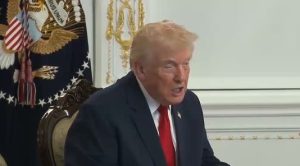
Trump’s Greenland Gambit Is Shattering the West
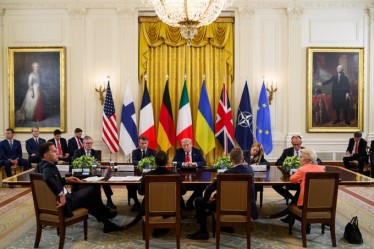
US President Donald Trump hosts Ukrainian President Zelenskyy and European allies at the White House! (Image The White House)
Trump’s Greenland crisis—leaked messages, tariff threats and imperial imagery—exposes a deep rupture in the US-Europe alliance.
By TRH World Desk
New Delhi, January 20, 2026 —Trump’s Greenland crisis has crossed a dangerous line—from provocative rhetoric into an open assault on alliance trust. What unfolded this week is not a policy debate over Arctic security, but a public unravelling of the transatlantic order, driven as much by spectacle as by strategy.
Political commentator Brian Krassenstein in a post on X captured the scale of the moment, noting that Donald Trump is now posting private messages from European foreign leaders, while simultaneously attacking the UK, circulating AI-generated images of US ownership over Canada, Greenland and Venezuela, and watching markets tumble as interest rates spike and precious metals surge. The message to allies is blunt: diplomacy is now performative, and private channels are expendable.
Strategic analyst Ian Bremmer cuts through the noise with a stark reality check. “There’s no legal way for the United States to ‘take’ Greenland short of invasion,” he argues—an option he calls implausible. The real damage, Bremmer warns, lies elsewhere: Trump is “destroying trust in the US-Europe alliance”, and on that front, “he’s making a lot of progress.” This is the true crisis—not territory, but credibility.
Trump’s own words sharpen the confrontation. In a Truth Social post, he accused the UK of “total weakness” for moving to hand over Diego Garcia to Mauritius, framing it as a national security blunder that China and Russia would exploit. He then linked this directly to Greenland, insisting that Denmark and its European allies must “do the right thing” and allow US acquisition. The subtext is unmistakable: allies comply—or face pressure.
From a structural perspective, economist and author Jason Hickel argues that this episode exposes the hierarchy within the so-called “imperial core.” According to Hickel, European leaders like Emmanuel Macron mistakenly appeal to shared Western solidarity, failing to acknowledge that the US ultimately seeks to shape—even coerce—its allies. “From the perspective of the US,” Hickel suggests, “no such core-core solidarity exists.”
The economic fallout could be severe. Analyst Theresa Fallon warns that a break with Europe would damage the US economy itself. The EU is America’s largest trading partner and the biggest source of foreign direct investment into the US. With memories of Trump 1.0 still fresh, European capitals are again discussing the EU’s Anti-Coercion Instrument—the so-called trade “bazooka.”
At its heart, Trump’s Greenland crisis is less about Arctic ice and more about ego-driven geopolitics. A bitter Nobel Peace Prize snub, maximalist territorial claims, and tariff threats have converged into a strategy that treats alliances as disposable. The result: shaken markets, alarmed allies, and a West confronting an uncomfortable question—can the transatlantic order survive its most powerful member turning against it?
Follow The Raisina Hills on WhatsApp, Instagram, YouTube, Facebook, and LinkedIn




About The Author