Trump’s Dictator Rhetoric: A 2026 Test for Modi’s Foreign Policy
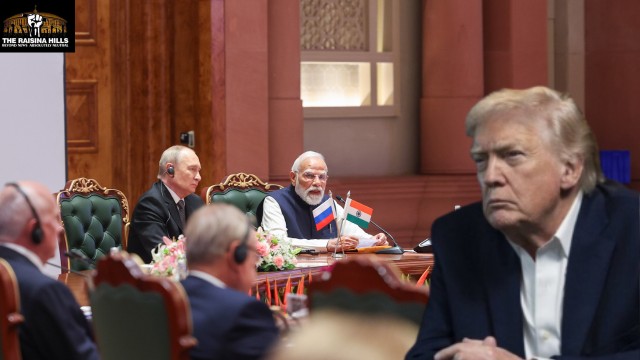
PM Narendra Modi with Russian President Vadimir Putin. (Image PMO)
As the US signals sanctions, unilateralism, and 500% tariff threats, India must reassess whether America remains a reliable strategic partner
By TRH Foreign Affairs Desk
New Delhi, January 2026 — The year 2026 has opened with disturbing signals for global geopolitics—and even sharper warnings for India. Within days of the new year, a Republican member of the US Congress proposed imposing 500% tariffs on countries continuing economic engagement with Russia despite sanctions. India, given its energy and strategic ties with Moscow, finds itself directly exposed.
This is not an isolated trade threat. “It reflects a deeper transformation in American political behaviour—one that challenges the very foundations of the rules-based international order that India has consistently supported,” said Manish Anand, a geopolitics commentator.
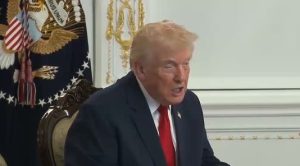
The concern intensified after US President Donald Trump told The New York Times that no law, convention, or global rule could restrain him—except his own moral values. When asked what could stop him from doing anything, his answer was chillingly simple: “My own mind.” “Coming from the leader of the world’s largest economy and most powerful military, such rhetoric is not theatrical excess. It is a strategic red flag,” added Anand.
For India, the stakes are unusually high. The US is India’s largest trading partner, with bilateral trade nearing $140 billion. Defence cooperation has expanded rapidly, and millions of Indians live and work in America. “Yet Trump-era politics—marked by sanctions threats, tariff coercion, and increasingly hostile treatment of even Green Card holders—has injected deep uncertainty into the relationship,” stressed Anand.
The timing could hardly be worse. As India prepares for its Budget Session and charts its economic priorities, signals from Washington suggest instability rather than reassurance. “For Prime Minister Narendra Modi, Modi Foreign Policy 2026 is shaping up as a stress test like no other,” warned Anand.
Seasoned observers of Trump argue that engaging him rhetorically achieves little. Trump understands only leverage. His negotiating style begins with maximalist demands—often unrealistic—and retreats only when confronted with tangible bargaining power. “The lesson for India is clear: managing the US relationship will require hard-headed realism, not sentimental assumptions about partnership,” added Anand.
This realism is already visible in India’s diplomatic posture. At the Shanghai Cooperation Organisation meeting in China, External Affairs Minister S. Jaishankar spoke of reviving the RIC framework—Russia, India, China. Once a regular summit mechanism, RIC stalled amid India-China border tensions. Its renewed mention now signals something more profound: India quietly preparing for strategic options beyond Washington.
“The uncomfortable truth is that American politics may remain inward-looking and transactional well beyond Trump. Even potential successors echo similar rhetoric. In such an environment, India cannot afford strategic overdependence on any single power,” stressed Anand.
China recognised this shift years ago. Concluding that US power would inevitably be deployed against its rise, Beijing invested in strengthening multilateral institutions and pushing for a multipolar world. “This strategic assessment partly explains China’s recent interest in stabilising relations with India,” added Anand.
A credible alternative global order cannot be built without India, China, Russia, Brazil, South Africa, Europe—and without America at its centre. “Europe’s participation, however, hinges on the end of the Russia-Ukraine war, where China holds significant leverage over Moscow and has already proposed peace initiatives,” added Anand.
India’s task in 2026 is therefore clear but difficult. “It must engage the US without illusions, deepen ties with reliable partners like France and Germany, maintain pragmatic relations with Russia, stabilise ties with China where possible, and actively shape a multipolar, rules-based order that does not depend on American goodwill,” added Anand.
Trump’s rhetoric is aimed less at global governance and more at domestic political mobilisation. “India should recognise it as such—and plan accordingly. Strategic autonomy is no longer a choice. It is becoming a necessity,” noted Anand.
Elon Musk’s Grok Limits ‘Sexualizing’ Image Feature to paid Users
Follow The Raisina Hills on WhatsApp, Instagram, YouTube, Facebook, and LinkedIn




About The Author