Trump’s Beijing Gamble: ‘Global Rebalancing’ in US-China Ties?

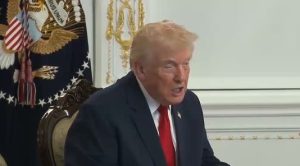
US President Donald Trump with Chinese President Xi Jinping. (Image video grab)
Ahead of April summit, Washington shifts from tariff coercion to G7 pressure as $1 trillion China trade surplus debate intensifies
By TRH World Desk
New Delhi, February 11, 2026 — When Donald Trump lands in Beijing this April, the optics will matter as much as the substance. The former tariff warrior now returns to a relationship that his own Treasury Secretary, Scott Bessent, describes as being in a “very comfortable place.”
Comfortable — but competitive.
Bessent’s remarks, shared on Wednesday through a video message, signal a recalibration in the Trump China trade strategy. The language is no longer about decoupling. Instead, it is about “de-risking,” reclaiming sovereignty in strategic industries, and forcing what Washington calls “global rebalancing.”
Translation: the tariff hammer alone did not deliver structural change.
For years, Trump’s economic doctrine rested on bilateral pressure — punitive tariffs aimed at shrinking America’s trade deficit with China. Yet Beijing’s trade surplus has only ballooned, hovering near the politically explosive $1 trillion mark. Manufacturing migration has been partial. Supply chains have diversified — but not decisively severed.
Now the strategy appears to be shifting. Rather than framing the imbalance as a purely bilateral grievance, Washington is internationalising it. Bessent’s reference to IMF Article IV consultations and G7 “global rebalancing” suggests the US wants multilateral validation. The message is clear: China’s export-heavy model is not just an American problem — it is a systemic one.
This pivot matters. If tariffs were blunt instruments, multilateral pressure is a subtler lever. By framing China’s surplus as destabilising global demand and strategic supply chains — from semiconductors to critical minerals and medicines — Washington is attempting to shift the onus onto global institutions.
Yet contradictions remain. The US insists it does not want decoupling. It claims rivalry should be “fair.” At the same time, it is subsidising domestic chips, reshoring pharmaceuticals, tightening tech controls, and asserting dominance in AI. Bessent confidently declares America is “winning the AI race.”
Beijing hears something else: containment.
The April summit will test whether “de-risking” is merely semantic softening or genuine strategic moderation. China’s leadership will resist being lectured via the G7 or IMF. And it will argue that America’s own fiscal deficits and consumption patterns contribute to global imbalances.
Competition may sharpen both economies. But coercion — even multilateralised coercion — rarely builds trust.
Trump’s Beijing visit is not just about trade numbers. It is about whether rivalry can coexist with stability in a world too interconnected for clean economic divorces.
The tariff era sought shock therapy. The rebalancing era seeks legitimacy. Whether either produces equilibrium remains an open question.
Matt Gaetz Warns: China Uses Hollywood for Strategic Leverage
Follow The Raisina Hills on WhatsApp, Instagram, YouTube, Facebook, and LinkedIn




About The Author