Trump Venezuela Takeover Doctrine: ‘Drill Baby Drill’

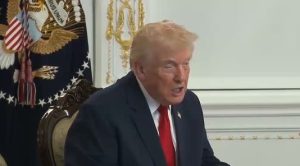
US President Donald Trump addresses a press conference after military attacks on Venezuela. (Image White House on X)
As US oil giants prepare to enter Venezuela, Trump signals prolonged control, larger strikes, and a Panama-style precedent that bypasses Congress
By TRH Foreign Affairs Desk
New Delhi, January 3, 2026 — US President Donald Trump’s remarks on Venezuela leave little room for ambiguity. The United States, he says, will “run the country” until a “safe, proper and judicious transition” is achieved. There is no timeline. No mention of elections. And no pretence that Washington intends to step aside anytime soon.
What is unfolding is not a limited intervention. It is the articulation of a new Trump Doctrine—one that openly links military force, regime control, and the transfer of strategic national resources into American corporate hands.
Oil at the Center of the Strategy
Trump has been blunt about Venezuela’s oil sector. Calling it “a bust”, he argued that the country was pumping “almost nothing” compared to its potential. His solution is unapologetically transactional: America’s largest oil companies, Trump said, will enter Venezuela, spend billions of dollars, repair the “badly broken infrastructure”, and begin “making money for the country.”
But the structure of that statement matters. The country that will benefit first is not named. The operators are American. The capital is American. The control, by Trump’s own admission, will be American.
Venezuela, home to the largest proven oil reserves in the world, is no longer being discussed as a sovereign state—but as a distressed asset awaiting acquisition.
“We’re Ready for a Much Larger Wave”
Trump’s warning of a second, “much larger” wave of strikes confirms that Washington is prepared to escalate militarily if resistance emerges. This is occupation logic, not crisis management.
The message to Caracas—and to the world—is stark: compliance ensures reconstruction under US supervision; defiance invites overwhelming force.
The Panama Precedent Returns
US journalist Ken Dilanian has pointed to a critical historical parallel. In 1989, President George H. W. Bush ordered the invasion of Panama to arrest Manuel Noriega without prior Congressional authorization. Congress was informed only after the operation had begun.
Bush justified the action on grounds now being echoed by Trump: protecting US personnel, enforcing criminal charges, and restoring order.
That precedent matters. It suggests that the Venezuela operation is not an aberration, but a revival of executive war powers—where Congress becomes an afterthought and legality is asserted retroactively.
Running a Country, Not Protecting One
Trump’s words are revealing not only for what they say, but for what they omit. There is no talk of multilateral oversight, UN mandates, or regional consensus. Instead, there is direct language of control, administration, and economic restructuring.
“We don’t want to be involved with having somebody else get in,” Trump said.
In plain terms, Washington is not backing a transition—it is managing one, indefinitely.
A Signal to the World
This moment will resonate far beyond Venezuela.
For energy markets, it signals a potential reassertion of US dominance over oil supply chains.
For global politics, it marks a shift away from liberal interventionism toward open resource-driven power projection.
For smaller states, it raises a chilling question: what happens when internal collapse meets external appetite?
Venezuela is no longer just a crisis. It is a test case for how power will be exercised in the coming decade—directly, unapologetically, and backed by force.
Venezuela Oil Geopolitics: Next 72 Hours Could Rewire Geopolitics
Follow The Raisina Hills on WhatsApp, Instagram, YouTube, Facebook, and LinkedIn




About The Author