Trump–Modi Trade Deal Signals a Reset in India–US Ties
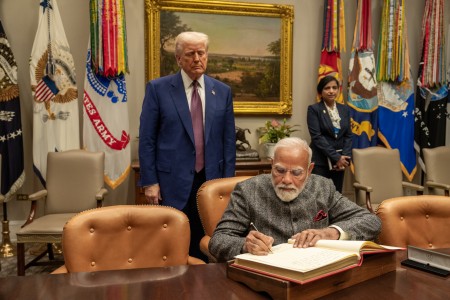
PM Narendra Modi with US President Donald Trump. Image credit White House
Reduced Tariffs, Strategic Alignment, and the Politics Behind a Headline-Grabbing Pact
By S JHA
Mumbai, February 3, 2026 — A single social media post has done what months of closed-door negotiations could not—announce a dramatic reset in India–US trade relations.
US President Donald Trump, posting on his Truth Social, declared that Washington and New Delhi had agreed to a trade deal reducing reciprocal tariffs on Indian goods entering the United States from 25 per cent to 18 per cent, while India would move to lower its own tariffs and non-tariff barriers “to zero.”
Prime Minister Narendra Modi swiftly confirmed the breakthrough on X, calling Trump a “dear friend” and welcoming the reduced tariff regime for Make in India products. Modi went further, publicly backing Trump’s global leadership and peace initiatives—language that signals political alignment, not just commercial convenience.
At one level, the deal is transactional. Trump’s post makes clear that the US expects India to sharply increase purchases of American energy, technology, agricultural goods, coal, and manufacturing products—over and above the already substantial trade flows. The emphasis on “BUY AMERICAN” fits squarely within Trump’s long-standing economic nationalism.
At another level, however, the announcement carries unmistakable geopolitical undertones. Trump linked the trade deal to a broader global realignment—criticising Russian oil purchases, naming Venezuela, and explicitly framing India as a preferred partner in a world of tightening blocs. Modi’s response, praising Trump’s leadership on global peace and stability, reinforces that this is as much about strategic signalling as tariffs.
For India, the immediate upside is clear. An 18 per cent tariff ceiling improves competitiveness for Indian exporters across textiles, engineering goods, pharmaceuticals, and manufactured products at a time when protectionism is rising globally. The messaging around “unprecedented heights” reflects New Delhi’s calculation that access to the US market remains indispensable for sustaining growth.
Yet questions remain unanswered. Trump’s post offers no legal text, no timelines, and no safeguards. It is a political declaration—powerful, headline-grabbing, and deliberately maximalist. Whether India’s promise to reduce non-tariff barriers to zero can survive domestic political and bureaucratic resistance is an open question.
What is undeniable is the tone. This is not the language of incremental diplomacy. It is the language of deal-making at scale, where economics, elections, and geopolitics blur into one.
The Trump–Modi trade deal may still need fine print. But as a signal, it is loud and clear: India and the United States are willing to align openly—economically and politically—at a moment when global trade is fragmenting and strategic loyalties are being tested.
Modi vs Trump Tariffs: How India Quietly Recalibrated Strategy
Follow The Raisina Hills on WhatsApp, Instagram, YouTube, Facebook, and LinkedIn




About The Author