Trump Greenland Deal: Europe’s Capitulation Under Pressure
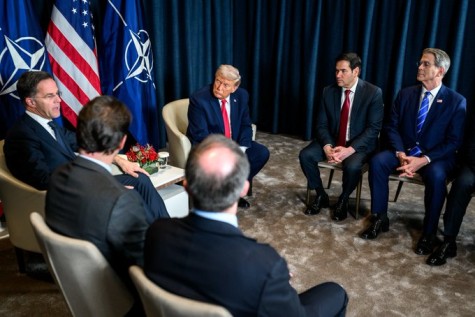
US President Donald Trump with NATO officials (Image The White House)
Reports of Greenland sovereignty concessions raise alarm over Europe’s credibility and consent
By TRH World Desk
New Delhi | January 22, 2026 — Reports emerging from diplomatic and media sources suggest that European leaders have explored a framework with US President Donald Trump that could allow Washington expanded control over limited areas of Greenland for military purposes. If confirmed, the development would mark a profound shift in transatlantic power dynamics and raise serious questions about sovereignty, consent, and democratic accountability.
According to The New York Times, President Trump’s decision not to impose new tariffs on European Union members followed a NATO meeting on Wednesday. The report said senior military officials discussed a possible compromise in which Denmark would permit the United States to exercise sovereignty over specific, demarcated areas of Greenland to enable the construction of American military facilities.
Trump, speaking at the World Economic Forum in Davos, stated that he had a “framework of a deal on Greenland.” While emphasizing that the United States would not use force, he also indicated that a rejection of American proposals would carry consequences—remarks that analysts have interpreted as diplomatic pressure rather than negotiation.
Danish officials have not publicly confirmed any agreement, and there has been no indication that Greenland’s elected leadership or population has formally consented to such an arrangement. This absence of clarity has intensified debate across Europe, where critics argue that strategic expediency is once again overriding principles of sovereignty and self-determination.
The New York Times further reported that NATO officials framed the proposal as a response to mounting security concerns in the Arctic, particularly amid heightened tensions with Russia. Under the reported framework, Washington would assume responsibility for building and operating military infrastructure in Greenland, strengthening US presence in the High North.
In Davos, Trump also drew a controversial historical parallel, noting Denmark’s rapid defeat during World War II—remarks that were widely viewed as politically provocative rather than historically instructive.
Adding to the geopolitical tension, Russian President Vladimir Putin referenced past US territorial acquisitions, including Alaska, and Denmark’s 1917 sale of the Virgin Islands to Washington, suggesting that territorial transactions have historical precedent. His remarks were interpreted by analysts as an effort to underscore European vulnerability at a moment of visible strategic uncertainty.
Trump has since spoken of incorporating Greenland into a broader “Golden Dome” security architecture, reinforcing the perception that Arctic territory is becoming a central arena of great-power competition.
Whether the reported framework evolves into a binding agreement or collapses under legal and political scrutiny, the episode has already exposed deep fissures in Europe’s strategic autonomy—and revived uncomfortable questions about how power, pressure, and consent operate in the modern international order.
Follow The Raisina Hills on WhatsApp, Instagram, YouTube, Facebook, and LinkedIn




About The Author