Trump, Greenland and NATO: Ex-Aid Decodes Trumpian Bullying
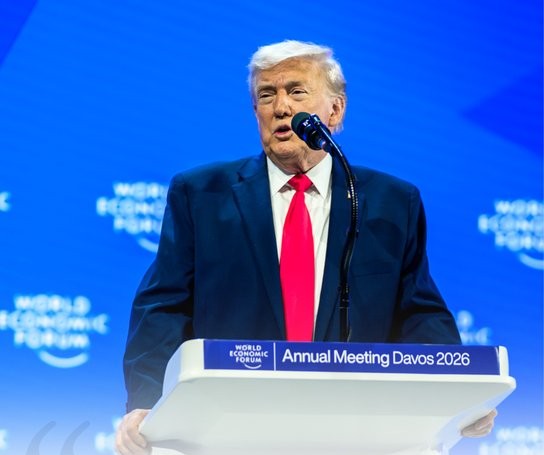
US President Donald Trump at Davos (Image The White House)
Trump’s Arctic ambitions may be strategic—but his rhetoric is shaking European trust, warns former NSA H.R. McMaster
By TRH World Desk
New Delhi, January 22, 2026 — Speaking to CBS News after US President Donald Trump’s combative appearance at Davos, former US National Security Adviser H.R. McMaster offered a rare insider’s assessment of Trump’s worldview—one that helps explain both America’s strategic intent and Europe’s growing alarm.
“What you saw today was like every day for me in the Oval Office from 2017 to 2018,” McMaster said, suggesting that Trump’s Davos remarks were not an aberration but a familiar pattern.
According to McMaster, Trump’s objectives are often strategically sound. His focus on economic growth, deregulation, manufacturing revival, resilient supply chains, and border security has been consistent. So too is his insistence on greater burden-sharing within NATO.
On Greenland, McMaster acknowledged that Trump’s concern over Arctic security is legitimate. “China and Russia clearly have designs on dominating the Arctic,” he said, noting Greenland’s strategic importance for missile defence and early warning systems.
But the problem, McMaster argued, lies not in the goal—but in the method.
“The way to achieve that objective is to be a champion of sovereignty,” he said, stressing that Denmark’s sovereignty and the rights of Greenlanders must be protected, not questioned. Any suggestion of taking Greenland by force, McMaster warned, would be “an affront” to a NATO ally.
Denmark, he reminded viewers, stood firmly with the United States after 9/11. In fact, McMaster noted, Denmark suffered one of the highest per-capita casualty rates in Afghanistan, fighting alongside US forces against the Taliban and jihadist terror groups.
McMaster also took direct issue with Trump’s claim that NATO has never truly stood with America. “That is simply not accurate,” he said. Article 5—the alliance’s collective defence clause—was invoked only once in history, after the 9/11 attacks.
While McMaster conceded that Trump is right about Europe’s historic underinvestment in defence, he emphasised that NATO remains a net strategic gain for Washington. Combined NATO defence spending, excluding the US, far exceeds Russia’s military budget, he noted.
“NATO makes America stronger,” McMaster said, pointing to rapid deployments, forward-based forces, and overflight rights that enabled US operations in Afghanistan within weeks of 9/11.
Yet the most serious damage, he warned, may be intangible. “The hardest thing to rebuild is trust,” McMaster said, cautioning that aggressive rhetoric and public disparagement risk eroding the transatlantic bond at a time when the free world faces coordinated pressure from China and Russia.
Trump, McMaster concluded, often walks back his most provocative statements toward more rational outcomes. But in geopolitics, words linger—and trust, once weakened, is slow to return.
Follow The Raisina Hills on WhatsApp, Instagram, YouTube, Facebook, and LinkedIn




About The Author