Trump at Davos on Greenland: A Return to Raw Power Politics
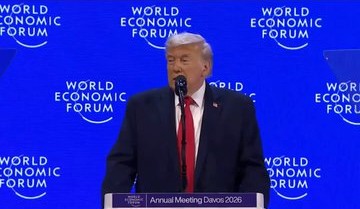
US President Donald Trump at World Economic Forum, Davos on Wednesday (Image The White House)
By declaring Greenland a core US security interest, Donald Trump revived an old American doctrine—one that challenges allies, redraws sovereignty, and redefines NATO’s burden-sharing.
By TRH World Desk
New Delhi, January 21, 2026 — US President Donald Trump’s speech at Davos was vintage Trump—provocative, historically revisionist, and strategically blunt. But beneath the rhetorical bravado lay a serious geopolitical signal: Greenland, in Trump’s worldview, is no longer merely Danish territory—it is a frontline of American national security.
Expressing “tremendous respect” for the people of Greenland and Denmark, Trump nonetheless delivered a harsh verdict on NATO allies: they are incapable of defending their own territory. Greenland, he argued, sits exposed at the crossroads of American, Russian, and Chinese strategic interests—vast, underdeveloped, and effectively undefended.
Trump’s historical framing was deliberate. He invoked World War II, recalling Denmark’s rapid fall to Nazi Germany and the subsequent US military presence in Greenland. America, he claimed, fought not only for Denmark but for its own hemispheric security, establishing bases and preventing enemy footholds “at great cost and expense.” Returning Greenland after the war, Trump suggested, was an act of generosity—one Denmark has since failed to adequately acknowledge.
The tone then shifted from history to warning.
According to Trump, the world today faces far greater threats—from missiles, nuclear weapons, and advanced warfare systems. Referencing a recent US operation in Venezuela, he boasted of American military superiority, claiming adversarial systems “made by Russia and China” failed spectacularly. The message was unmistakable: US power deters, allies hesitate.
Crucially, Trump dismissed the idea that Greenland’s value lies in minerals or rare earths. The ice-covered terrain, he said, makes extraction impractical. Instead, its true worth is strategic. Greenland, he stressed, is geographically part of North America—“our territory” in all but name—and central to a centuries-old US policy of preventing external threats from entering the Western Hemisphere.
This framing reopens an uncomfortable question for NATO and Europe: Does alliance solidarity override national sovereignty when security interests diverge?
Trump’s remarks echo a long-standing American impulse to purchase or control Greenland—but delivered in a world defined by renewed great-power rivalry. What was once an eccentric idea now sounds like a doctrine.
At Davos, Trump did not merely talk about Greenland. He reminded allies that in his America-first calculus, security trumps sentiment—and history justifies power.
Follow The Raisina Hills on WhatsApp, Instagram, YouTube, Facebook, and LinkedIn




About The Author