Time for India to Lead? Trump’s Drift Reopens the Quad Question
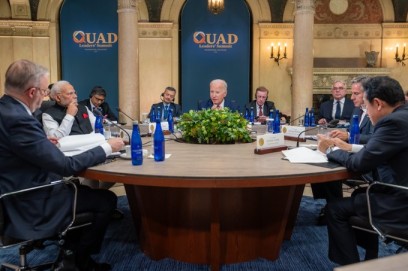
Image credit X.com @Potus
As Donald Trump courts China and retreats from the Indo-Pacific, India faces a stark choice: wait for Washington or reimagine a Quad 2.0 without it.
By TRH Foreign Affairs Desk
New Delhi, December 14, 2025 — Is the moment finally here for India to stop waiting—and start leading? That question no longer sounds speculative. It sounds urgent.
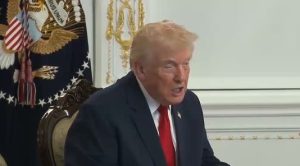
The evolving posture of US President Donald Trump suggests a strategic withdrawal not just from global leadership but specifically from the Indo-Pacific. Trump’s visible tilt toward China, his diminishing interest in alliances, and Washington’s silence on regional flashpoints have raised uncomfortable questions about America’s reliability as a partner.
The signs are difficult to ignore.
India was conspicuously not invited to an upcoming US-convened meeting on critical mineral. At the same time, trade pressure mounted—including a 50 per cent tariff move routed via Mexico. Together, these actions feed a growing perception in diplomatic circles that the current US approach risks isolating India rather than anchoring it.
This has consequences for the Quadrilateral Security Dialogue.
With just days left in 2025, the much-anticipated Quad leaders’ summit in New Delhi has not materialised. Quietly, diplomats acknowledge that Trump’s unpredictability has frozen momentum. Ironically, the Quad was never a US idea to begin with. It was conceived by Japan’s late Prime Minister Shinzo Abe—a leader who foresaw China’s expanding military and strategic footprint across the Indo-Pacific and South China Sea.
Today, that challenge is sharper than ever.
Japan is uneasy, especially after China attempted to intimidate its new prime minister over remarks on Taiwan—while Washington stayed silent. Australia remains anxious about Chinese naval presence in its waters. India, with an unresolved and volatile land border with China, needs no reminder of the risks, particularly after Ladakh 2020 and four years of military eyeball-to-eyeball confrontation.
The reality is blunt: no major power is willing to openly confront China. Least of all the US, whose economy is deeply intertwined with Chinese capital—over $200 billion invested across critical American sectors. Washington cannot afford a clean break with Beijing.
So what should India do?
One option is to imagine a Quad 2.0—a rebalanced quadrilateral where India, Japan and Australia remain constants, but the fourth pillar changes.
France appears unlikely, given its careful courtship of China. Canada, however, stands out.
Ottawa is a developed economy with financial strength, technological capability, Indo-Pacific interests, and growing friction with Beijing over alleged Chinese interference in its domestic politics. Canada has already signalled intent through cooperation with India and Australia on critical minerals at the G20 sidelines in South Africa.
That could be the first stepping stone.
A reconfigured Quad—India, Japan, Australia and Canada—could focus on critical minerals, financial coordination, and strategic resilience to counter China’s dominance in supply chains and capital flows.
The question now is political.
Will Prime Minister Narendra Modi consider this moment as an opportunity—or let it pass?
Trump’s Mixed Signals to India: A Call, a Snub, and a Warning
Follow The Raisina Hills on WhatsApp, Instagram, YouTube, Facebook, and LinkedIn




About The Author