‘Tiger Is Still Alive’: How Nitish Kumar Won Most Stunning Mandate
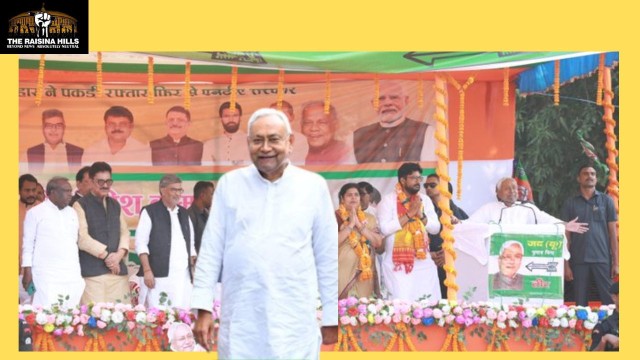
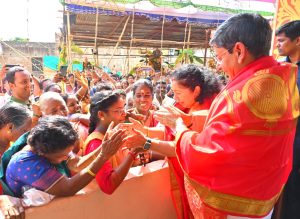
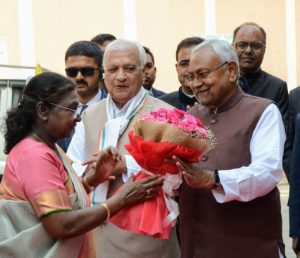
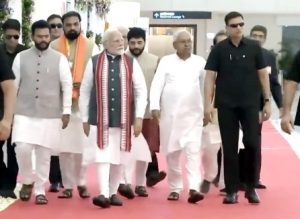
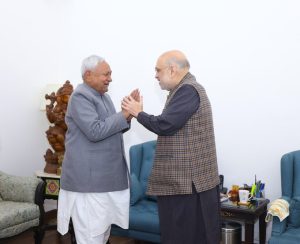
Bihar Chief Minister Nitish Kumar during election campaign. (Images X.com)
A sweeping win for the JD(U)-BJP alliance has revived Nitish Kumar’s political aura, with his ₹10,000 women’s transfer scheme, EBC empowerment, and coalition chemistry seen as decisive forces behind Bihar’s unexpected verdict.
By TRH Political Desk
Patna, November 14, 2025 — Bihar’s election verdict has delivered a political message few saw coming: Nitish Kumar—at 74—is still the central axis of the state’s politics.
As journalist Manish Anand puts it, “Tiger abhi zinda hai.”
Despite months of speculation about his health and rumours of a fading political presence, Kumar has led the JD(U)–BJP alliance to an extraordinary victory—one that has rewritten expectations and electoral arithmetic. The JD(U), which won just 43 seats in 2020, is poised to cross 80 seats this time, while the BJP is set for its biggest-ever haul of around 90 seats in the state.
This is more than a coalition win—this is a mandate with Nitish Kumar’s imprint all over it.
A Mandate With One Signature Scheme at Its Core
Manish Anand argues that one decision transformed the election: the ₹10,000 direct transfer to 1.35 crore women in Bihar.
As long as the campaign lasted, cash flowed into beneficiaries’ accounts in batches. If each beneficiary influenced even two other voters in her home, Anand estimates that the scheme alone may have shaped up to 3.5 crore votes—a staggering number in a state long shaped by welfare and social mobility politics.
The opposition cried foul, yet the impact was unmistakable: women across castes and districts credited Nitish Kumar for immediate financial relief.
The Most Unexpected Verdict in Years
No poll, no political analyst, no party war room predicted what happened. The Mahagathbandhan—spread across RJD, Congress, CPI(ML), CPI, VIP and allies—collapsed to just 28 seats in a 243-seat assembly. The NDA, by contrast, is projected to cross 200 seats.
Anand calls the result “apratyashit”—so unexpected that even BJP leaders privately admit that the Nitish factor lifted their fortunes dramatically.
The Nitish Formula: Women, EBCs, and a 25-Year Social Engineering Arc
Nitish Kumar’s political architecture has always rested on two pillars:
- Women as the Most Loyal Political Constituency
From cycles for schoolgirls (2007) to scholarships, from ₹50,000 for graduation to prohibition—women have been at the heart of his model.
- Prohibition, despite an estimated ₹40,000 crore revenue loss, remained untouched because women strongly supported it.
- SHGs under the Jeevika programme produced a vast network of loyal women voters.
- Empowerment of EBCs and Marginalised Castes
Nitish did what Mandal-era leaders did not: He politically elevated smaller castes—EBCs, Mahadalits, non-dominant OBCs—and made them stakeholders in power.
This social engineering changed Bihar’s caste hierarchy, weakening traditional strongholds of big castes like Yadavs.
As Anand notes, “Chhoti jaatiyon ka sashaktikaran… became Nitish Kumar’s permanent seat of power.”
Alliance Chemistry That Worked to Perfection
Elections are often discussed in terms of arithmetic—but Anand stresses that the chemistry mattered more:
- JD(U)’s women, EBC, Mahadalit vote transferred seamlessly to BJP.
- LJP(RV) transferred the Paswan vote.
- No sabotage between allies.
- Nitish Kumar’s team monitored booth-level coordination relentlessly.
The Modi–Nitish partnership, restored after several political shifts, clicked at the right moment.
The Other Variable: Bihar’s Massive Voter Roll Purge
The Special Intensive Revision (SIR)—in which 65 lakh voter entries were deleted—remains a political talking point.
Opposition leaders claim it skewed the electorate, while the Election Commission maintains it was a routine purification.
While the debate continues, the verdict is clear: Bihar voted in a way no one predicted.
‘Tiger Is Still Alive’—And Bihar’s Politics Still Orbits Him
In a state known for swift political shifts, Nitish Kumar has once again proved he remains the indispensable centre of power.
Since 2005, he has survived party splits, alliance jumps, ideological storms, and years of anti-incumbency.
What explains this longevity?
A durable vote base built on welfare, social engineering, and law-and-order credibility—and a political instinct unmatched in contemporary Bihar.
As Anand concludes: “Bihar ka jo chunav hai, uska kendriya bindu koi aur nahi—sirf Nitish Kumar hai.”
Whatever direction Bihar’s politics takes next, one thing is now certain: the tiger is, indeed, still alive.
Follow The Raisina Hills on WhatsApp, Instagram, YouTube, Facebook, and LinkedIn




About The Author