


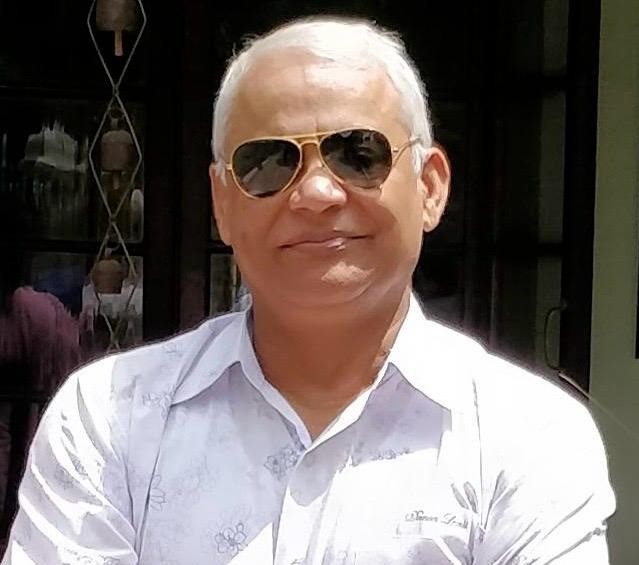
INTERVIEW: Retired Army commander Lt Gen Abhay Krishna says in an interview with NIRENDRA DEV that paper leaks thrive because society creates a market for them, while discussing Atmanirbhar Bharat, defence manufacturing, AI, Gen Z and social media algorithms.
Lt Gen Abhay Krishna (Retd) served as Commander of Eastern Command, Central Command and South Western Command. He has vast experience in man-management, developmental projects, and matters related to science, IT tools and algorithms
Nirendra Dev: We have all heard about ‘Azadi Ka Amrit Mahotsav’ and ‘Atmanirbhar Bharat’. These are two slogans of New India and the Modi era. Yet, there are problems. There is joblessness and many other challenges. The so-called NEET paper leak and the protests in July shook the government’s foundation. One minister resigned; the Leader of the Opposition was lifted and left injured. Are you, as a retired soldier, perplexed or anguished?
Lt Gen Abhay Krishna (Retd): Your question is a googly for me. I hardly understand politics. But I am perturbed by the manner in which things have turned out. Why should there be a question paper leak at all, and that too repeatedly?
NEET is just one of them. Essentially, all these things are happening because, as citizens, we encourage paper leaks. The wrongdoers know there is a good market. They can make fortunes and are confident that the money they make from the notorious deal can be used to suppress the case and investigation even if they are caught.
The stringent law that has now come handles only one part of the problem — punishment and the judicial process. But what about the prevailing greed in society?
The greed to make your child a doctor? Why? To serve society and heal people? No. You want to buy a medical seat and a question paper today because tomorrow you want to loot people in hospitals?
Nirendra Dev: Maybe I could provoke you. You are angry at many things. First of all, at our society.
Lt Gen Abhay Krishna (Retd): Of course, I am feeling disturbed. The youths and their anger are all part of society. They are the streams. But what is the source of the stream?
In the Army, we have a different culture. Prime Minister Narendra Modi ji often talks about it: Nation First. If you implement that spirit, all problems can be solved.
Nirendra Dev: What about the terms ‘Azadi Ka Amrit Mahotsav’ and ‘Atmanirbhar Bharat’?
Lt Gen Abhay Krishna (Retd): I will come to that. Atmanirbhar Bharat is the vision of our Prime Minister. Under this, the defence sector finally got a long-awaited big boost. This big push was given under a clear and well-planned roadmap, treating it as a critical sector for boosting the Indian economy. This will bring self-reliance.
Next, if you recall, when the nation celebrated its 75th year of Independence, we called it ‘Azadi Ka Amrit Mahotsav’. It was a time to cheer up. In 2014, when the new government came to power, the country started to witness a decisive roadmap unfolding towards Viksit Bharat.
Even after the coronavirus pandemic, India managed to become the fastest-growing major economy globally, surpassing even China. In 2022-23, I think the GDP was $3.37 trillion, and our defence- and technology-related exports touched Rs 13,000 crore.
Many countries were obviously unnerved. So, certain things behind the curtain started happening in India. We saw the same pattern growing in Bangladesh, Nepal and Sri Lanka.
Nirendra Dev: So, you are pleased with the manner in which things were handled?
Lt Gen Abhay Krishna (Retd): I will tell you this way. The government is telling the wrongdoers: “Hello, dear; beware of stealing question papers in future.”
I think our government has taken a correct and decisive step to protect the future of India’s students. This will go a long way in protecting and upholding the merit-based system. And the new law will make it clear that those who “corrupt and make the system dirty” and subject it to manipulation by unfair means will face the harshest consequences.
Nirendra Dev: You once said technology is the backbone of any military power and also the economic strength of a nation. What is your take on this in 2026? We have AI making waves and people are losing jobs. We still have miles to go in many areas, such as defence manufacturing.
Lt Gen Abhay Krishna (Retd): I agree to a large extent with what you are saying. As far as I know, we are the third-largest in defence spending. It is true that, over a period of time, India slowly developed a number of ordnance factories, several laboratories, R&D centres and so on. But we still continued to remain one of the largest importers of defence equipment.
This is a critical paradox. The armed forces of all developed countries have been rapidly enhancing their defence capabilities for many decades.
Both the US and China are already way ahead of all the countries in the world. But somehow, India did not remain as focused until 2014 onwards.
‘Operation Safed Sagar’: When Kargil War History Meets Netflix Fiction
Nirendra Dev: What about initiatives such as ‘Make in India’?
Lt Gen Abhay Krishna (Retd): (Smiles) I have a different name for this. I call this ‘the route to progress’.
The big push to ‘Make in India’ is a reality for all of us to see, with defence exports having risen to almost eight times what they were just five or seven years ago.
India is now seen as an emerging major arms supplier at the international level, and we are making arms for ourselves too. Imports have been reduced. The government has also handled middlemen well. The Prime Minister did accept the indispensability of agents for defence imports, so now these agents have to register themselves. (Smiles)
Nirendra Dev: Maybe you can talk a bit about defence production corridors and states showing deep interest.
Lt Gen Abhay Krishna (Retd): Yes, that’s correct. In 2018, the Government of India took a major policy decision to set up two defence production corridors, one each in Uttar Pradesh and Tamil Nadu.
Gujarat then came with a request. I would say, taking a similar great initiative, the states of Maharashtra, Telangana, Andhra Pradesh and Karnataka, too, have come forward to set up defence manufacturing hubs.
I see this development as a revolutionary step. It ensures jobs and improves the economy too. These certainly contribute to the growing indigenous arms exports.
Nirendra Dev: Lastly, maybe I can ask you about terms such as Gen Z and the power of social media and algorithms.
Lt Gen Abhay Krishna (Retd): This is a vast subject. India’s demographic structure and youth population are very large. Therefore, there is an unprecedented concentration of political and social power in the hands of a single cohort.
The age group roughly corresponding to Gen Z, that is, those aged between 14 and 29 years in 2026, actually numbers approximately 407 million.
This is 28% of our national population and is larger than the entire population of the US.
Look here, when hundreds of millions of young people devote this volume of attention each day to algorithmically curated feeds, then we must not ignore one disturbing fact: the content that reaches them is not a neutral reflection of reality. It is the product of systems engineered to maximise engagement and to “guide and misguide” them.
Nearly Double the MPs? Analyst Says Delimitation Push Is Self-Interest Dressed as Reform
Follow The Raisina Hills on WhatsApp, Instagram, YouTube, Facebook, and LinkedIn




