The West on Test: China Scholar on Trump’s New Monroe Doctrine

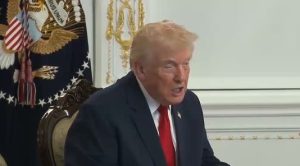
US President Donald Trump addresses a press conference after military attacks on Venezuela. (Image White House on X)
Yan Xuetong warns that a New-Era Monroe Doctrine could shatter democratic peace theory and permanently weaken Western legitimacy
By TRH Foreign Affairs Desk
New Delhi, January 16, 2026 — The most unsettling critique of the West’s current trajectory is not coming from Washington or Brussels—but from Beijing.
Chinese international relations scholar Yan Xuetong, as analysed by James Farquharson in Sinification, dismisses fashionable slogans such as “the East is rising and the West is declining” as intellectual fantasies. Yet he delivers a far more devastating judgment: that the West may be destroying itself from within, not through military defeat but through a collapse of legitimacy.
At the centre of Yan’s argument is Donald Trump’s revived and radicalised New-Era Monroe Doctrine. What began historically as a hemispheric warning against European colonialism has mutated into something far darker—an assertion of imperial entitlement. Under Trump, Yan argues, the United States is no longer behaving as a republic anchored in law, but as an empire driven by coercion.
This shift has two consequences.
Domestically, the routine bypassing of Congress for military operations marks a transition toward what Yan calls a semi-dictatorial state. The debate inside America is no longer whether such interventions are wise, but merely whether they are legal—a revealing downgrade of democratic norms.
Internationally, the consequences are more explosive. Trump’s military intervention in Venezuela, conducted without congressional approval and framed rhetorically as “law enforcement,” signals a rejection of national sovereignty as a governing principle. The objective, Yan argues, is not regime change alone, but fear—turning Latin America into a US-centric tributary system, forcing regional states to decouple from China and Russia.
Yet the real rupture may come closer to home.
Yan takes seriously what many Western analysts dismiss: the power of norms. The West’s coherence rests on the democratic peace theory—the belief that democracies do not attack one another. If the United States were to use military coercion against Greenland, a territory linked to a democratic ally, that foundational myth would collapse overnight.
Such an act would not merely fracture alliances; it would shatter Western self-belief. Americans would no longer see their country as a pillar of the rules-based order. Europeans would no longer trust that shared values offer protection. The damage, Yan suggests, would be irreversible.
Unlike other Chinese scholars who frame the West as a racial or civilisational bloc, Yan sees it as an ideological construction—and therefore fragile. Once the fantasy breaks, no amount of rhetoric can restore it.
The irony is stark. In trying to restore American dominance, the New Monroe Doctrine may succeed only in accelerating the end of the very idea of “the West.”
Trump, Greenland, and the Alliance Test: Whither World Order?
Follow The Raisina Hills on WhatsApp, Instagram, YouTube, Facebook, and LinkedIn




About The Author