The Sikh Conversion Surge That Has the Sangh Worried
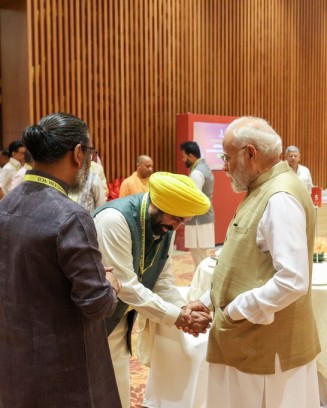
PM Narendra Modi with Punjab CM Bhagwant Mann at Niti Aayog Governing Council Meeting (Image credit X)
Growth of evangelical activity in Punjab kicks the political tremors with the RSS working strategy to stem the shift.
By NIRENDRA DEV
New Delhi, December 10, 2025 —Punjab is once again at the centre of a quiet churn—one that has nothing to do with farm unrest, militancy, or electoral volatility. Instead, it is a demographic undercurrent that has begun unsettling the state’s political, social, and religious actors: the sharp rise in conversions to Christianity among Sikhs and Dalits.
For years, public debate in India has been dominated by questions of Islamophobia, Muslim marginalisation, and the politics of identity. But conversion trends, especially in Punjab, offer a different twist in the narrative.
Globally, a shift is visible: a growing number of Muslims embracing Christianity. David Garrison’s study A Wind in the House of Islam described it as the “greatest historic turning” of Muslims to Christianity, estimating 2–7 million converts in two decades.
In India, the phenomenon is not primarily Muslim—it is unfolding in the Sikh-majority pockets of Punjab with a speed few anticipated.
Reports suggest that in Gurdaspur district alone, Christian population numbers rose by more than four lakh in five years. In Tarn Taran, the community grew by 102 percent over a decade. Numbers may vary depending on the source, but the trendline is unmistakable.
A Dainik Jagran report earlier this year claimed that over 3.3 lakh people converted in Punjab within two years, with about 1.5 lakh converting in 2023–24 alone. For a state where Sikh identity is foundational, this has triggered alarm in both religious circles and the Sangh Parivar.
Punjab Bachao Andolan president Tejasvi Minhas went so far as to announce a ₹2 lakh reward for information on what he calls “illegal conversions.” According to him, pastors and “self-styled godmen” are “targeting poor Dalit Hindus and Sikhs,” offering faith-healing, miracles, and emotional support structures that the state and mainstream institutions have long failed to provide.
Indians, pluralistic by nature, would one day revolt against CAA: Islamic scholar
Evangelical activity has expanded. Many Punjabi villages now host one or two Christian families, with over 65,000 missionaries active, according to some estimates. The rise of home-based churches is especially visible in Amritsar, Pathankot and Dhariwal. Even Jat Sikhs, traditionally steeped in Sikh institutions, are reportedly setting up church committees.
Christian organisations deny the allegations and say right-wing groups are exaggerating numbers to polarise the atmosphere. “This is a ploy to divide peace-loving people,” says Sanwar Bhatti of the United Church of Northern India Trust Association.
But what has caught the attention of the Sangh Parivar is not just the growth, but the strategic method behind it.
Christian groups often refer to the “10/40 Window”—a global missionary term for the region between 10° and 40° North latitude, stretching across Asia, the Middle East, and North Africa. This area is considered the world’s most concentrated zone of non-Christians and “unreached people.” Punjab falls squarely within this arc.
RSS and BJP leaders are increasingly studying these operational models. Some Sikh Jathedars are already in conversation with Sangh affiliates about the scale and methods of evangelical penetration.
Punjab Movement ‘Vehan’ Raises People’s Voice over Water Crisis
The Modi government’s national-level response has taken a different shape. Through stricter scrutiny under the Foreign Contribution Regulation Act (FCRA), thousands of organisations lost their foreign-funding licences. In 2015 alone, around 10,000 licences were cancelled, including those of Greenpeace, Ford Foundation, and 20 Christian organisations.
In 2022, when Oxfam India’s FCRA renewal was denied, the NGO warned of severe disruption to humanitarian work. To critics, this is evidence of the state tightening the screws on Christian networks. To supporters, it is a necessary regulatory clean-up.
It is also politically relevant. The BJP’s long-term expansion plan includes making inroads into regions historically dominated by minorities or regional forces—Goa being one example. Managing the conversion narrative feeds into this broader strategic vision.
But the matter is undeniably complex. Economic distress, caste hierarchies, and lack of social mobility push many Dalits toward new faiths that promise dignity and institutional support. Simultaneously, Sikh institutions worry about erosion of identity. And the Sangh Parivar sees conversions as both an ideological threat and a political challenge.
Punjab’s conversion surge is not merely a religious trend. It is a socio-political flashpoint with implications for identity, caste mobility, national politics, and even foreign relations. Whether the trend stabilises or intensifies will depend not only on legislation and surveillance but on whether mainstream institutions can address the deeper vulnerabilities that make conversions appealing.
(This is an opinion piece. Views are the author’s own.)
Follow The Raisina Hills on WhatsApp, Instagram, YouTube, Facebook, and LinkedIn




About The Author