The ₹1.6 Lakh Crore GST Fraud: Weighing Fake-Invoice Empire
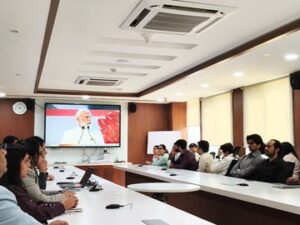
Delhi traders hold a meeting on GST cuts (Image X.com)
From dummy firms to “invoice factories,” enforcement records reveal a nationwide tax scam industrial complex—evolving faster than India’s ability to crush it.
By P. SESH KUMAR
New Delhi, December 12, 2025 — If one wants a single, readable “case-trail” of how GST’s most abused pressure points—Input Tax Credit (ITC) and refunds—have been exploited, the public record gives a remarkably consistent story. It is not a story of one-off cheats; it is a story of industrialised fraud, where the “goods” are often imaginary, the invoices are the only merchandise, and the real cargo is ITC—passed like contraband through layers of dummy GSTINs until it lands inside a genuine taxpayer’s ledger or gets converted into a refund claim.
The most reliable, attributable record comes from official enforcement communications and Parliamentary disclosures, supplemented by mainstream reporting. In July 2020, for instance, the DGGI publicly described the classic template: issuance of invoices without actual supply, detected through data analytics that grew out of a broader anti-fraud operation focused on fraudulent IGST refunds on the strength of ineligible ITC-and it explicitly stated that a case was booked against three firms for tax evasion of more than ₹600 crore.
By September 2021, the machinery had become more confident about going after the “facilitator ecosystem”. DGGI Gurugram announced arrests in a racket built around fictitious firms, forged documents, commission agents, and even professional enablers, claiming fake ITC of ₹121 crore and moving to arrest the mastermind, the commission agent and a chartered accountant.
This matters because it signals an enforcement pivot from merely catching “users” of fake invoices to disrupting the supply chain that manufactures them. In January 2022, the Mumbai zone’s Palghar Commissionerate described another large “invoice factory”: bogus billing of over ₹1,000 crore linked to ITC fraud of ₹181 crore, culminating in an arrest.
Then, in April 2022, Maharashtra’s State GST department announced the arrest of a proprietor for generating and utilising fraudulent ITC of ₹14 crore through bogus invoices of ₹102 crore-smaller in value, but vital as evidence that states were also using criminal provisions, not merely raising demands.
The summer of 2022 reads like a drumbeat. In July 2022, the Central GST Commissionerate in the Mumbai zone said more than 20 fake entities were used to evade GST through fake invoices of ₹585 crore and reported two arrests.
A month later, CGST Mumbai (South) publicly stated it had busted a fake invoice racket involving ₹455 crore and announced an arrest, in a case where bogus invoices were used to claim and pass inadmissible ITC without actual supply or receipt of goods. Then comes the scale story that only Parliament can put beyond dispute.
In an official reply placed on the record in January 2024, the Government reported that 29,273 bogus firms involving suspected ITC evasion of ₹44,015 crore had been detected during a drive against fake registrations, with revenue protection through blocking of ITC and recoveries, and with arrests made.
It also broke out a quarter-specific figure: 4,153 bogus firms involving suspected ITC evasion of ₹12,036 crore, with a stated number of arrests and central-state detection split. This is crucial because it establishes that the phenomenon is not episodic; it is structural and nationwide, spanning both central and state enforcement.
Refund misuse, too, surfaces periodically in the public record-often through corruption and facilitation angles. A high-profile example was the Maharashtra ACB-linked case described in the public domain as a ₹175-crore GST fraud/refund scam, with multiple accused being booked.
While the procedural fate of arrests can vary in court, the case itself illustrates the uncomfortable truth: refund fraud often needs a gatekeeper failure-either a weak system control, a compromised official process, or both. By November 2025, the story returns to “platform-enabled mass fraud”.
The DGGI Delhi Zonal Unit publicly described a network involving 229 dummy firms and fraudulent ITC of ₹645 crore, with the alleged mastermind arrested. It is hard to read that figure without drawing one conclusion: the fraud ecosystem does not merely survive enforcement; it adapts, scales, and reappears-because the economic incentives remain huge and the detection-to-conviction pipeline remains slow.
The 10×Illusion: A Critical Review of GST 2.0’s Self-Eulogies
Finally, in December 2025, the Government disclosed in the Rajya Sabha (as reported in major media) that 55,813 GST evasion cases amounting to ₹1,60,950 crore were detected over the preceding three years and seven months, with a large share linked to fake invoicing and dummy entities-precisely the ecosystem that fuels wrongful ITC and, in many designs, refund extraction.
This is the “aerial view” that frames all the individual case-stories above: the fraud is not scattered; it is a repeating architecture. How These Frauds Actually Work-and How DGGI/State GST Typically Detect Them What looks like “ITC misuse” in a show-cause notice is usually the final symptom of a carefully staged supply chain theatre.
The fraudster’s first move is to create the illusion of commerce-through layers of registrations, often using compromised identities, rented premises, and disposable mobile numbers. The second move is to generate invoices that create ITC in the ledger without corresponding movement of goods.
The third move is to “launder” that ITC-either by passing it through multiple entities so that the trail becomes noisy, or by injecting it into a real business that can utilise it against output tax. The refund variant adds a fourth move: use the paper-ITC to support refund claims (including designs historically seen in IGST refund abuse), or manipulate the refund processing chain through forged documentation and facilitation failures.
The public enforcement releases repeatedly describe these elements in different words-“issuance of invoices without supply,” “fake entities,” “bogus bills,” “passing on inadmissible ITC,” “fraudulent refunds”—but the core architecture remains the same.
Detection, too, has a recognizable rhythm. The strongest cases usually begin not with a raid but with data analytics-pattern recognition across registrations, return filing behaviour, invoice networks, and transport trails. Investigations often snowball from one suspect exporter, one high-risk registrant, or one abnormal return/refund behaviour into an entire graph of linked entities, as official releases have explicitly acknowledged.
Once a network is mapped, enforcement typically looks for corroboration points that collapse the “paper supply chain”: absence of physical business activity at declared premises, lack of stock capacity, non-existent transporters, circular payments, improbable turnover spikes, and return anomalies where outward supplies do not match the story told in invoices.
Where the facilitation angle emerges, agencies widen the net toward commission agents and professional intermediaries, as seen in the September 2021 arrests.
A Short Decoder: What “Criminal Action” Really Means Under GST Law
In GST enforcement parlance, phrases such as case booked, FIR filed, complaint launched, arrest made and prosecution initiated are often used interchangeably in media reports-but legally, they mark very different stages of the criminal process.
A “case booked” usually means that an offence has been formally recorded by the GST department under the CGST/SGST Acts after preliminary investigation, often followed by summons and statements. An FIR is lodged when the matter is taken to the police framework, typically in cases involving conspiracy, forgery, money laundering or corruption alongside GST offences.
An arrest under GST law is a strong coercive step permitted only for specified cognisable and non-bailable offences-such as fraudulent ITC availment or passing beyond statutory thresholds-and requires the Commissioner’s authorisation.
Prosecution begins only when a formal complaint is filed before a competent criminal court after sanction, and this is the stage at which the case enters the long judicial pipeline. Crucially, detection or arrest does not imply guilt; conviction depends on sustained prosecution, evidentiary rigor and judicial scrutiny—an area where GST enforcement is still building track record.
Understanding this distinction is essential to avoid mistaking headline-grabbing arrests for final outcomes, and to appreciate why systemic fixes matter as much as enforcement muscle. The reason criminal cases become visible to the public is that arrests and “case booked” announcements are used as deterrence signals.
But the deeper governance lesson is this: as long as controls remain fragmented across registration, invoicing, returns, e-way bills and refunds, fraud networks will keep finding the seam to cut through. The enforcement record of the last five years shows capacity and intent; it also shows that the ecosystem is large enough to regenerate unless systemic integration tightens continuously.
(This is an opinion piece, and views expressed are those of the author only)
Follow The Raisina Hills on WhatsApp, Instagram, YouTube, Facebook, and LinkedIn




About The Author