Suresh Kalmadi: Fungus of Corruption That Ate Political Credibility
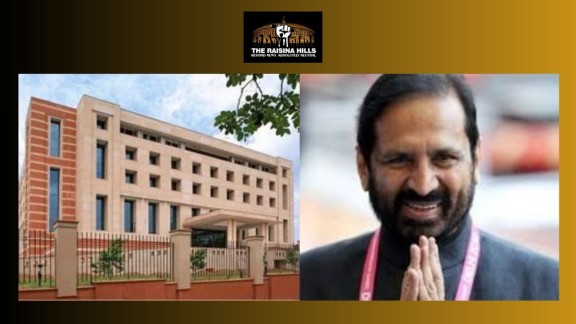
CAG Building in New Delhi and Suresh Kalmadi (Image credit LinkedIn)
From fighter pilot to fallen sports czar, Suresh Kalmadi’s collapse mirrored a decade when corruption hollowed out India’s politics and governance
By NIRENDRA DEV
New Delhi, January 7, 2026 — If politics and power can be ruthless, they can also be unforgiving. Few public lives illustrate this better than that of Suresh Kalmadi—a former Indian Air Force fighter pilot who rose to national prominence, only to end his career as a symbol of an era overwhelmed by corruption.
Born in 1944, Kalmadi began his professional journey in the Indian Air Force. He flew fighter aircraft and served the nation during both the 1965 and 1971 wars, a credential that once gave him moral authority and public respect. From the cockpit, he transitioned into politics and sports administration, representing the prestigious Pune Lok Sabha constituency as a Congress leader and serving as a Union minister.
For a period, Kalmadi enjoyed proximity to power. He was considered close to former Prime Minister late P.V. Narasimha Rao, and later emerged as a dominant figure in Indian sports administration. As president of the Indian Olympic Association (IOA) for a considerable time, he wielded enormous influence during years when Indian sport was seeking global recognition.
That ascent, however, ended in a dramatic collapse.
The Commonwealth Games and the breaking point
The 2010 Commonwealth Games in Delhi were meant to be a showcase of India’s arrival on the global stage. Instead, they became shorthand for excess, mismanagement, and alleged corruption on a massive scale. The scandal did not merely tarnish the event; it shattered Kalmadi’s public standing beyond repair.
On 25 April 2011, the Central Bureau of Investigation arrested Kalmadi in the Timing, Scoring and Results (TSR) case. He was charged under Sections 120B (criminal conspiracy) and 420 (cheating) of the Indian Penal Code. Less than a month later, on 20 May 2011, the CBI filed its first chargesheet, naming him as the principal accused in the award of the TSR contract to a Swiss firm.
The chargesheet stated bluntly that Kalmadi exercised “supreme overriding powers” within the Commonwealth Games Organising Committee. That line alone captured why his fall was so steep. Power that had once protected him now isolated him.
Soon after his arrest, the Congress party suspended his membership. On 26 April 2011, he was removed as IOA president. In July 2013, he lost the presidency of the Asian Athletics Association, a post he had held uninterrupted for 13 years. The political influence, institutional control, and prestige that once defined him vanished in quick succession.
Those close to him say he felt devastated—and perhaps believed he had been made a scapegoat for systemic failures far larger than one individual.
A scandal that defined a political climate
Kalmadi’s downfall did not occur in isolation. It came at a time when India’s governance record was under unprecedented international and domestic scrutiny. Around the same period, Time magazine described former Prime Minister late Manmohan Singh as an “underachiever,” while The Washington Post labelled him a “tragic figure.”
The Commonwealth Games scandal became one chapter in a much larger story.
India was rocked by a cascade of corruption allegations—2G spectrum allocation, coal block allocations (Coalgate), irregularities in airport privatisation, housing scams for war widows, and questionable defence and infrastructure deals. The Comptroller and Auditor General (CAG) estimated notional losses running into tens of billions of dollars. In Coalgate alone, a 2010 CAG report spoke of potential losses amounting to US$37 billion.
The political response often worsened public distrust. When then Finance Minister P. Chidambaram argued that there was “no loss” in coal allocations because mining had not yet begun, it deepened the perception of denial rather than accountability.
Arun Jaitley, then Leader of the Opposition in the Rajya Sabha, summed up public anger when he declared that corruption in coal block allocations “ended at the Prime Minister’s doorstep.”
When corruption becomes systemic
What made that period particularly damaging was not just the number of scandals, but their breadth. Corruption appeared embedded across ministries, sectors, and institutions. Ministers resigned. Senior officials were jailed. Yet the damage to credibility proved irreversible.
The fungus of corruption, as many described it, had eaten into all spheres of public life. Kalmadi’s case became emblematic—not necessarily because it was the largest, but because it involved sport, nationalism, and global prestige.
By the time India went to the polls in 2014, the Congress party’s moral authority stood eroded. The electoral verdict that brought the BJP back to power was as much a rejection of that scandal-ridden decade as it was an endorsement of change.
A cautionary memory
Suresh Kalmadi will be remembered not merely as an individual who fell from grace, but as a cautionary memory of how power, when unchecked, corrodes both institutions and individuals. His life traces a tragic arc—from war veteran to political heavyweight, from national organiser to a man politically isolated.
History may yet debate the proportionality of blame. But public memory is unforgiving. And in that memory, Kalmadi’s name remains inseparable from an era when corruption hollowed out trust and changed the course of Indian politics.
(This is an opinion piece. Views expressed are author’s own)
Follow The Raisina Hills on WhatsApp, Instagram, YouTube, Facebook, and LinkedIn




About The Author