Statecraft: Why Left-Wing Ideas Still Run India—Even Under Modi
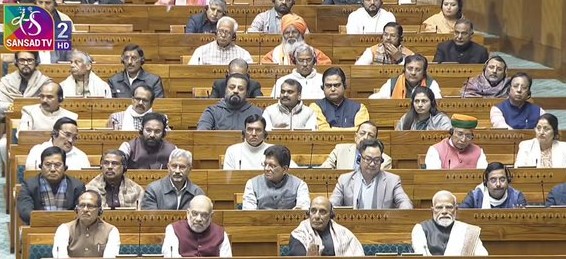
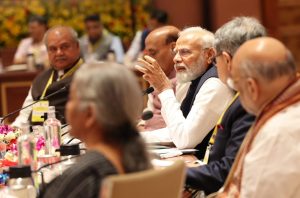
Prime Minister Narendra Modi during Budget presentation (Image Sansad TV)
From the ‘entrepreneurial state’ to equity politics, India’s governance remains captive to ideas it never voted for
By RAVI SHANKER KAPOOR
New Delhi, February 6, 2026 — In The Kashmir Files, a Left-wing professor delivers a line that struck a nerve far beyond cinema halls: “Sarkar chahe kisi ki bhi ho, system to hamara hai (Whoever runs the government, the system belongs to us).”
It sounded like cinematic exaggeration. It wasn’t.
Nearly twelve years into Narendra Modi’s prime ministership, Left-wing ideas still dominate Indian governance—not because communists are secretly sabotaging the state, but because their ideas have become the default operating system of Indian politics, across parties and ideologies.
The Indian Left may be electorally marginal. But intellectually, it has won.
We Are All Leftists Now
Communism as a political force is fading. Communism as an idea is thriving. Like a slow-acting toxin, it has seeped into India’s economic thinking, welfare architecture, academic regulation, and moral vocabulary.
Every major political party—Congress, regional outfits, and even the supposedly right-wing BJP—has internalised socialist assumptions reflexively. Markets are mistrusted. Private enterprise is morally suspect. The state is imagined as benevolent, omniscient, and indispensable.
The Economic Survey 2025–26, tabled by Finance Minister Nirmala Sitharaman, proves the point.
The Myth of the ‘Entrepreneurial State’
The Survey openly embraces the Leftist concept of the “entrepreneurial state,” popularised by economist Mariana Mazzucato. It argues that uncertainty requires the state to “structure risk,” act before certainty emerges, and experiment like an entrepreneur.
This is not bold thinking. It is conceptual confusion dressed up as sophistication. The state cannot be entrepreneurial without becoming corrupt.
Entrepreneurship is about risk, reward, discipline, and failure. The state, by definition, spends other people’s money, absorbs no personal risk, and rarely faces consequences for failure.
When business and state merge, cronyism is not an accident—it is the outcome.
India has lived this nightmare before. In the pre-liberalisation era, success belonged not to efficient producers but to those who mastered bureaucratic navigation. Politicians and babus, guided by socialist economists, throttled growth while entrenching poverty.
Calling that system “entrepreneurial” does not redeem it. It resurrects it.
Corruption Is the System’s Natural Companion
Defenders argue that today’s India is different—cleaner, smarter, digitally monitored. That confidence is misplaced.
In December, the Comptroller and Auditor General of India flagged massive weaknesses in the Direct Benefit Transfer system, with thousands of crores flowing without mandatory verification due to siloed data and weak oversight.
Dozens of Skill India centres face police cases. Nearly 180 training partners were found non-compliant under PMKVY schemes. These are not glitches. They are symptoms of a state that is overextended and under-disciplined.
An “entrepreneurial state” in such an ecosystem is not visionary. It is an open invitation to rent-seeking.
Equity: The Other Trojan Horse
The entrepreneurial state is not the only Left-wing import shaping policy. “Equity” has already crossed from jargon into law.
The UGC’s Promotion of Equity Regulations, 2026 triggered turmoil within the BJP ecosystem because they expose a deeper contradiction. Equity masquerades as equality but is its opposite.
Equality is about equal opportunity. Equity is about equal outcomes. The latter demands perpetual intervention—endless reservations, coercive redistribution, and ideological policing. It is the logic behind DEI regimes in the West and identity-based governance in India.
The United States, under Donald Trump, is dismantling DEI precisely because it corrodes merit and social cohesion. India, meanwhile, is institutionalising it—without debate, clarity, or philosophical grounding.
The Right Without Ideas
The tragedy is not that the Left dominates ideas. It is that the Indian Right has none of its own.
The Sangh Parivar speaks of “integral humanism,” but slogans are not philosophy. Without a coherent worldview, governance becomes improvisation. Power becomes the end, not the means.
In such a vacuum, Left-wing ideas fill the space—not because they are superior, but because they are available.
This is how a nationalist government ends up running a social-democratic state, preaching markets while expanding bureaucratic control, opposing socialism rhetorically while implementing it administratively.
A Reckoning Awaits
Ideas have consequences. The Modi government’s selective adoption of Left-wing frameworks—entrepreneurial state, equity, expansive welfare—will eventually collide with economic reality. When that happens, it will not be cinema dialogue that explains the failure. It will be policy choices made without intellectual courage.
The system does belong to someone. And unless India confronts the ideas running it, elections alone won’t change that.
(This is an opinion piece. Views expressed are author’s own. This article is brought in a collaboration with The Hindu Chronicle.)
Follow The Raisina Hills on WhatsApp, Instagram, YouTube, Facebook, and LinkedIn




About The Author