Snow, Suits, and Self-Congratulation: India at Davos Explained
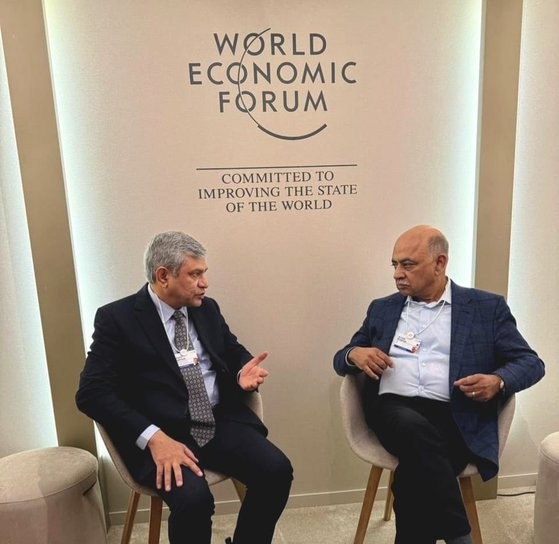
Union Minister Ashwani Vaishnaw in conversation with Arvind Krishna, CEO of IBM (Image Vaishnaw on X)
Why India’s Davos pilgrimage flatters political power, amplifies the ‘India story’, but rarely fixes India’s real governance problems
By P. SESH KUMAR
New Delhi, January 28, 2026 — Every January, when snow blankets a quiet Swiss ski town, India’s political leadership and senior civil servants descend upon Davos for the annual conclave of the World Economic Forum. The optics are grand—global leaders, CEOs, policy mandarins, and media all packed into one elite amphitheatre.
But a nagging question refuses to go away: what exactly are Indian politicians and bureaucrats seeking in Davos? Are they hunting for solutions to India’s pollution, poverty, inequality, governance deficits, and geopolitical anxieties-or merely polishing India’s brand before a global audience?
When Indian ministers and civil servants land in Davos, they do not arrive as pilgrims in search of wisdom. They arrive as salesmen, narrators, and occasionally cheerleaders of the “India story.” The brochures may have gone digital, but the pitch remains familiar: India is open for business, India is reforming, India is stable, scalable, and strategic. State chief ministers tout land banks and policy incentives; secretaries speak the language of ease of doing business, digital public infrastructure, and demographic dividends. The mood is confident, sometimes triumphalist. Yet Davos was never designed to be a clinic for national soul-searching, and it shows.
The annual jamboree organised by the World Economic Forum is not a problem-solving workshop for individual countries. It is a networking bazaar where influence circulates faster than insight. Panels on climate change, inequality, artificial intelligence, or geopolitical risk rarely descend into the messy institutional specifics that plague countries like India-municipal capacity collapse, regulatory capture, weak contract enforcement, polluted rivers, or politicised welfare delivery. Davos conversations are high-altitude by design; India’s problems are stubbornly ground-level.
To be fair, Indian delegations do not go there pretending otherwise. They are not seeking Swiss formulas for Delhi smog or Gangetic pollution. Nor are they expecting Davos to hand them a blueprint for social cohesion in a diverse, argumentative democracy of 1.4 billion people. What they seek instead is validation-confirmation that India is on the “right side” of global capital flows, supply-chain reconfiguration, and strategic realignment away from China. In that narrow sense, Davos serves a purpose. It reassures investors already inclined towards India and provides a platform to signal continuity and predictability.
But here lies the first uncomfortable truth. Davos rarely changes investor behaviour; it mostly amplifies decisions already made elsewhere. Capital does not move because a minister spoke eloquently on a panel. It moves because contracts are enforceable, courts are predictable, regulators are competent, and infrastructure works on the ground. No number of Davos memoranda of understanding can compensate for stalled projects, retrospective taxation scares of the past (Vodafone and Tiger Global cases would haunt), or the quiet fear of policy whimsy. The deals announced amid Alpine snow often melt away by the time summer arrives back home.
The second truth is more political. Davos offers Indian politicians a global stage largely free of domestic accountability. At home, they face Parliament, audit scrutiny, media interrogation, and voters. In Davos, they face applause, curated questions, and friendly moderators. Civil servants, too, find Davos attractive because it allows them to speak in the idiom of global best practice without being immediately confronted by India’s implementation gaps. It is easier to discuss climate finance in Davos than to explain why Indian cities cannot even price water rationally.
Does this mean Davos participation is pointless? Not quite. The soft gains are real, if modest. Indian officials use Davos to sense global mood swings-on interest rates, trade fragmentation, ESG fatigue, technology regulation, or geopolitical risk. These informal signals do not come neatly packaged in official communiqués. They are picked up in corridor conversations, closed-door breakfasts, and side meetings. For a country increasingly embedded in global supply chains, such situational awareness has value.
Yet the asymmetry remains stark. Davos does far more for India’s image than for India’s governance capacity. It flatters the political executive while bypassing the harder institutional reforms that actually determine outcomes. Pollution is not solved by panels; it is solved by empowered city governments and credible regulators. Social inequality is not bridged by narratives; it is narrowed by quality public education, health systems, and fair taxation. Geopolitical leverage is not earned through applause lines; it is built through economic resilience, technological depth, and diplomatic consistency.
There is also a deeper cultural mismatch. Davos thrives on consensus language, while India thrives on contestation—the cacophonous democracy that we have. Davos prefers sleek narratives; India advances through noisy, incremental compromise. Expecting Davos to “solve” India’s problems is like expecting a glossy annual report to fix a leaking factory roof.
Wanted Self-Awareness
India does not need to stop going to Davos—but it does need to go with clearer self-awareness and tighter discipline. Participation should be lean, purposeful, and outcome-linked, not a ritualistic migration of delegations. Every Davos pitch must be backed by domestic follow-through that investors can verify without PowerPoint. Civil servants attending Davos should treat it less as a validation stage and more as an intelligence-gathering exercise, translating global signals into actionable domestic reform agendas. Most importantly, India must resist the temptation to confuse global applause with national progress. Davos can amplify a strong story, but it cannot write one. That task remains firmly—and unglamorously—at home.
(This is an opinion piece. Views expressed are author’s own.)
Follow The Raisina Hills on WhatsApp, Instagram, YouTube, Facebook, and LinkedIn




About The Author