Sixteen Years Without Jyoti Basu: Bengal’s Long Shadow
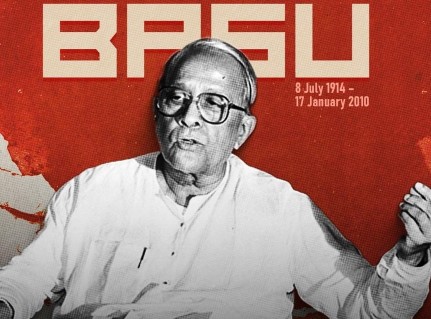
Former West Bengal Chief Minister Jyoti Basu. (Image CPI M on X)
As West Bengal’s politics fractures and the Left fades into irrelevance, revisiting Jyoti Basu’s legacy reveals how pragmatism, power, and paralysis reshaped Bengal’s destiny.
By NIRENDRA DEV
New Delhi, December 17, 2025 — In January 2026, West Bengal will complete sixteen years without Jyoti Basu. It is a milestone that invites reflection—not nostalgia alone, but a hard political audit. For as long as Basu occupied the writer’s chair in Writers’ Buildings, Bengalis appeared to take a collective pause from voting him out. The Left was finally ousted in 2011; Basu did not live to see that verdict.
Today, as Bengal’s politics is once again in fierce debate, revisiting Jyoti Basu’s legacy is not merely an academic exercise. It is essential to understanding how the state arrived at its present condition—politically polarised, economically hesitant, and ideologically exhausted.
In 2021, the communists could not even open their account in the West Bengal Assembly. That collapse makes Basu’s era appear even more extraordinary. A stalwart of the much-fractured communist movement, Basu was a devout Marxist whose socialism was tempered by pragmatism. That distinctive blend came to be known as Jyotism.
Basu ruled West Bengal continuously for over 23 years—a record unmatched in Indian federal politics. He first became chief minister in 1977, in elections held simultaneously for the Assembly and Parliament. The question before Bengal’s voters then was not Marxism versus non-Marxism; it was whether to punish the Congress for the Emergency. Basu became the beneficiary of that historic backlash.
There were, of course, many explanations for his longevity. One was the infamous phenomenon of “scientific rigging,” widely acknowledged and widely believed. The term has returned to political discourse today in a cruder form as “vote chori.” Yet allegations alone do not build durable regimes. Basu’s endurance rested on deeper structural weaknesses of his opponents.
After the death of B.C. Roy in 1963, the Congress never produced a truly mass-based leader in Bengal. Pranab Mukherjee, despite his national stature, remained a High Command loyalist and a Rajya Sabha politician for most of his career. His first Lok Sabha victory came only in 2004—the year he famously missed becoming prime minister. Basu, by contrast, cultivated a direct emotional bond with Bengal’s electorate.
He was, in many ways, the last living link between Bengalis and a bygone era. Voters saw in him the legacy of Deshbandhu C.R. Das and, sentimentally, even Netaji Subhas Chandra Bose. Basu belonged to a rare generation of Indian politicians whose careers began before the end of British rule. Educated at Presidency College and trained in law in England, Jyoti Kiran Basu emerged from privilege into radical politics—much to the horror of his respectable medico father.
Over 23 years in power, Basu achieved much and failed spectacularly. He brought land reforms to a largely feudal countryside, redistributing land-wealth in a manner that made the Left electorally invincible for decades. He also brought political stability to a previously chaotic state.
Yet his stamp on urban Bengal proved far more damaging. Kolkata remained a lovable city, but one denied the prosperity visible in other Indian metros. Anti-industry politics, union militancy, goondaism, and dada-giri defined the era. Global firms like IBM were shown the door. Bengal’s loss became Bengaluru’s gain.
‘Should I laugh at the death of people’; Netai killings pained Buddhadeb Bhattacharjee
Even under his successor Buddhadeb Bhattacharya, the Left’s labour unions continued to raise wage demands on firms already under strain, worsening industrial flight. According to senior bureaucrats, a compliant administrative culture thrived, reinforced by chief secretaries perceived as either ideologically sympathetic or reluctant to confront party interests. Alongside formal governance, there emerged a parallel ecosystem of “street cadre”—officials and sympathisers operating beyond institutional accountability.
In death, Basu was assessed with rare clarity. The Guardian wrote in 2010 that while he remained an idol to workers and peasants, he ultimately became a symbol of statist rigidity despised by the MBA generation. That verdict has aged well.
Ironically, the politics Basu created eventually delivered Bengal to Mamata Banerjee. Her long stint in power carries many chapters of non-performance, with Muslim appeasement becoming its most controversial feature—an electoral strategy that, it must be noted, also existed during the Basu years. Syndicates have replaced dada-giri; industrial decay continues; investor confidence remains fragile.
Sixteen years on, Jyoti Basu’s legacy is neither heroic nor villainous. It is cautionary. He showed how pragmatism could sustain ideology, how power could mask paralysis, and how electoral invincibility could coexist with economic decline. Bengal is still living in that long shadow.
Follow The Raisina Hills on WhatsApp, Instagram, YouTube, Facebook, and LinkedIn




About The Author