Scapegoats, Spectacles, and the Cost of Optics at the AI Summit
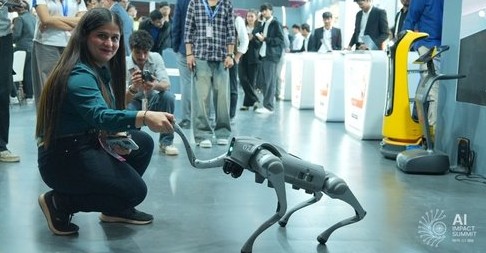
Galgotias University pavilion at AI Impact Summit in New Delhi (Image X.com)
As the Galgotias University AI Summit controversy spirals, questions shift from one professor to institutional accountability and event oversight
By Sidharth Mishra
New Delhi, February 19, 2026 — In the predictable aftermath of controversy, institutions often look for individuals to bear the weight of collective misjudgments. The recent uproar surrounding Galgotias University’s presence at the AI Summit appears to be following that familiar script.
At the centre of the storm is Neha Singh, a Professor of Communication, who has been portrayed in some quarters as the face of an alleged embarrassment. Yet, a calmer assessment suggests that such criticism may be profoundly misplaced.
By most reasonable standards, Singh appears to have performed the task assigned to her. Her role was neither to conceptualise cutting-edge robotics nor to engineer technological marvels. She was entrusted with a communications function: to present the university’s stall, engage audiences, and manage perceptions. That she did so with composure, even amid a rapidly escalating digital controversy, speaks more to professional competence than culpability.
To hold a communication professional responsible for the design and technical content of an exhibition stall is to misunderstand both organisational hierarchies and functional roles. Decisions about what to display, be it a robotic dog or any other showpiece, are rarely made at the level of a faculty member tasked with narration. Such choices are typically determined by institutional management, marketing teams, or external vendors. In this sense, Singh’s narrative was not of her own making; she was interpreting a script rather than authoring one.
This naturally raises a more pertinent question: if blame must be assigned, should it not travel upwards? The metaphorical “scriptwriter” in this case would be the university’s management, those who approved the stall’s concept, curated its content, and assessed its potential impact. But even this line of critique demands nuance.
Private, self-financing universities operate under relentless financial and competitive pressures. Unlike publicly funded institutions, they depend heavily on student enrolments for survival and growth.
In a country where demand for higher education, especially in engineering and technology far outstrips the capacity of government-run institutions, private universities fill a structural gap. To maintain regulatory approvals and accreditations, they must invest significantly in infrastructure, faculty, and facilities. Such investments, inevitably, require financing, much of which flows from tuition fees.
Viewed through this lens, participation in a high-visibility event like the AI Summit becomes understandable. The gathering promised not only prestige but also access to a concentrated pool of prospective students and parents. For university administrators, setting up a stall would have appeared a rational marketing decision. And once committed to the stage, the logic of exhibition culture takes over: visual appeal, attention-grabbing displays, and crowd engagement become central objectives.
Enter the robotic dog, less a technological claim than an instrument of window dressing. Trade fairs and summits have long blurred the line between demonstration and spectacle. Institutions compete for visibility in environments designed as much for optics as for substance. In such settings, presenters and narrators are often merely cogs in a larger promotional machinery.
However, the controversy invites scrutiny beyond the confines of a single university. The AI Summit was not a private exposition; it was a government-organised event positioned as a serious platform on an issue of profound technological and strategic importance. That context inevitably expands the circle of responsibility.
If questions are being raised about the credibility of displays, the rigour of presentations, or the reputational consequences of missteps, they cannot be directed solely at exhibitors. Event organisers bear a fundamental obligation to ensure baseline standards of quality, coherence, and relevance. Mechanisms for vetting participants, reviewing exhibits, and monitoring communications are not ornamental bureaucracies; they are safeguards of institutional and national credibility.
How, for instance, were exhibition spaces allocated? What processes governed the selection and evaluation of stalls? Were there technical validations or representational guidelines? And crucially, was the summit curated as a forum for serious technological engagement, or did it drift into becoming a social-media spectacle dominated by optics and “reel-making”?
In an era where narratives can be reshaped by a single viral post, reputational risk management is no longer optional. The speed with which controversy travels across digital networks demands heightened diligence from organisers. If indeed India’s image as an emerging technological power was vulnerable to ridicule triggered by one social-media exchange, the episode underscores systemic weaknesses rather than isolated errors.
This is not an argument for shielding institutions from criticism. Universities, like all public-facing entities, must exercise judgment in how they represent themselves. But fairness requires distinguishing between individual functionaries and decision-making structures. It also requires acknowledging that national-scale events carry national-scale responsibilities.
Public discourse benefits little from the ritual of scapegoating. The more constructive response lies in institutional introspection: universities examining their representational strategies, and policymakers reassessing the design, governance, and objectives of high-profile summits.
In the end, reputations rarely collapse because of a single prop or presenter. They erode when systems meant to anticipate, filter, and manage risks fail to perform their role. That is where the buck truly stops.
(This is an opinion piece. Views expressed are author’s own.)
Follow The Raisina Hills on WhatsApp, Instagram, YouTube, Facebook, and LinkedIn




About The Author