Sam Manekshaw: How One General Made India a Fighting Power
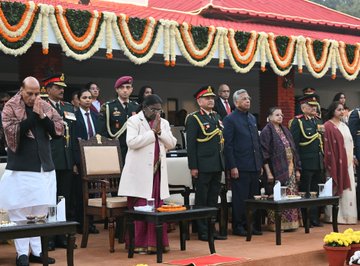
President Droupadi Murmu at Vijay Diwas reception. (Image Indian Army on X)
On Vijay Diwas, remembering Field Marshal Sam Manekshaw—the soldier who defied political pressure, enforced professionalism, and delivered India’s greatest military victory in 1971.
By NIRENDRA DEV
New Delhi, December 16, 2025 — December 16 marks a decisive moment in South Asian history. The 13-day India–Pakistan war of 1971 ended with Pakistan’s unconditional surrender in Dhaka, the birth of Bangladesh, and India’s emergence as a confident regional power. It is Vijay Diwas in India and Victory Day in Bangladesh.
Bangladesh today may be in political turmoil—its present alignments and amnesia about Pakistan Army atrocities are a separate chapter. But December 16 belongs unmistakably to one man in uniform: Field Marshal Sam Hormusji Framji Jamshedji Manekshaw—India’s “Universal Soldier.”
Manekshaw did not merely win a war; he professionalised the Indian Army at a critical moment in the Republic’s history. He brought efficiency, discipline, and intellectual honesty to an institution that deals in blood and guts, not slogans.
One enduring legend captures his moral authority. When Prime Minister Indira Gandhi was keen on personally presiding over Pakistan’s surrender in Dhaka, Manekshaw firmly insisted that it be conducted by the Eastern Army Commander, Lt Gen Jagjit Singh Aurora. Protocol mattered. Institutions mattered. Personal glory did not.
That refusal was not defiance—it was leadership.
Manekshaw’s tenure was eventful, often punctuated by biting one-liners that concealed a steely command ethic. He famously said, “If a man says he is not afraid of dying, he is either lying or is a Gurkha.” The humour disarmed; the message was uncompromising.
He was ruthless against incompetence. One story recounts a senior general accused of misusing funds protesting, “Sir, do you realise you are accusing a general of dishonesty?” Manekshaw’s reply was brutal: “Your chief is not only accusing you of dishonesty, but calling you a thief. If I were you, I would either shoot myself or resign.” The officer resigned.
Manekshaw stood up to politicians and bureaucrats alike, not through theatrics but through professional authority. As India Today wrote in 2000, “Manekshaw’s competence and public stature were such that politician and bureaucrat alike crossed his path only at their peril.”
Lt Gen A S Kalkat aptly called 1971 his finest hour. Manekshaw resisted political pressure to rush into war, planned meticulously, and unleashed a campaign so precise that Indian pincers cut through Pakistani forces “like a knife through butter.”
Perhaps his most relevant warning today was this: A ‘Yes man’ is a dangerous man… He may rise very far, but he can never be a leader, nor ever be respected.
In an age of performative patriotism and institutional erosion, Sam Manekshaw reminds us that true power lies in competence, courage, and the spine to say no.
Birth of Bangladesh: Niazi’s ‘Kuj palley hai’ Set up Pakistan’s Surrender
Follow The Raisina Hills on WhatsApp, Instagram, YouTube, Facebook, and LinkedIn




About The Author