Russia Isn’t a China Buffer Anymore — India Must Face It
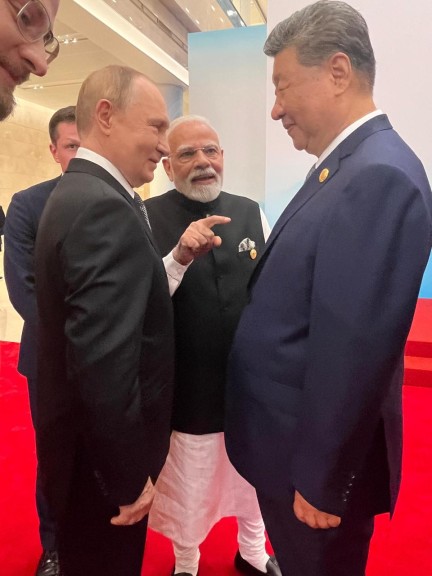
Prime Minister Narendra Modi with Chinese and Russian President Xi Jinping and Vladimir Putin at SCO Summit! (Image PMO)
Russia’s political embrace cannot offset China’s widening military edge in Ladakh. As the US sharpens its China strategy, India faces a hard truth: only Delhi can secure its Himalayan frontier.
By TRH Foreign Affairs Desk
New Delhi, December 11, 2025 — The week witnessed three developments that, taken together, sharpen the contradictions shaping India’s strategic environment: Vladimir Putin’s high-visibility visit to Delhi, China’s continued military expansion near Ladakh, and Washington’s blunt assessment in its National Security Strategy identifying Beijing as America’s “pacing threat.”
None of these events are isolated. They intersect squarely at India’s most vulnerable fault line — the unresolved, volatile Himalayan frontier.
In an analysis for The Raisina Hills, geopolitical analyst Manish Anand said that “Delhi for years held on to the belief that Moscow, as Beijing’s ‘old friend,’ retained some moderating influence in Sino-Indian affairs. That hope looks increasingly misplaced.”
“The Russia–China equation today is structurally asymmetrical. Economically weakened and diplomatically isolated after the Ukraine invasion, Moscow depends on Beijing for markets, finance, and political cover. This is not the Russia of the Cold War era that could lean on the Chinese leadership. If anything, Moscow now leans towards it,” Anand argued.
He further argued that Putin’s trip did carry familiar warmth: expansive talk of “civilizational ties,” renewed defence cooperation, and hints of upgrading the Su-30 fleet and co-developing advanced platforms. “Yet the political symbolism masks a harder strategic reality: Russia cannot and will not challenge China on India’s behalf. It has neither the incentive nor the leverage,” added Anand.
Meanwhile, China has quietly doubled down on its Ladakh posture. New military infrastructure — airstrips, hardened shelters, and logistics nodes — reflects a deliberate strategy, not a temporary surge. “Border talks have dragged through more than 25 rounds without altering ground facts. Beijing’s calculus is straightforward: sustained pressure along the Line of Actual Control gives China bargaining power without inviting full-scale war,” noted Anand.
‘India–Russia Ties Not Transactional’: Why Moscow Still Matters
India’s response has been steady but insufficiently transformative. Military modernisation is underway, but the capabilities gap with China is widening in air power, naval tonnage, missile depth, and industrial capacity. “The border, which was once treated as manageable friction, is now a structural point of coercion,” Anand reasoned.
The United States sees this trend with increasing clarity. “Its new strategic document reads as an unambiguous call to prepare for long-term competition with China. Whether led by Biden or Trump next year, Washington’s Asia policy will revolve around constraining Beijing’s power projection across the Indo-Pacific,” added Anand.
India’s role is central to this design — not because of alliance expectations, but because Asia’s balance of power cannot hold without India’s rise, added Anand.
This places Delhi at an inflection point. “A polite, predictable relationship with Russia remains valuable. But the idea that Moscow can mediate, moderate, or manage China is strategic nostalgia,” argued Anand.
The geopolitical geometry has changed. “Beijing has no incentive to soften its position; Moscow has no ability to compel it; Washington, for all its rhetoric, can only align interests, not solve India’s continental challenge,” added Anand.
Which leaves the most important conclusion: India must confront the China question on its own terms. “That means a faster military modernisation cycle, more resilient supply chains, deeper maritime partnerships, and a political willingness to treat the LAC crisis as a long-term reality, not a temporary disruption,” added Anand.
Putin’s visit was a reminder of historical comfort. China’s behaviour is a reminder of emerging danger. “The task before India lies somewhere between the two — neither nostalgia nor alarm, but clear-eyed readiness for a decade defined by competition, not conciliation,” argued Anand.
(Manish Anand analysis geopolitics with India’s perspective on the YouTube channel of The Raisina Hills)
Africa Rising: India’s Partnerships Beyond Traditional Alliances
Follow The Raisina Hills on WhatsApp, Instagram, YouTube, Facebook, and LinkedIn




About The Author