Regulating the Healers: The Crisis of Medical Education in India
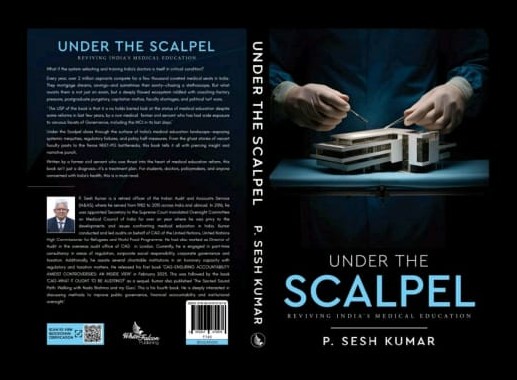
Under the Scalpel Reviving India's Medical Education by P. Sesh Kumar. (Image book cover)
Book Review: Under the Scalpel: Reviving India’s Medical Education
By KUMAR VIKRAM
New Delhi, January 18, 2026 — Under the Scalpel: Reviving India’s Medical Education by P. Sesh Kumar is a significant contribution to the literature on professional regulation, higher education governance, and health policy in India. Written by a former senior civil servant who was closely associated with regulatory oversight during the final years of the Medical Council of India (MCI), the book offers a rare insider’s account of institutional breakdown, reform attempts, and the persistent political economy of medical education.
Unlike many reformist narratives that foreground legislative change or judicial intervention in isolation, Kumar situates India’s medical education crisis within a wider system of regulatory capture, market distortion, and administrative weakness.
The book is neither a memoir nor a polemic. It is structured as a thematic institutional analysis, with chapters devoted to entrance examinations, undergraduate and postgraduate mismatches, inspection regimes, federal tensions, and the transition from the MCI to the National Medical Commission (NMC). Throughout, the author’s central contention remains consistent: structural reform without regulatory integrity merely reproduces dysfunction under new statutory labels.
Analytical Framework and Method
Methodologically, the book relies on a combination of archival regulatory material, judicial orders, inspection records, and first-hand administrative experience. While it does not employ statistical modelling or large-scale empirical datasets, its evidentiary strength lies in institutional process tracing. Kumar reconstructs how regulatory decisions are made, subverted, delayed, and judicialised—often through detailed descriptions of inspection practices, faculty verification procedures, and seat-allocation disputes.
The analytical frame is essentially political-economy oriented. Medical education is treated not merely as a pedagogic enterprise but as a high-rent sector where real estate interests, speculative capital, and political patronage intersect with professional training. This approach allows the author to reconcile two otherwise contradictory phenomena: the rapid numerical expansion of medical colleges on the one hand, and the persistent shortages of trained faculty, clinical exposure, and postgraduate seats on the other.
NEET and the Reconfiguration of Merit
One of the book’s strongest analytical interventions concerns the National Eligibility cum Entrance Test (NEET). Kumar evaluates NEET not simply as an admission mechanism but as a redistributive instrument whose socio-economic effects are uneven. While acknowledging that NEET curtailed several forms of overt admission corruption, he argues that it simultaneously entrenched a new stratification regime driven by coaching markets, urban educational infrastructure, and linguistic advantage.
The discussion is notable for its restraint. Rather than framing NEET in ideological terms, Kumar situates it within the sociology of competitive examinations in developing economies. The result is a nuanced assessment in which meritocracy appears as a procedural ideal whose distributive consequences remain deeply unequal.
The Undergraduate–Postgraduate Asymmetry
A major structural insight of the book is the persistent asymmetry between undergraduate MBBS production and postgraduate seat availability. Kumar demonstrates that successive governments prioritised politically visible undergraduate expansion without a commensurate increase in postgraduate capacity, teaching hospitals, or accredited faculty. The result has been the creation of a large pool of under-specialised medical graduates facing intense competition, professional insecurity, and informal labour absorption.
This mismatch is treated as a systems failure rather than a capacity lag. The analysis links regulatory design, fiscal incentives, and institutional accreditation standards to show how the bottleneck is structurally reproduced despite repeated policy interventions.
From MCI to NMC: Reform Without Institutional Rupture
Kumar’s assessment of the transition from the MCI to the NMC is among the most empirically grounded sections of the book. Drawing on his role during the period of judicially supervised regulatory restructuring, he argues that while procedural rationalisation has improved—through digital inspections, standardised norms, and expanded seat approvals—the deeper pathologies of regulatory capture and symbolic compliance persist.
The continuity of inspection manipulation, paper-only faculty appointments, and hospital infrastructure inflation is presented as evidence that statutory change alone cannot transform entrenched incentive structures. The book thus makes an important contribution to debates on regulatory design by demonstrating how institutional cultures often outlive formal dissolution.
Judicialisation of Medical Education Governance
Another analytically rich section examines the increasing role of the judiciary in governing medical education. Courts, Kumar argues, have gradually moved from correcting regulatory excesses to substituting for regulatory authority itself. Admissions, inspections, fee regulation, and even institutional approvals now routinely pass through judicial orders.
While acknowledging that judicial intervention has often prevented systemic collapse, the author warns that excessive judicialisation generates unpredictability and weakens executive accountability. This critique resonates with broader scholarship on Indian administrative law, where courts frequently compensate for regulatory incapacity without addressing its structural roots.
Federalism, Language, and Regional Inequality
The book situates medical education governance within India’s contested federal architecture. Kumar carefully traces centre-state disputes over fee control, seat allocation, language requirements, and admission criteria. The Tamil Nadu–NEET standoff is interpreted not as an episodic political conflict but as a manifestation of deeper tensions between national standardisation and regional social policy objectives.
This federal lens adds analytical depth by linking medical education to India’s constitutional design rather than treating it as a purely sectoral policy field.
Marketisation and Regulatory Capture
The political economy of private medical colleges occupies a central place in the book. Kumar documents how formal prohibitions on capitation coexist with layered financial practices that effectively monetise admission and accreditation. The medical college, in this account, increasingly functions as a hybrid asset—simultaneously an educational institution, a real estate venture, and a political resource.
Importantly, the author avoids a binary public-private framing. Private participation, he argues, is not inherently problematic; the core failure lies in the inability of regulatory institutions to discipline market behaviour. This distinction gives the analysis greater conceptual rigour and policy relevance.
Limitations
From an academic perspective, the book’s primary limitation is its restricted engagement with comparative international data. While select global references appear, the analysis would have benefited from systematic cross-national benchmarking of regulatory capacity, inspection design, and postgraduate training models. Additionally, the treatment of alternative systems of medicine remains peripheral.
The work is also predominantly qualitative and institutional. Readers seeking quantitative outcome evaluation—such as graduate competence metrics, patient safety correlations, or longitudinal training outcomes—will not find extensive empirical modelling here.
Contribution and Significance
Despite these limitations, Under the Scalpel stands out as one of the most nuanced institutional analyses of Indian medical education currently available. Its principal contribution lies in bridging three normally siloed domains: regulatory governance, professional education, and political economy. By demonstrating how reform efforts repeatedly falter at the level of enforcement rather than legislation, the book offers a cautionary framework applicable far beyond the health sector.
Kumar’s call for a second-generation reform agenda—centred on pre-insolvency-style regulatory early warning, credible digital audits, faculty-centric governance, and mental-health safeguards for students—emerges as both normatively grounded and administratively pragmatic.
Final Verdict
Under the Scalpel is an important academic intervention in the study of professional regulation in India. It demonstrates how institutional decay is reproduced through procedural compliance, how judicialisation compensates for executive weakness, and how markets colonise regulatory spaces in the absence of credible enforcement. For scholars of public administration, legal studies, health policy, and political economy, this book provides both empirical insight and conceptual leverage.
It deserves close reading not only by health-sector specialists but by anyone interested in how large regulatory states struggle to govern complex, high-rent professional systems.
Follow The Raisina Hills on WhatsApp, Instagram, YouTube, Facebook, and LinkedIn




About The Author