Rahul Gandhi and the Youth Leadership Question in the Opposition

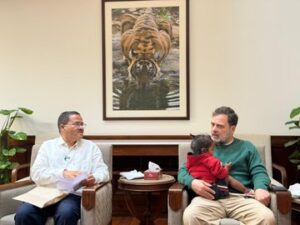
Congress leader Rahul Gandhi with Makhana workers in Bihar on Saturday! (Image Rahul Gandhi, X)
The question that now confronts the Congress is no longer merely electoral. It is existential: can the party rebuild a national identity while guarding power for a single political figure?
By SUMEET BHASIN
New Delhi, November 16, 2025 — A recurring pattern of exits raises questions about leadership space within the Congress ecosystem. As the Opposition continues its search for direction and cohesion, an inescapable question resurfaces: why do young leaders with mass influence repeatedly exit the political orbit of Rahul Gandhi?
From Congress to its allies, the departures form a pattern that has shaped the national landscape over the last decade and weakened the broader Opposition bloc. The trend began with early warning signs inside the Congress. Hardik Patel, once the face of the Patidar agitation and a rising youth mobiliser in Gujarat, was welcomed into the Congress with much anticipation. Instead of becoming the party’s frontline challenger to the BJP in the state, Patel soon complained of organisational resistance and lack of space. He eventually resigned, accusing the leadership of ignoring ground realities and suppressing initiative.
The case of Jyotiraditya Scindia was more consequential. A confidant of the Gandhi family and one of Congress’s brightest youth leaders, Scindia was repeatedly pushed to the margins within the Madhya Pradesh unit. His departure in 2020 not only took a generation of young party workers with him but also collapsed the sitting Congress government. Strategists across the political spectrum regard this as one of the biggest organisational errors of the decade.
Earlier, Himanta Biswa Sarma in Assam had highlighted a similar story of neglect. Credited for building the Congress network in the Northeast, Sarma left the party after raising concerns over leadership indifference. His exit triggered a political realignment across the region and played a central role in the BJP’s unprecedented expansion there. The Northeast remains one of Congress’s weakest territories today.
The list has continued to grow with the exits of Jitin Prasada, RPN Singh, Sushmita Dev, Milind Deora and several others all of whom were once projected as the future face of the party. Their departure has systematically eroded the Congress’s youth bench strength, organisational depth and ability to project young leadership across states.
What makes the current phase politically significant is that this pattern now appears to be extending beyond the Congress into its coalition ecosystem. Reports of friction with Tejashwi Yadav, one of the few younger Opposition leaders with a proven mass base, have brought renewed attention to Rahul Gandhi’s leadership approach. Yadav, who successfully consolidated youth, OBC and minority support in Bihar, was initially celebrated within the INDIA bloc. However, once his popularity began to overshadow national figures within the alliance, strain reportedly surfaced.
Political observers argue that the Congress under the Gandhis faces a structural paradox. Publicly, the organisation positions itself as a platform for internal democracy and the promotion of new leadership. Internally, however, it has struggled to accommodate young figures who command mass support or show independent decision-making ability. As a result, the party’s centralisation has intensified even as its electoral footprint has reduced.
The consequences have echoed across the national map. The exits of youth leaders have strengthened rival parties and weakened Opposition cohesion. The loss of Scindia contributed to the fall of the Madhya Pradesh government. The departure of Sarma reshaped the Northeast. Patel’s exit in Gujarat closed the gap Congress had sought to build among Patidars. And a fractured equation with Tejashwi Yadav threatens one of the strongest regional alliances available to the Opposition.
The underlying issue runs deeper than individual departures. In a political era defined by coalition building, regional pride and social coalitions, accommodating multiple centres of power has become essential. For the Opposition to offer a meaningful challenge to the BJP, its constituent parties require the confidence that their leadership will not be overshadowed or undermined.
Whether the Congress is willing to share space with strong young leaders within its own ranks or among allies will play a decisive role in shaping the Opposition’s future. India’s political landscape has changed. Parties that resist generational leadership transitions risk marginalisation.
The question that now confronts the Congress is no longer merely electoral. It is existential: can the party rebuild a national identity while guarding power for a single political figure?
Until the dilemma is resolved, the cycle of exits and the cost they bring may continue to define the Opposition space.
RJD’s Collapse Exposes the Brutal Grip of Caste Politics: Analyst
Follow The Raisina Hills on WhatsApp, Instagram, YouTube, Facebook, and LinkedIn




About The Author