


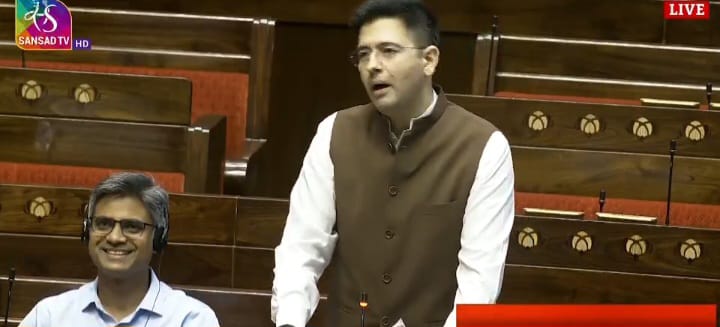
In a video statement, the suspended deputy leader frames himself as the voice of ordinary Indians silenced by his own party. AAP’s national media head fires back with a list of specific failures — and a pointed accusation of political cowardice.
By TRH Political Desk
New Delhi, April 3, 2026 — The rupture between Raghav Chadha and the Aam Aadmi Party has moved from institutional action to open public confrontation. Hours after AAP wrote to the Rajya Sabha secretariat to strip Chadha of his deputy leader position and block his parliamentary speaking time, the MP uploaded a video statement addressing supporters directly. AAP’s national media head Anurag Dhanda responded within hours — and the exchange has laid bare a bitterness that goes well beyond procedural disagreement.
Chadha speaks: the people’s voice silenced
In his video, Chadha framed his removal from parliamentary speaking rights not as an internal party matter but as an act of censorship against the public interest. He listed the causes he has raised in the Rajya Sabha: expensive food at airports, the problems faced by Zomato delivery riders, food adulteration, toll plaza overcharging, bank charges, the tax burden on the middle class, strikes against content creators, and telecom companies forcing 13 recharges in 12 months while cutting incoming calls mid-validity.
“Whenever I get the chance to speak in Parliament, I raise the issues of the public,” Chadha said. “I raise topics that are usually not raised in Parliament. But is raising public issues a crime? Have I committed some mistake? Was something wrong?”
He did not address the specific allegations made against him — his absence during Kejriwal’s arrest, his silence on the excise case, his refusal to sign a proposal against the Chief Election Commissioner. Instead, he chose the register of injury and resolve.
“Those who have today snatched my right to speak in Parliament, who have silenced me — I want to say something to them too,” he said. “Do not mistake my silence for my defeat. Do not mistake my silence for my defeat. I am that river which, when the time comes, becomes a flood. Jai Hind.”
The dramatic closing — invoking a river becoming a flood — was a signal directed as much at a future political audience as at AAP’s current leadership.
Dhanda fires back: a point-by-point indictment
AAP national media head Anurag Dhanda did not engage with the poetry. He engaged with the record.
“We are soldiers of Kejriwal,” Dhanda said. “Fearlessness is our first identity. If someone is afraid of Modi, what will he fight for the country?”
Dhanda’s statement was structured as a specific catalogue of omissions. The party gets limited speaking time in Parliament, he argued, and that time must be used for the country’s real battles — not, as he put it dismissively, “getting samosas cheaper in airport canteens.”
He listed what he called Chadha’s failures of solidarity. When hundreds of AAP workers were arrested by BJP-aligned police in Gujarat, Chadha said nothing in the House. When the right to vote was being undermined in West Bengal and AAP brought a proposal against the Chief Election Commissioner, Chadha refused to sign. When the party walked out of the House in protest, Chadha stayed in his seat — “to mark attendance for Modi ji,” in Dhanda’s words.
Then came the accusation that cuts deepest in AAP’s internal culture.
“For the past few years, you have become afraid, Raghav. You are scared to speak against Modi. You are scared to speak on the real issues of the country. He who becomes afraid…”
Dhanda left the sentence deliberately incomplete. The ellipsis was the point.
What the exchange reveals
Read together, the two statements illuminate a conflict that is not simply about speaking time or party discipline. It is about two incompatible definitions of what a parliamentarian is for.
Chadha’s definition is consumer-facing and retail in its political instinct: raise the cost of airport food, protect delivery workers, challenge telecom billing practices. These are issues with broad, cross-partisan resonance. They generate clips. They build a personal brand that transcends party affiliation.
AAP’s definition — at least as articulated by Dhanda — is adversarial and ideologically committed: every parliamentary moment must be weaponised against BJP, every walkout must be collective, every party position must be signed. The individual voice exists only in service of the collective struggle.
The accusation of fear is the most loaded element of Dhanda’s statement. In AAP’s founding mythology, courage under BJP pressure is the core identity marker. To say that Chadha has lost that courage — to say he is “scared of Modi” — is not merely a political criticism. It is an excommunication from the party’s self-image.
Chadha’s river-and-flood metaphor suggests he understands the gravity of what has happened and is already speaking past AAP to whatever comes next. A politician who announces he will become a flood is not planning to return quietly to the fold.
The formal separation may still be weeks away. But both sides are now speaking in the language of endings.
AAP Moves to Silence Raghav Chadha — A Divorce in Slow Motion
Follow The Raisina Hills on WhatsApp, Instagram, YouTube, Facebook, and LinkedIn




