


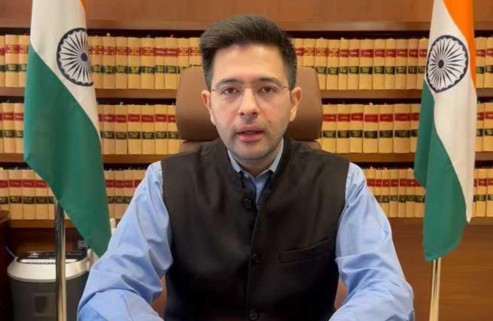
The party has asked the Rajya Sabha secretariat to strip Chadha of his deputy leader title and block his speaking time. The formal action is new. The estrangement is not. Estimated Read Time: 5 minutes
By AMIT KUMAR
New Delhi, April 2, 2026 — The Aam Aadmi Party has written to the Rajya Sabha secretariat seeking the removal of Raghav Chadha as its deputy leader in the upper house, directing that he not be allotted speaking time in Parliament. MP Ashok Mittal has been named as his replacement in the role.
The letter is administrative in form. In political terms, it is a severance notice.
AAP has communicated three things to the Rajya Sabha secretariat: that Chadha should no longer hold the position of deputy leader of the party in the House, that he should not be granted time to speak on the party’s behalf, and that Ashok Mittal — a relatively low-profile figure — should assume the deputy leader role with immediate effect.
The party has not issued a public statement explaining the decision.
The rupture between Chadha and AAP’s core leadership did not happen overnight. It has been accumulating across several pressure points, each individually explicable, but together forming a pattern that the party appears to have finally decided to act on.
The sharpest grievance concerns timing and loyalty under fire. When Arvind Kejriwal and senior AAP associates were facing Enforcement Directorate action that ultimately sent them to Tihar Jail, Chadha was in the United States. The optics — a rising party face absent during the leadership’s most acute legal and political crisis — were noted and, by most accounts, not forgotten within the organisation.
His silence in the aftermath compounded matters. When Kejriwal and associates received relief from the courts in the Delhi excise policy case, Chadha did not visibly celebrate or amplify the moment in the manner expected of a senior party figure. In AAP’s culture of conspicuous solidarity with its founder, that silence registers as a statement.
The months leading up to Thursday’s action offered a readable public signal. Chadha has been increasingly active on social media — but the content has been strikingly self-referential. His parliamentary speeches, including a notable push on paternity leave legislation, have been amplified as personal achievements. Personal milestones, including the birth of his child, have featured prominently. References to AAP’s agenda, to Kejriwal, or to the party’s political programme have been sparse.
In a party that built its identity on collective messaging and the singular figure of its founder, a senior MP running what amounts to a personal political brand is not a neutral act. It is read — correctly or not — as positioning.
The speculation that Chadha may be preparing an independent political trajectory, whether through exit, realignment, or a move toward a rival platform, has circulated in political circles for months. Thursday’s letter transforms that speculation into something with institutional weight behind it.
This is not Chadha’s first moment of friction with the party. In 2023, AAP suspended him from Rajya Sabha committee memberships amid internal tensions. In 2024, he was named in accusations by AAP MLAs — the precise nature of which remained contested. Each episode was managed and absorbed. The question now is whether Thursday’s action represents another episode in an ongoing tension, or the beginning of a formal separation.
The answer may lie in what happens next. Removing someone’s speaking rights in Parliament is not a symbolic gesture. It is a structural one. It limits a politician’s national visibility and signals to the broader political ecosystem that the party no longer stands behind him.
For AAP, the move carries risk alongside the message it sends internally. Chadha is one of the party’s most recognisable faces nationally — telegenic, English-fluent, and with a media profile that extends well beyond his parliamentary constituency. Sidelining him publicly invites questions about internal discipline and about what the party’s bench looks like without him.
For Chadha, the path forward is now narrowed within AAP. If the intent was to signal that he should fall back in line, it is a high-stakes bet. Politicians who are publicly demoted rarely recover their standing within the same organisation. The more likely outcome, if history is any guide, is acceleration — of whatever trajectory he was already on.
Follow The Raisina Hills on WhatsApp, Instagram, YouTube, Facebook, and LinkedIn




