Putin’s India Visit Spotlights Strategic Calculus in New Delhi
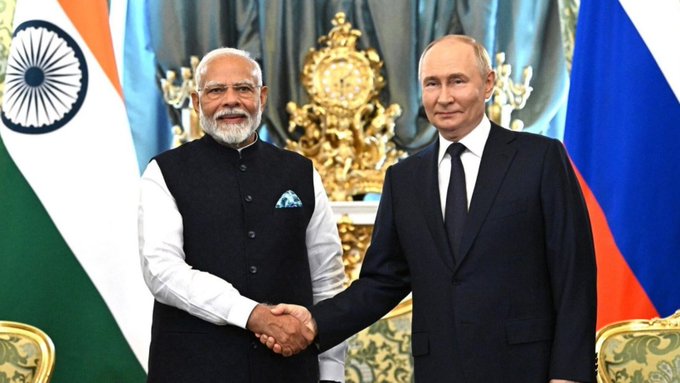
Prime Minister Narendra Modi with Russian President Vladimir Putin (Image Russian embassy in India)
Putin’s India Visit Triggers European Uproar: Manish Anand Explains the Strategic Stakes from S-400 to Energy Security
By TRH Foreign Affairs Desk
New Delhi, December 3, 2025 — Russian President Vladimir Putin’s visit to India — his first in several years — has set off ripples across global capitals, especially in Europe, even as New Delhi prepares to roll out the red carpet in the middle of the fourth year of the Ukraine war.
Analysing the impact on The Raisina Hills, strategic affairs editor Manish Anand explained that Europe’s anger is rooted in the belief that Russia’s president, whom many European leaders view as the principal architect of Ukraine’s devastation, should be globally isolated — not accorded a state-level welcome in a major democracy like India.
Three key European ambassadors in New Delhi even issued a joint op-ed expressing unease over India hosting Putin at a time when large parts of Ukraine remain under Russian control and the humanitarian toll continues to mount.
Why Europe Is Alarmed
European governments fear that Ukraine may only be the beginning of Russia’s military ambitions. There is growing anxiety that if Moscow is not decisively checked, future targets could extend deeper into Europe. This fear has led to calls within NATO-aligned states to raise defence spending from the current approximate 2% of GDP to as high as 5%.
From Europe’s perspective, India — as the world’s largest democracy — should morally align with Western democracies against what they describe as authoritarian aggression. New Delhi, however, insists foreign policy cannot be driven by moral binaries alone when national security and economic stability are at stake.
India’s Strategic Compulsions: Defence and Energy
According to Manish Anand’s analysis, India’s posture is shaped by two overriding national interests:
- Defence Security
Russia remains India’s most critical defence partner. The Russian-supplied S‑400 air defence system has already been deployed as part of India’s layered air-shield. During recent tensions with Pakistan involving drone and missile threats, the S-400 is believed to have played a key deterrent role.
During his recent Moscow visit, Defence Minister Rajnath Singh pushed for additional S-400 units. With Prime Minister Narendra Modi having declared from the Red Fort that India’s vital regions must be covered by advanced air defence, more acquisitions from Russia remain high on the agenda.
Russia is also uniquely willing to transfer sensitive military technology to India. The BrahMos missile — a joint Indo-Russian project named after the Brahmaputra and Moskva rivers — is a prime example of deep strategic trust and co-production.
- Energy Security
Russia has emerged as one of India’s largest suppliers of discounted crude oil and gas since Western sanctions tightened after the Ukraine invasion. Bilateral trade now stands at roughly $83 billion, although India runs a significant trade deficit of nearly 70% with Russia.
Despite this imbalance, New Delhi views affordable Russian energy as essential for controlling inflation, protecting growth and insulating the economy from global supply shocks.
India Rejects Europe’s “Moral Policing”
Manish Anand argues that Europe’s criticism overlooks its own strategic vulnerabilities, especially as the United States shows signs of retrenching from its traditional security commitments. If any power appears to be stepping back from global security responsibilities, he notes, it is Washington — not New Delhi.
From India’s viewpoint, the Ukraine war resembles other long, grinding conflicts like Iran-Iraq, with no quick resolution in sight. New Delhi believes it is in no position to single-handedly mediate or coerce either Moscow or Kyiv.
The Bigger Picture
Putin’s India visit is therefore not just about diplomacy; it is about:
- Sustaining India’s defence readiness amid regional threats
- Safeguarding energy security in a volatile global market
- Preserving a strategic partnership that no other power currently replicates in terms of technology transfer
- Signalling India’s continued pursuit of strategic autonomy, even under Western pressure
As Manish Anand puts it, the uproar in Europe reflects European anxieties — not an Indian retreat from democratic values. For New Delhi, national interest, security imperatives and economic stability will continue to define its engagement with Moscow, even as the war in Ukraine drags on.
Follow The Raisina Hills on WhatsApp, Instagram, YouTube, Facebook, and LinkedIn




About The Author